Robot Joint End Cover in 7075-T6, Double Layer Stepped Cavities, 0.025 mm Coaxiality
7075-T6 robot joint module end cover, 125 mm diameter with 101.6 K6 and 115 J6 locating fits, 111 H7 bore, double layer stepped cavities, 70+ equally spaced holes, parallelism 0.025 mm and coaxiality 0.025 mm, black anodized over 180 grit blast. Quote in 24 hours.
Robotics & Humanoid Robots
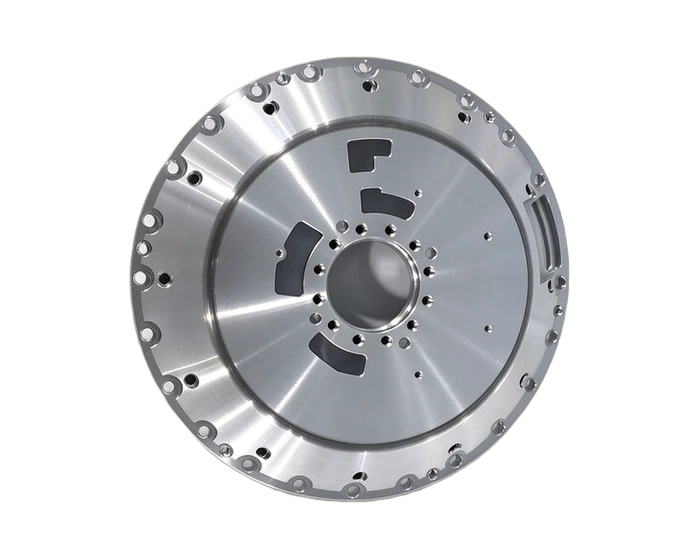
The closing cover of a robot joint module, machined from 7075-T6: K6/J6 locating fits on the outside, an H7 bearing bore inside, dense equally spaced hole fields, and a black anodize over 180 grit blast for a hard matte finish.
Or email drawings to kgl@kglmfc.com
Key Specifications
| Parameter | KGL Capability |
|---|---|
| Material | Aluminum 7075-T6 |
| Locating fits | 101.6 K6 and 115 J6; 125 mm envelope; 110 and 98 mm references |
| Internal bore | 111 H7 with 34 g6, 26 H7, 25 H7 and 24 mm steps |
| Flange holes | 12x 3.2 mm equally spaced through; 12x M3 equally spaced |
| Outer rings | 24x 3.2 mm equally spaced through; 24x 1.4 mm equally spaced reverse through |
| Other features | 6x R2.5 reverse through; 4x 3.01 x 5 mm; 5x M2 x 3 deep; 4x M2 through |
| Geometry | Parallelism 0.025 mm; coaxiality 0.025 mm |
| General notes | Unspecified boss chamfers C0.5, recess radii R0.2, ISO 2768-m |
| Process | Turn-mill machining of fits, bores and stepped cavities in one chucking, indexed drilling and tapping, R2.5 reverse drilling, deburr and edge dulling, 180 grit blast and black anodize |
| Inspection | Caliper and micrometer on key dimensions, thread plug gauges, CMM full verification of geometry and critical dimensions |
| Tolerance | ±0.005 mm standard on metals, engineering plastics, and carbon fiber composite |
| Certifications | ISO 9001:2015, ISO 13485:2016, AS9100D |
| Capacity | 100+ CNC machines including 11 five-axis centers |
| MOQ | No MOQ; 1-piece prototypes supported |
| Quote | Within 24 hours for complete 2D/3D files |
About This Part
This cover closes the joint module of a robot arm, and it is a locating part, not just a lid. Its outside carries the fits: 101.6 K6 and 115 J6 transition fits register the cover to the module housing, the 125 mm diameter sets the envelope, and a 110 mm reference and 98 mm step complete the stack. Inside, the 111 H7 bore carries the bearing or seal seat, with 34 g6, 26 H7, 25 H7 and 24 mm diameters stepping down the axis. Coaxiality is held within 0.025 mm and parallelism within 0.025 mm, because a cover that locates a tenth off loads the joint bearings unevenly for the life of the robot.
The hole fields are dense and equally spaced: twelve 3.2 mm through holes and twelve M3 threads on the flange circles, twenty four 3.2 mm and twenty four 1.4 mm through holes on the outer rings, six R2.5 features drilled through in reverse, four 3.01 x 5 mm dowel features, five M2 threads 3 mm deep and four M2 through. Indexing the patterns is what lets the cover, housing and stator bolt up without hole-to-hole fighting.
Structure is a double layer of stepped cavities, which the turn-mill route cuts in one chucking so the fits share one axis with the bore. Unspecified bosses break at C0.5 and recesses at R0.2 per the drawing's general notes.
The finish is black anodize over a 180 grit bead blast, a hard matte surface that handles the abrasion of a moving joint and reads as finished equipment, not a machined blank. This is a controlled critical part: geometry and key dimensions are CMM verified in full, with thread plug gauges on every tapped hole.
This part family supports the Robotics Parts industry. Read how KGL machines parts for that sector, then send your drawing for a quote.
Why Machine It at KGL
Five-Axis Fleet
100+ CNC machines including 11 five-axis centers run complex geometry in single setups, so tolerances do not stack up across refixturing.
Verified Accuracy
±0.005 mm standard on metals, plastics, and carbon fiber composite, verified on Hexagon and Zeiss CMMs (0.0015 mm accuracy).
Fast Prototypes
Engineering feedback with every quotation; prototype parts typically machined in 15 to 25 days.
One Supplier, End to End
Material sourcing, machining, heat treatment coordination, finishing, CMM inspection and export packaging under one roof.
Part-Specific Advantages
- 7075-T6 high strength cover locating a robot joint module
- 101.6 K6 and 115 J6 transition fits with 111 H7 internal bore
- Coaxiality 0.025 mm and parallelism 0.025 mm on a double layer cavity part
- 70+ equally spaced holes including 24x 3.2 mm and 24x 1.4 mm rings
- Six R2.5 reverse through features and 3.01 x 5 mm dowel features
- Black anodize over 180 grit blast, hard matte equipment finish
Typical Applications
- Robot joint module end covers and closing plates
- Servo joint components in humanoid and industrial arms
- 7075-T6 covers combining locating fits with dense hole patterns
Commercial Terms
| Commercial | Detail |
|---|---|
| MOQ | No MOQ; 1-piece prototype supported |
| Quote | Within 24 hours for complete 2D/3D files |
| Terms | EXW / FOB Shenzhen |
| Certifications | ISO 9001:2015 |
| Packaging | Individual bubble wrap, export carton or wooden case |
| Lead Time | Prototypes 7 to 15 days; production scheduled by volume |
Common Questions
Why does a cover need K6 and J6 fits?
Because this cover locates the joint, not just closes it. Transition fits like K6 and J6 position the cover to the housing with minimal play but removable assembly, so the rotating group inside stays on axis. The 0.025 mm coaxiality is that same promise measured.
Why so many equally spaced holes?
The cover bolts to the housing, stator and bearing carriers through stacked circular patterns. Equal spacing, machined with indexed positioning, is what lets every layer drop together without fighting hole-to-hole error.
What tolerances can you hold on covers like this?
The drawing's own callouts govern. Send the tolerance band together with the housing interfaces, and we will confirm feature by feature what can be held before quoting.
More Robotics & Humanoid Robots Parts
Other parts KGL machines in this industry. Every card links to its own detail page.
Ready to Machine This Part?
Send your 2D/3D drawings and get a quote within 24 hours. No MOQ for prototypes and small lots.
Request a Quote