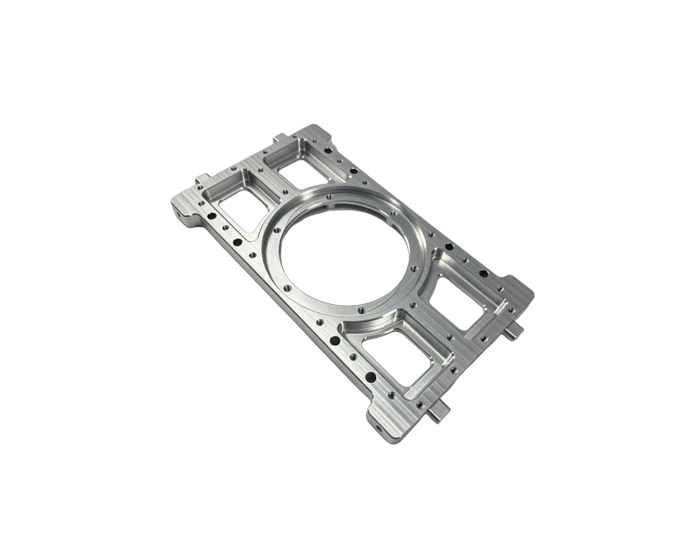
220 x 110 mm Skeletonized Motor Mount Frame, Ø80 +0.02/0 mm Bore
Skeletonized robot frame in 6061-T6: Ø80 mm +0.02/0 bearing bore, pocket depth +/-0.03 mm, full hole pattern at 0.03 mm position, flatness 0.02 mm. Vacuum fixtured, CMM 100 percent. Quote in 24 hours.
Robotics & Humanoid Robots
A 220 by 110 by 15 mm robot or automation frame with a central precision bearing bore and four symmetric weight relief pockets. Large removal on a thin frame, flatness held at 0.02 mm.
Or email drawings to kgl@kglmfc.com
Key Specifications
| Parameter | KGL Capability |
|---|---|
| Material | Aluminum 6061-T6 |
| Process | Vertical and 5 axis CNC milling, one setup bore and pockets, staged stress relief, vacuum and dedicated fixturing, precision tapping, micro deburring, ultrasonic cleaning |
| Dimensions | 220 x 110 x 15 mm |
| Bearing bore | Ø80 +0.02/0 mm, counterbore depth 5.0 +/-0.03 mm |
| Hole pattern | 12X M3 / M4, Ø4 +0.015/0 mm dowels, position Ø0.03 A|B|C |
| Flatness | 0.02 mm |
| Inspection | CMM 100 percent on bore, pocket positions, and flatness, thread and plug gauges |
| Tolerance | ±0.005 mm standard on metals, engineering plastics, and carbon fiber composite |
| Certifications | ISO 9001:2015, ISO 13485:2016, AS9100D |
| Capacity | 100+ CNC machines including 11 five-axis centers |
| MOQ | No MOQ; 1-piece prototypes supported |
| Quote | Within 24 hours for complete 2D/3D files |
About This Part
Robot frames trade mass for stiffness, and the trade is decided in the machining sequence. This frame removes four large rectangular pocket fields while keeping the central Ø80 mm +0.02/0 mm bearing bore and the whole hole pattern true: pocket depths at plus or minus 0.03 mm, hole positions at 0.03 mm to datums A, B, C, and frame flatness at 0.02 mm.
The bore and the pocket fields are cut in one clamping on vertical and five axis centers, with staged symmetric stress relief passes and vacuum plus dedicated fixtures carrying the thin walls. Twelve M3 and M4 threads and Ø4 +0.015/0 mm dowel holes surround the bore for the motor and encoder mounts.
End faces carry raised locating ears with side locking threads. After high speed drilling and precision tapping, every edge is micro deburred, ultrasonically cleaned, and the CMM runs 100 percent on bore coaxiality, pocket positions, and flatness before release.
This part family supports the Robotics Parts industry. Read how KGL machines parts for that sector, then send your drawing for a quote.
Why Machine It at KGL
Five-Axis Fleet
100+ CNC machines including 11 five-axis centers run complex geometry in single setups, so tolerances do not stack up across refixturing.
Verified Accuracy
±0.005 mm standard on metals, plastics, and carbon fiber composite, verified on Hexagon and Zeiss CMMs (0.0015 mm accuracy).
Fast Prototypes
Engineering feedback with every quotation; prototype parts typically machined in 15 to 25 days.
One Supplier, End to End
Material sourcing, machining, heat treatment coordination, finishing, CMM inspection and export packaging under one roof.
Part-Specific Advantages
- Ø80 mm +0.02/0 mm bearing bore, single setup to datum system
- Frame flatness 0.02 mm despite four large relief pockets
- Pocket depth uniformity plus or minus 0.03 mm
- 12X M3 / M4 threads and Ø4 dowels at 0.03 mm position
- Skeletonized both side layout for weight reduction
Typical Applications
- Robot joint and actuator mount frames
- Motor and bearing carrier frames in automation equipment
- Weight optimized structural plates with precision bores
Commercial Terms
| Commercial | Detail |
|---|---|
| MOQ | No MOQ; 1-piece prototype supported |
| Quote | Within 24 hours for complete 2D/3D files |
| Terms | EXW / FOB Shenzhen |
| Certifications | ISO 9001:2015 |
| Packaging | Individual bubble wrap, export carton or wooden case |
| Lead Time | Prototypes 7 to 15 days; production scheduled by volume |
Common Questions
How do you hold 0.02 mm flatness with that much material out?
Remove the stress before it removes your flatness: symmetric roughing passes, relaxation time between ops, and finishing both faces against a verified reference. The bore is cut after the frame is stable.
Why one setup for the bore?
The bore is the assembly datum. Refixturing between roughing and finishing would add eccentricity that no later op can remove.
More Robotics & Humanoid Robots Parts
Other parts KGL machines in this industry. Every card links to its own detail page.
Ready to Machine This Part?
Send your 2D/3D drawings and get a quote within 24 hours. No MOQ for prototypes and small lots.
Request a Quote