Precision Aluminum CNC Machining: A Practical Guide for Engineers
Guide to aluminum CNC machining at KGL. Material selection, tooling, surface treatments (anodizing, alodine, plating), and cost breakdown for machined aluminum parts.
Aluminum is often called easy to machine, and in general terms that is true. The real challenge starts when the drawing asks for micron-level precision, thin walls, leak-tight holes, or cosmetic anodizing. At KGL we machine 6061, 7075, 2024, 5052, A380, and other grades for aerospace, medical, robotics, and fluid systems. This guide covers the decisions that affect whether an aluminum part comes out good or great.
Start with the right alloy
Alloy choice drives machinability, strength, corrosion resistance, and finish. The table below shows the grades we use most often and why.
| Alloy | Key properties | Typical parts |
|---|---|---|
| 6061-T6 | Good strength, weldable, anodizes well | Frames, brackets, general hardware |
| 7075-T6 | High strength-to-weight ratio, aerospace grade | Aircraft brackets, robot arms, orthopedic fixators |
| 2024-T3 | High fatigue resistance, lower corrosion | Aerospace structural parts |
| 5052-H32 | Soft, high formability, marine corrosion resistance | Sheet metal prototypes, covers |
| A380 / ADC12 | High silicon, cast then machined | Automotive housings, heat sinks |
We see a common mistake: specifying 7075 everywhere because it is strong. If the part does not need the strength, 6061 machines faster, wears tools less, and costs less per part. The full alloy table with machinability notes sits on our aluminum machining page.
Tooling: sharp, uncoated, and well supported
Aluminum sticks to many standard coatings. TiAlN contains aluminum and can weld to the chip. For most aluminum work we use uncoated ultra-fine-grain carbide or DLC-coated tools. For high-silicon cast grades like A380, PCD tooling pays for itself in surface finish and tool life.
| Tool type | Process | Key geometry | Advantage |
|---|---|---|---|
| 3-flute end mill | Roughing, cavity milling | 45-50 degree helix, large gullet | Balance of rigidity and chip evacuation |
| 2-flute ball end mill | 5-axis finishing | 15-20 degree rake, edge radius below 2 μm | Clean shearing in tight corners |
| Internal-coolant micro-drill | Deep precision holes | 130-140 degree point angle, dual coolant channels | Chip flushing prevents drill breakage |
| PCD fly cutter | Large flat surfaces | Wide wiper blade | Mirror finish, flatness within 0.005 mm |
Thin walls and thermal control
Aluminum expands with heat. A part cut at 28 C will measure smaller at 20 C. For features held to ±0.005 mm, temperature is part of the tolerance stack. KGL keeps the production area near 20 C year round. Machine spindles run oil cooling with thermal displacement compensation. Before final CMM measurement, parts rest in a temperature-controlled room until they reach equilibrium.
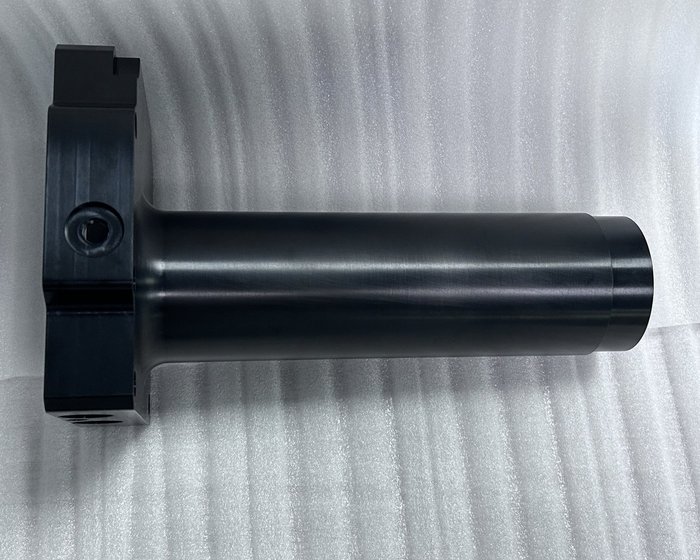
Thin walls are another weak point. Aluminum's low elastic modulus means a 0.5 mm wall can deflect under cutting force and spring back after the tool passes. We use vacuum chucks, contour-matching fixtures, and layered depth cuts to keep walls straight.
Surface treatment changes the numbers
Almost every precision aluminum part gets a finish. The treatment must be designed into the tolerance, not added as an afterthought.
Type II anodizing adds 5 to 15 μm and can be dyed black, blue, red, or gold. It is common on medical device housings and consumer electronics brackets.
Type III hard anodizing builds 25 to 50 μm with hardness around HV 400 to 500. It is used on fluid pump bodies, cylinder bores, and vacuum chambers where wear resistance matters.
Chromic or phosphoric anodizing produces a very thin film used mainly as a paint base layer on aerospace structural parts.
Alodine / conversion coating adds less than 1 μm, so it has almost no effect on precision dimensions. It is popular for electronic chassis that need electrical conductivity and EMI shielding.
Electroless nickel plating deposits a uniform nickel-phosphorus layer even inside blind holes and complex pockets. It raises wear and corrosion resistance on valve blocks and robot fittings.
Three typical aluminum parts, three cost drivers
| Part type | Primary cost driver | KGL approach |
|---|---|---|
| Precision valve block | Intersecting hole network and leak testing | Ream after coating, 100% airtightness test |
| Thin-wall aerospace bracket | Cutting time and deformation correction | Vacuum fixture, rough-age-finish route |
| High-volume cover plate | Cycle time and burr removal | PCD tooling, automated deburring |
Need a quote?
Send your 2D drawing with tolerances and 3D model to kgl@kglmfc.com. We will recommend the alloy, tooling approach, and surface finish, then return a quote within 24 hours.
Have a project in mind?
Send drawings to kgl@kglmfc.com or request a quote. We respond within 24 hours.
Request a Quote