ISO 13485:2016 Medical Device Quality Management System Certification
ISO 13485:2016 certifies that KGL can machine precision hardware parts under a medical-device-grade quality system. The certificate was issued by NQCC on 2026-05-15 and is valid until 2029-05-14.
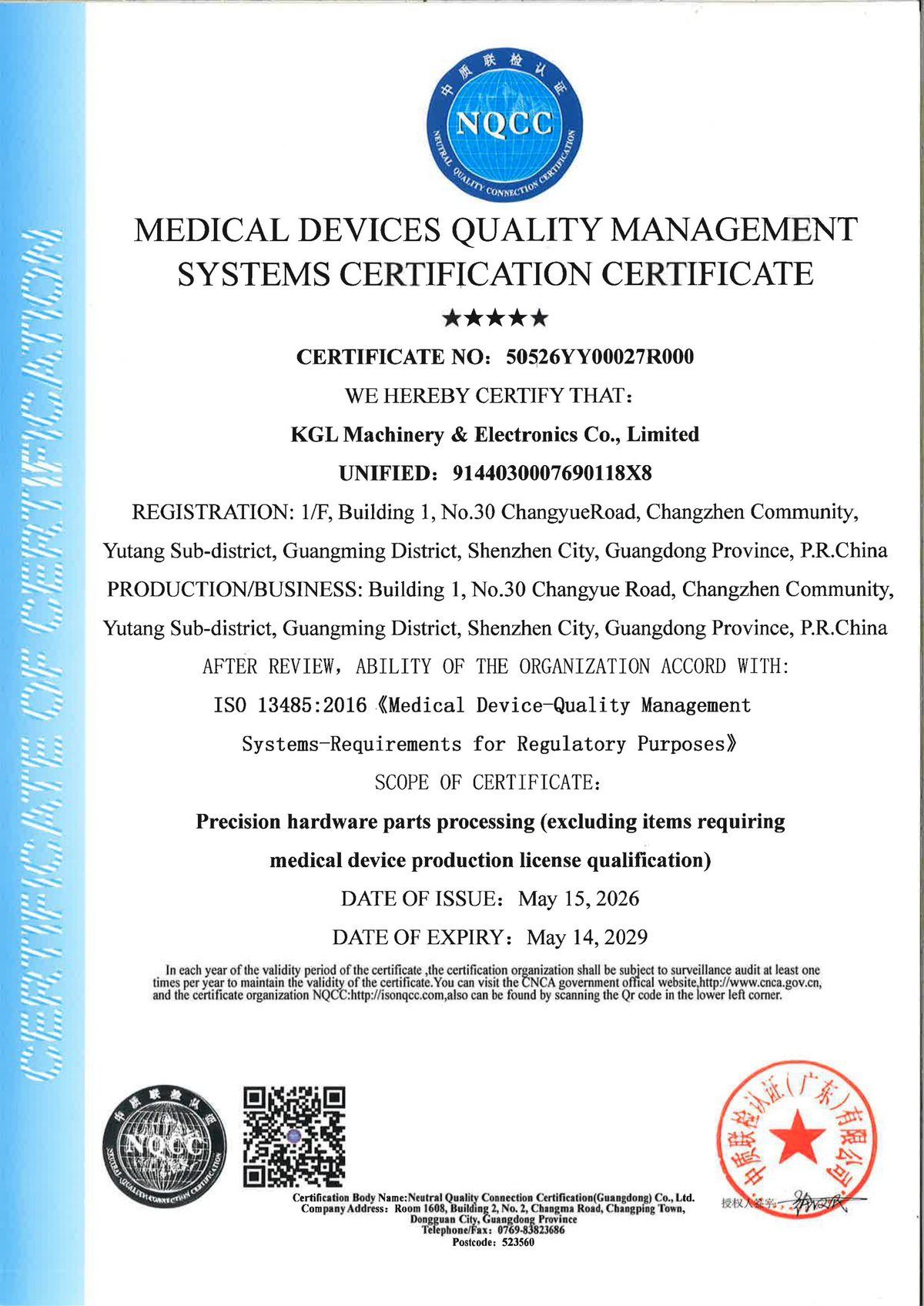
ISO 13485:2016 is the quality management standard for organizations that supply parts and services to the medical device industry. KGL was certified by NQCC (Neutral Quality Connection Certification Guangdong) under certificate number 50526YY00027R000, with validity from 2026-05-15 to 2029-05-14. The scope covers precision hardware parts processing, excluding items that themselves require a medical device production license.
Why KGL pursued ISO 13485:2016
Medical device customers began asking for the certificate in 2024. They were willing to place prototype orders based on our ISO 9001 system, but once a part moved toward clinical validation or regulatory filing, they needed a supplier whose quality system explicitly addressed risk management, traceability, and process validation. We started the certification project in late 2024 and closed the gaps before the initial audit in May 2026.
What the certificate covers
The certificate scope reads:
Precision hardware parts processing (excluding items requiring medical device production license qualification).
This means KGL can machine surgical instruments, orthopedic brackets, endoscope housings, implant-related fixtures, and other precision hardware that becomes part of a finished medical device. The exclusion protects both parties: KGL does not assemble or sterilize final devices, and the customer remains responsible for final-device regulatory approval.
How the system runs on the floor
ISO 13485 adds several controls on top of ISO 9001. We implemented the following and run them as standard practice.
Traceability by lot. Every medical job carries a lot number tied to raw-material certificates, machine operator, inspection report, and surface-treatment batch. If a customer asks where a specific batch of titanium brackets was machined, we can answer within minutes.
Contamination and handling controls. Medical parts are packed in sealed bags with desiccant after final inspection. We segregate medical work from general production when the drawing calls for it, and we control cutting fluids and coolants to avoid residue that could affect biocompatibility.
Process validation. When a process output cannot be fully verified by inspection, we validate the process. This applies mainly to special surface treatments and some heat-treatment steps performed by approved subcontractors. We keep validation records and supplier approval records.
Corrective action with risk analysis. Every nonconformance on a medical job is analyzed for patient-safety risk, not just dimensional impact. Corrective actions are closed only after the root cause is eliminated and effectiveness is verified.
Surveillance audits
NQCC will conduct surveillance audits at least once per calendar year during the certificate validity period. We maintain an internal audit schedule that covers all ISO 13485 clauses before the external auditor arrives, so there are no last-minute surprises.
What this means for customers
For medical device engineers, ISO 13485:2016 certification means KGL speaks the same quality language as their own regulatory team. It shortens supplier qualification, reduces audit findings, and gives them a documented foundation for their own device-submission files.
Read the related article: Why KGL pursued ISO 13485:2016 Medical Device Quality Management and how it runs on the shop floor.
Ready to Machine This Part?
Send your 2D/3D drawings and get a quote within 24 hours. No MOQ for prototypes and small lots.
Request a Quote