Blue POM Flared Valve Ring Nozzle, Turn-Mill and 5-Axis Machined, 130 mm Long
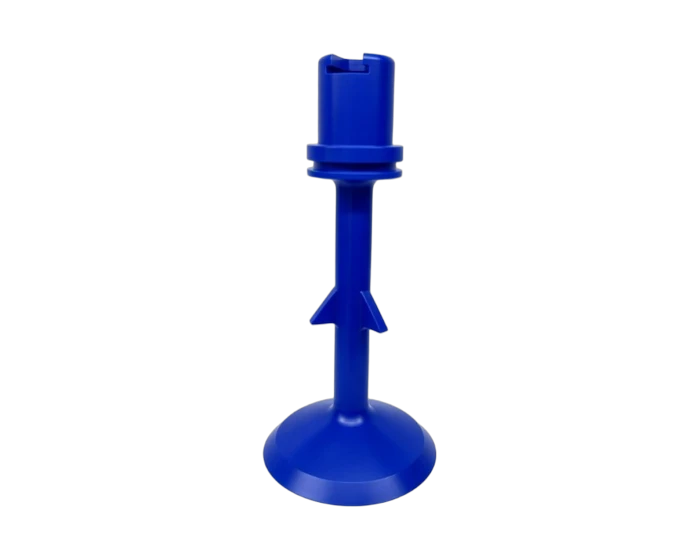
Blue glass filled POM spray valve nozzle with an 85.7 mm flared mouth, a 10 mm shaft 130 mm long, three flow fin sets at 120 degrees, coaxiality within 0.03 mm, and a top bayonet lock. Turn-mill plus 5-axis. Quote in 24 hours.
General Industrial Components
One piece blue glass filled POM nozzle: a 3.375 inch flared mouth on a thin wall, a slender 10 mm shaft running the full 130 mm, three sets of flow fins spaced 120 degrees apart, and a bayonet lock with O-ring groove at the top.
Or email drawings to kgl@kglmfc.com
Key Specifications
| Parameter | KGL Capability |
|---|---|
| Material | Blue glass filled POM (acetal), solid bar |
| Overall length | Approximately 130 mm |
| Flared mouth diameter | Approximately 85.7 mm (3.375 in), thin wall |
| Shaft diameter | Approximately 10 mm |
| Flow fins | Three sets, spaced 120 degrees apart around the shaft |
| Coaxiality | Within 0.03 mm over the full length |
| Locking slot tolerance | +/-0.005 mm |
| Sealing | O-ring groove plus bayonet locking slot at the top interface |
| Central bore | Through bore over the full length, clean wall, free of flash and stringing |
| Process | Turn-mill center for all axis sharing features, 5-axis finishing of the fins, dedicated finish boring of the through hole |
| Finishing | Microscope deburring, pure water ultrasonic cleaning, low temperature drying |
| Inspection | CMM 100 percent on coaxiality, flare roundness and fin position; go no-go and dedicated plug gauges on the slot and O-ring groove; air tightness check |
| Tolerance | ±0.005 mm standard on metals, engineering plastics, and carbon fiber composite |
| Certifications | ISO 9001:2015, ISO 13485:2016, AS9100D |
| Capacity | 100+ CNC machines including 11 five-axis centers |
| MOQ | No MOQ; 1-piece prototypes supported |
| Quote | Within 24 hours for complete 2D/3D files |
About This Part
This nozzle is one of those parts where the geometry, not the material, sets the difficulty. It is a single blue glass filled POM component with four things stacked along one axis: a wide thin wall flared mouth at the bottom, a slender shaft through the middle, three sets of flow fins spaced 120 degrees around that shaft, and a bayonet locking slot with an O-ring groove at the top. Overall length is about 130 mm, the flare is roughly 85.7 mm across (3.375 inches), and the shaft is around 10 mm in diameter.
The proportions are the problem. A 130 mm part carried on a 10 mm shaft will whip and chatter the moment a tool leans on it, and the flare at the end is thin wall, so it wants to deflect as well. Holding concentricity to 0.03 mm or better over that span means supporting the part along its length instead of gripping one end.
The route starts on a turn-mill center. Everything sharing the main axis is cut in one clamping: the flared mouth profile, the external shaft diameters, and the O-ring groove and bayonet slot at the top. Doing them together is what keeps the fins in phase with the locking feature.
The three sets of flow fins come next, finished on a 5-axis machining center so all groups are generated from a single part setup. Indexing around the shaft on a separate fixture would introduce angle error between the groups. After that the central bore is drilled and bored through the full length. A deep bore in plastic tends to wander, which shows up as wall variation and roundness error at the flare, so it is bored as a dedicated finishing pass rather than left inside the roughing.
Finishing is deliberately plain. Every edge is deburred under a microscope, because the fins and the flare edge hold micro flash that would otherwise break loose into the spray path. Then the part is ultrasonically cleaned in pure water and dried at low temperature, so nothing is left inside the fluid channel.
This part family supports the Industrial Parts industry. Read how KGL machines parts for that sector, then send your drawing for a quote.
Why Machine It at KGL
Five-Axis Fleet
100+ CNC machines including 11 five-axis centers run complex geometry in single setups, so tolerances do not stack up across refixturing.
Verified Accuracy
±0.005 mm standard on metals, plastics, and carbon fiber composite, verified on Hexagon and Zeiss CMMs (0.0015 mm accuracy).
Fast Prototypes
Engineering feedback with every quotation; prototype parts typically machined in 15 to 25 days.
One Supplier, End to End
Material sourcing, machining, heat treatment coordination, finishing, CMM inspection and export packaging under one roof.
Part-Specific Advantages
- Coaxiality within 0.03 mm held over a 130 mm part carried on a 10 mm shaft
- Flared mouth approximately 85.7 mm (3.375 in) across on a thin wall
- Three sets of flow fins at 120 degrees, 5-axis finished in one part setup
- O-ring groove and bayonet slot cut in the same clamping as every other axis feature
- Locking slot dimensions held at plus or minus 0.005 mm
- Central through bore bored as a separate finishing pass, clean wall, no flash
Typical Applications
- Spray and atomizing nozzles on food processing and packaging lines
- Fluid distribution heads on automated washing and coating equipment
- Quick disconnect nozzle bodies for industrial fluid systems
Commercial Terms
| Commercial | Detail |
|---|---|
| MOQ | No MOQ; 1-piece prototype supported |
| Quote | Within 24 hours for complete 2D/3D files |
| Terms | EXW / FOB Shenzhen |
| Certifications | ISO 9001:2015 |
| Packaging | Individual bubble wrap, export carton or wooden case |
| Lead Time | Prototypes 7 to 15 days; production scheduled by volume |
Common Questions
What makes this nozzle hard to machine?
The proportions. A 130 mm part that steps down to a 10 mm shaft deflects and chatters under normal cutting loads, and the flare at the end is thin wall. Add three fins that must sit 120 degrees apart and stay in phase with a bayonet slot at the far end, and every feature has to hold its angular position over the whole length, which is why they are cut without re-clamping.
Why finish the fins on a 5-axis machine?
Because all three sets are generated from one setup. Re-fixturing to index around the shaft introduces angle error between the groups, so the fins would no longer sit 120 degrees apart or line up with the locking slot.
How do you keep the through bore from wandering?
A deep bore in plastic drifts. It gets its own finishing pass after roughing, so the final cut removes the drift rather than following it, then the wall is inspected along its length for flash and stringing.
Can this be made in another plastic or color?
Yes. POM in natural or black, glass filled or unfilled, is the common alternative, and PEEK or PVDF are options when the media or operating temperature calls for them. Send the fluid and the service temperature with the drawing.
More General Industrial Components Parts
Other parts KGL machines in this industry. Every card links to its own detail page.
General Industrial Components
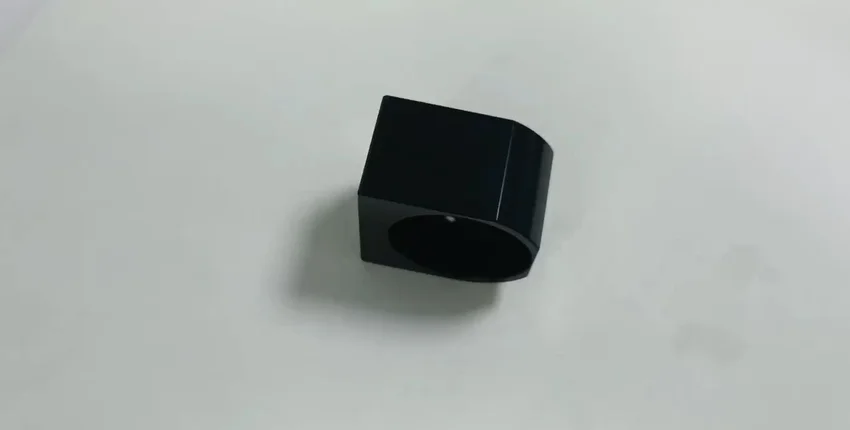
CNC Machining Chocolate Equipment Anodized Aluminum Slide Cover
View product →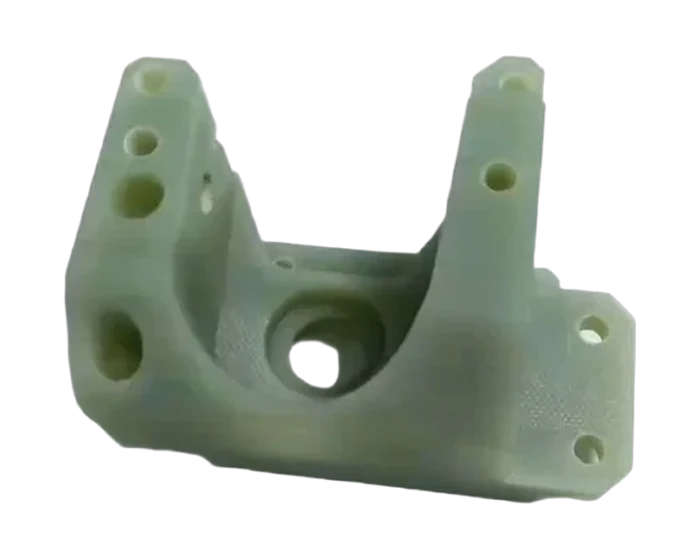
General Industrial Components
CNC Milling Industrial Equipment Filter Nozzle Mounting Base
View product →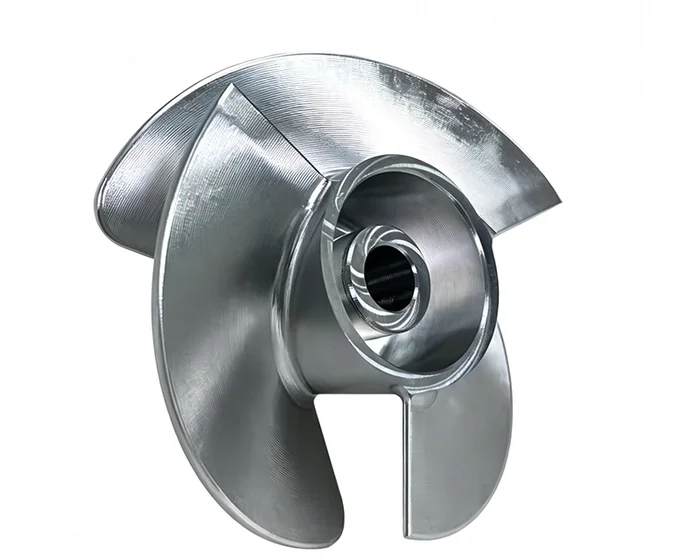
General Industrial Components
For Water SystemsCustom Milling Machining Impeller
View product →Ready to Machine This Part?
Send your 2D/3D drawings and get a quote within 24 hours. No MOQ for prototypes and small lots.
Request a Quote