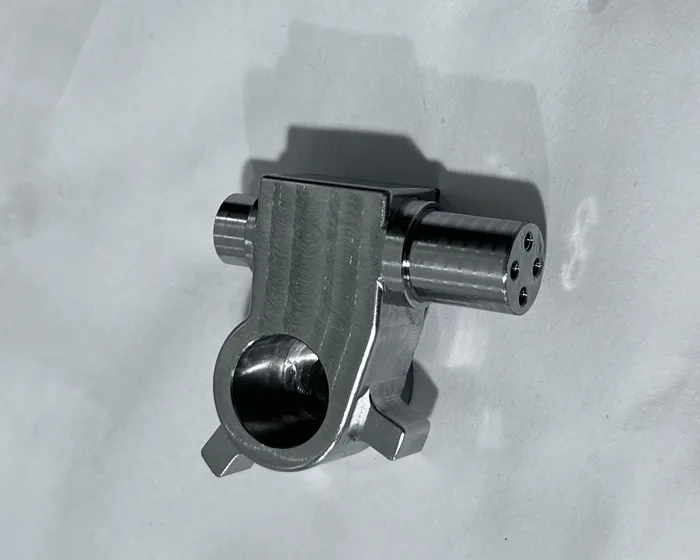
Precision Biaxial Ankle Joint Shafts in 17-4PH Stainless Steel
Biaxial ankle joint shafts in 17-4PH H900: crossed axes square within 0.008 mm, journals at g6/h6, Ra 0.2 to 0.4 um. Quote within 24 hours, no MOQ.
Robotics & Humanoid Robots
KGL machines biaxial ankle joint shafts for humanoid robots, exoskeletons, and prosthetics from 17-4PH stainless steel in H900 condition: crossed axes ground square within 0.008 mm, journal coaxiality within 0.005 mm, bearing seats at g6/h6, Ra 0.2 to 0.4 um on friction faces.
Or email drawings to kgl@kglmfc.com
Key Specifications
| Parameter | KGL Capability |
|---|---|
| Material | 17-4PH stainless steel, H900 precipitation hardened |
| Hardness | HRC 40 to 48 |
| Process | Horizontal machining center in one setup; crossed-axis precision grinding; fitting faces and anti-loosening grooves; deburring and ultrasonic cleaning; passivation or PVD coating |
| Size | Per drawing, crossed axes typically 12 to 30 mm diameter |
| Perpendicularity | 0.008 mm max between crossed axes |
| Coaxiality | 0.005 mm max on bearing journals |
| Fits | g6 / h6 on bearing seats |
| Surface Roughness | Ra 0.2 to 0.4 um on journals and friction faces |
| Standard Tolerance | Plus or minus 0.005 mm on machined features |
| Inspection | Hexagon / Zeiss CMM, profilometer, spectrometer, hardness tester |
| MOQ | No MOQ; 1-piece prototypes supported |
| Tolerance | ±0.005 mm standard on metals, engineering plastics, and carbon fiber composite |
| Certifications | ISO 9001:2015, ISO 13485:2016, AS9100D |
| Capacity | 100+ CNC machines including 11 five-axis centers |
| Quote | Within 24 hours for complete 2D/3D files |
About This Part
The biaxial ankle joint shaft is the crossed-axis core of a robot ankle. It carries pitch and roll at the same time, so the two axes must stay square to each other and true to their bearing journals; error at this part turns into stiction and uneven wear further up the leg. KGL machines each shaft from 17-4PH stainless steel and delivers it in H900 precipitation hardened condition at HRC 40 to 48, a grade that combines high shear and fatigue strength with the corrosion resistance a legged robot needs outside the lab.
The route is grinding led. A horizontal machining center completes the body, cross bores, and anti-rotation flats in one clamping. The crossed axes and bearing journals then go to precision grinding, which holds perpendicularity between the two axes at 0.008 mm or better and journal coaxiality at 0.005 mm, with bearing seats at g6 or h6 per the drawing. Journals and friction faces finish at Ra 0.2 to 0.4 um so seals run cool and bushings keep their clearance. After grinding, parts are deburred, ultrasonic cleaned, and passivated; PVD coating is available where wear life matters.
Cross-axis angle, perpendicularity, and journal geometry are verified on Hexagon and Zeiss CMMs, roughness on a profilometer, chemistry by spectrometer, and hardness on every heat treated lot. Send your drawing for DFM feedback and a quotation within 24 hours.
This part family supports the Robotics Parts industry. Read how KGL machines parts for that sector, then send your drawing for a quote.
Why Machine It at KGL
Five-Axis Fleet
100+ CNC machines including 11 five-axis centers run complex geometry in single setups, so tolerances do not stack up across refixturing.
Verified Accuracy
±0.005 mm standard on metals, plastics, and carbon fiber composite, verified on Hexagon and Zeiss CMMs (0.0015 mm accuracy).
Fast Prototypes
Engineering feedback with every quotation; prototype parts typically machined in 15 to 25 days.
One Supplier, End to End
Material sourcing, machining, heat treatment coordination, finishing, CMM inspection and export packaging under one roof.
Part-Specific Advantages
- Crossed double-axis geometry ground to 0.008 mm perpendicularity for smooth pitch and roll motion.
- Journal coaxiality within 0.005 mm and bearing seats at g6 / h6 for micron-level fits.
- 17-4PH H900 at HRC 40 to 48: high shear and fatigue strength for landing and impact loads.
- Compact one-piece design reduces assembly gaps and stacked tolerance in the ankle cluster.
- Passivated as standard, with optional PVD coating for wear life and surface finish.
Typical Applications
- Ankle pitch and roll drives for bipedal and humanoid robots
- Ankle mechanisms for lower-limb exoskeletons and prosthetics
- Precision miniature universal joints and cross-axis linkages
- Test rigs and gimbal stages needing two orthogonal precision axes
Commercial Terms
| Commercial | Detail |
|---|---|
| MOQ | No MOQ; 1-piece prototype supported |
| Quote | Within 24 hours for complete 2D/3D files |
| Terms | EXW / FOB Shenzhen |
| Certifications | ISO 9001:2015 |
| Packaging | Individual bubble wrap, export carton or wooden case |
Common Questions
Why 17-4PH instead of 304 or 7075?
After H900 hardening, 17-4PH reaches HRC 40 to 48, far beyond 304, while keeping better corrosion resistance than most high-strength steels. Against 7075 aluminum it carries far higher contact stress at the journals, which is what an ankle shaft sees on every footstrike.
Why grind the crossed axes instead of finish milling them?
The shaft is finish machined first, then hardened, then ground. Grinding after heat treatment removes hardening distortion and is the only way to hold 0.008 mm squareness and 0.005 mm coaxiality at HRC 40 to 48 with Ra 0.2 to 0.4 um finishes.
What does H900 mean for lead time?
H900 is the most common aging condition for 17-4PH and the material is stocked in bar. The route is machine, heat treat, grind, so typical prototype lead time runs alongside normal CNC work, and you get a quotation within 24 hours.
Can you match an existing ankle shaft?
Yes. Send the 2D drawing with the fits and axis relations, or a sample for inspection. Cross-axis angle, journal fits, and hardness are all covered in the first-article report before batch production.
What files do you need for a quote?
A 2D drawing marking the crossed-axis perpendicularity, journal fits, and hardness, plus a 3D model in STEP or IGES. You get engineering feedback with the quotation, within 24 hours.
More Robotics & Humanoid Robots Parts
Other parts KGL machines in this industry. Every card links to its own detail page.
Ready to Machine This Part?
Send your 2D/3D drawings and get a quote within 24 hours. No MOQ for prototypes and small lots.
Request a Quote