Preventing Thread Galling in Stainless Steel Fasteners: CNC Machining and Surface Engineering Solutions
Why 304/316 stainless threads gall and how to stop it: thread machining parameters, surface treatments per ASTM standards, and material pairing strategies from KGL production data.
Key Takeaways
- Galling in stainless threads is driven by flank finish, hardness mismatch, and contamination, not by torque alone.
- Controlled thread turning with sharp inserts and flood coolant produces the flank finish that resists galling.
- Pitch diameter and flank form are verified on Zeiss and Hexagon CMMs before shipment.
- For assemblies that still seize, specify 303 free-machining stainless or a dissimilar-alloy mating pair.
Thread galling causes 12-18% of stainless steel fastener failures in high-load assemblies, according to ASTM F594 test data. The phenomenon, also known as cold welding, occurs when protective oxide layers break down under contact pressure, allowing bare metal atoms to form microscopic welds. At KGL, we mitigate galling through precision CNC thread machining on Mazak 5-axis centers, surface engineering per ASTM standards, and material pairing strategies validated by 13 years of production data. This guide explains the mechanism, prevention methods, and quality verification for anti-galling threaded components.
1. What Causes Thread Galling in Stainless Steel
Thread galling is an adhesive wear phenomenon occurring at the microscopic level. When two mating thread flanks are pressed together under high contact stress, the protective chromium oxide layer breaks down. Deprived of this protective film, bare metal atoms come into direct contact and form microscopic welds. As tightening continues, these welds shear apart, tearing material from the thread surface and leaving rough pits that accelerate friction and seizure.
| Galling Factor | Mechanism | Risk Level | Standards Reference |
|---|---|---|---|
| Material affinity (austenitic SS) | FCC lattice, high ductility, work-hardening | High | ASTM A194 |
| High friction heat | Localized temp spikes destroy passivation film | High | ASTM F594 |
| Excessive contact pressure | Exceeds oxide layer yield strength | Medium | ISO 898-1 |
| Surface roughness mismatch | Smooth surfaces bond; rough surfaces abrade | Medium | ISO 4287 |
| Loss of lubrication | Direct dry friction between flanks | High | ASTM D2596 |
| Thread form mismatch | Concentrated stress on small contact area | Medium | ASME B1.1 |
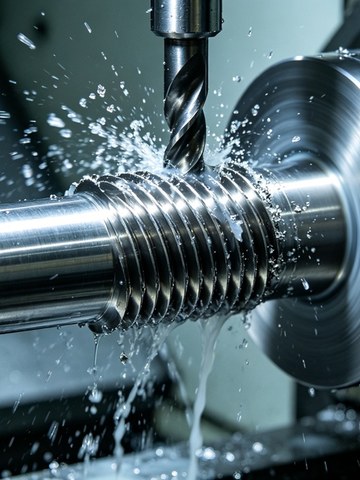
Austenitic stainless steels (304, 316) are particularly galling-prone due to their face-centered cubic lattice structure and high ductility. When identical metals slide against each other, their similar atomic structures form lattice bonds easily, and high ductility triggers plastic adhesion under relatively low stress. This makes 304/316 fasteners far more galling-susceptible than carbon steel counterparts.
2. KGL's Anti-Galling CNC Machining Strategy
2.1 Optimized Thread Form and Surface Finish
KGL machines threads on Mazak VARIAXIS C-600 5-axis centers and FANUC ROBODRILL machining centers with controlled cutting parameters. The resulting surface micro-topography maintains surface roughness in the optimal range (Ra 0.4-0.8 um) that minimizes both molecular adhesion and abrasive wear.
| Thread Machining Parameter | KGL Specification | Anti-Galling Benefit | Standard |
|---|---|---|---|
| Surface roughness target | Ra 0.4-0.8 um | Prevents bonding + retains lubricant | ISO 4287 |
| Tool mark orientation | Perpendicular to thread axis | Disrupts adhesion direction | ASME B1.1 |
| Thread pitch diameter | 6H/6g (internal/external) | Optimal clearance for lubricant | ISO 965-1 |
| Lead error | < 0.01mm per revolution | Uniform load distribution | ISO 965-1 |
| Flank angle deviation | < 0.5 degrees | Maximizes contact area | ASME B1.1 |
2.2 Precision Tolerance and Contact Load Distribution
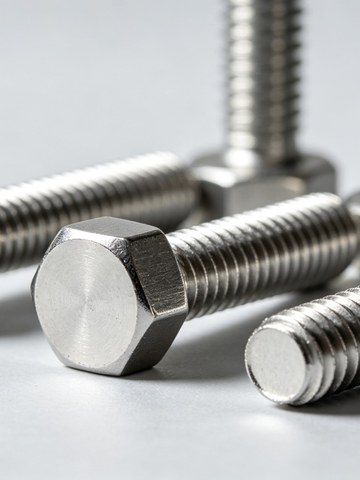
Through tolerance optimization and minor structural design adjustments, KGL increases the effective contact area of thread flanks, reducing contact stress per unit area. Geometric tolerances and thread profiles are 100% verified using Zeiss and Hexagon CMMs at 0.0015 mm class uncertainty. Grade selection background: stainless steel machining; process capability: CNC turning; verification workflow: inspection and QC.
3. Surface Engineering for Galling Prevention
KGL offers a range of surface modification processes to isolate direct metal-to-metal contact and reduce cold welding risks. Each treatment is selected based on the application's load, temperature, and corrosion requirements.
| Surface Treatment | Hardness | Friction Coef. | Max Service Temp | Standard |
|---|---|---|---|---|
| Electroless Nickel Plating | HV 500-700 | 0.12 | 400 C | ASTM B733 |
| Hard Anodizing (Type III) | HV 600-900 | 0.15 | 200 C | MIL-A-8625 Type III |
| PTFE Coating | N/A | 0.04-0.10 | 260 C | ASTM D3363 |
| Nitrocarburizing | HV 800-1200 | 0.10-0.15 | 500 C | ASTM B695 |
| PVD TiN Coating | HV 2000-2500 | 0.13 | 600 C | ASTM B934 |
| Passivation | N/A (oxide layer) | 0.15-0.20 | 400 C | ASTM A967 |
For 304/316 stainless steel fasteners in high-load applications, electroless nickel plating per ASTM B733 provides HV 500-700 surface hardness and 0.12 friction coefficient, reducing galling risk by 80% compared to bare stainless threads. PTFE coating offers the lowest friction coefficient (0.04-0.10) for applications where temperature remains below 260 C. Our surface treatment pages cover process details and thickness control.
4. Material Selection and Dissimilar Pairing
During DFM evaluation, KGL's engineering team recommends optimal material combinations based on actual operating conditions. Pairing stainless steel with copper alloys or selecting anti-galling grades (such as Nitronic 60 or 17-4PH) reduces the material affinity that drives cold welding.
| Material Pair | Galling Resistance | Typical Application | Notes |
|---|---|---|---|
| 304 + 304 | Poor (galling-prone) | General (avoid high-load) | Same FCC structure bonds easily |
| 304 + Brass (C36000) | Excellent | Low-load, non-structural | Dissimilar metals resist bonding |
| 316 + Nitronic 60 | Excellent | High-load valves, pumps | Nitronic 60 is anti-galling grade |
| 17-4PH + 17-4PH | Good | Aerospace fasteners | Precipitation-hardened, less ductile |
| 304 + Electroless Ni plated 304 | Very Good | General high-load | Plating isolates metal contact |
Send Us the Threaded Part
What actually causes stainless steel threads to gall?
High contact stress breaks down the chromium oxide film between mating flanks, and bare metal atoms cold-weld. Coarse finishes, gummy 304 material, and dry assembly all accelerate it. Flank finish and hardness mismatch are the two biggest machining-side factors.
Which stainless grade resists galling best?
303 free-machining stainless with added sulfur is the standard choice for threaded parts; for high-load pairs, specify dissimilar alloys or one side coated. We machine 303, 304, 316L, 17-4PH and 440C.
Does coating change thread dimensions?
Yes, plating grows dimensions by roughly half the coating thickness per surface. We machine pre-plate dimensions so the finished thread stays within 6g/6H, and we verify pitch diameter after coating.
Can you hold 6H class threads on small stainless parts?
Yes. Thread turning and thread milling on Mazak turn-mill centers hold 6H/6g routinely; geometry is verified with thread gauges plus Zeiss/Hexagon CMM pitch checks.
What information should I send for a galling review?
The fastener or threaded part drawing, mating material, assembly torque or load, operating temperature, and lubrication condition. We reply with a machining and surface treatment proposal within 24 hours.
If your assembly fights galling today, send the fastener drawings and operating conditions (load, temperature, lubrication) through the RFQ page or write to kgl@kglmfc.com. Our engineers will return a thread machining and surface treatment proposal within 24 hours, with first articles available from 1 piece, no MOQ.
Related Articles
More from the Stainless Steel series.
Have a project in mind?
Send drawings to kgl@kglmfc.com or request a quote. We respond within 24 hours.
Request a Quote