Stainless Steel Machinability: 303, 304, 316 and 17-4 PH Compared
303 cuts freely because of sulfur, 304 and 316 work harden, 17-4 PH must be machined before aging: what each grade costs at the spindle and why
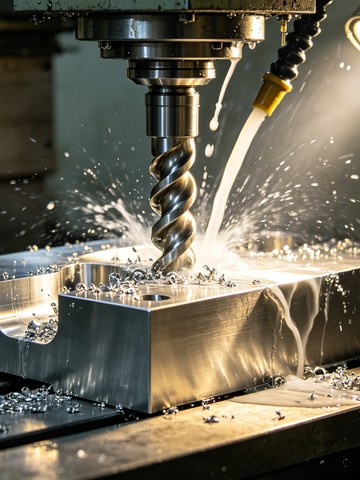
Two parts with identical geometry, one in 303 and one in 316, will not cost the same. The difference is not the material price alone: it is chip formation, cutting temperature, tool wear and the risk of a scrapped batch at the last operation. Engineers who treat stainless as one material spend a lot of time explaining why the second prototype cost twice the first.
This guide compares the grades we machine most often, explains the metallurgy behind the difference in behaviour, gives the parameter directions that follow from it, and puts numbers on the cost gap so a design decision can be made on evidence rather than on habit. It is about machinability specifically; the corrosion comparison between 304 and 316 is covered in a separate article.
At a glance
- 303 is free cutting because of sulfur, which forms manganese sulfide inclusions that break chips. The same inclusions make it unsuitable for welding and weaker in chloride service.
- 304 and 316 work harden at the surface if the tool rubs. The cut has to stay under the worked layer, which means a minimum feed and a minimum depth, not a lighter pass.
- 17-4 PH is machined in the solution treated condition and aged afterwards. Machining it after aging is possible and much slower.
- Stainless conducts heat about a third as well as carbon steel, so the heat stays at the edge. Coolant delivery matters as much as the insert grade.
1. What Makes 303 the Free Cutting Grade?
303 is an austenitic stainless with sulfur added in the range of 0.15 to 0.35 percent. The sulfur combines with manganese to form manganese sulfide inclusions, and those inclusions act as internal stress raisers that break the chip before it can grow long and stringy. The practical result is short chips, lower cutting forces, less built up edge and a surface that behaves predictably at ordinary speeds and feeds.
The published machinability ratings put that advantage in perspective. Using a free cutting carbon steel as 100 percent, 303 typically rates around 75 to 80 percent, 304 around 45 percent, and 316 around 35 to 40 percent. Those are relative figures from different sources and should not be treated as precise, but the ranking holds in every shop: 303 is roughly twice as machinable as 316 on the same operation.
The cost of that convenience is written into the same inclusions. Sulfur lowers weldability, because the sulfides promote hot cracking in the weld zone. It also reduces corrosion resistance in chloride environments, and the effect is worse on a machined surface where inclusions are exposed. So 303 belongs on parts that are not welded and not exposed to chlorides: shafts, bushings, fittings in benign chemistry, instrument bodies, and anything where the machining cost dominates the material cost.
2. Why Do 304 and 316 Work Harden So Aggressively?
Austenitic stainless work hardens because the crystal structure transforms under deformation and dislocation density rises at the cut surface. A single pass with a dull edge or a rubbing tool can take the surface from around 90 HRB to the equivalent of 30 HRC in a layer a few hundredths of a millimetre deep. The next pass then has to cut through that hard layer, which dulls the tool faster, which work hardens the next surface harder. This is the mechanism behind the familiar experience of a part that machines fine for ten minutes and then refuses to be cut at all.
The countermeasures are counter intuitive. The instinct when a stainless part is not cutting is to reduce feed and take lighter passes, which makes it worse. The correct response is to keep the tool engaged and the chip load above a minimum, typically 0.08 to 0.1 mm per revolution on turning and a comparable chip thickness on milling, and to keep the depth of cut large enough that the edge stays below the worked layer rather than skating on it. If the previous operation left a hardened skin, the first pass has to go under it, not skim it.
316 adds molybdenum at 2 to 3 percent for chloride resistance, and that addition costs machinability. The grade is tougher, gummier, and prone to built up edge and galling, which is why the 304 against 316 comparison is not only a corrosion question. In practice 316 runs about 15 to 20 percent slower than 304 for the same tool life, and tool life at a given speed is shorter. Neither grade is difficult with the right parameters, but both punish a program that was copied from carbon steel and left unchanged.
| Grade | Family | Machinability index (approx) | Behavior that matters | Typical use |
|---|---|---|---|---|
| 303 | Austenitic, sulfur added | 75 to 80 | Short chips, low forces, poor weldability | Shafts, fittings, non welded parts |
| 304 / 304L | Austenitic | 45 | Work hardens, gummy, built up edge | General hardware, tanks, brackets |
| 316 / 316L | Austenitic, molybdenum | 35 to 40 | Hardens faster, galls, lower speeds | Marine, chemical, medical, food |
| 17-4 PH | Martensitic precipitation | 45 to 50 in solution treated | Machines in the soft condition, shrinks in aging | Shafts, valve parts, aerospace fittings |
| 440C | Martensitic, high carbon | Around 40 annealed | Hardens to 58 to 60 HRC, grind after treatment | Bearings, knives, wear parts |
| 2205 | Duplex | 30 to 35 | High strength, severe galling tendency | Chemical process, offshore |
3. What Is Different About 17-4 PH and 440C?
17-4 PH is a precipitation hardening martensitic grade, and its machinability depends entirely on which condition it is in when the cutter arrives. In the solution treated condition it sits around 30 to 35 HRC and machines reasonably, comparable to a medium alloy steel. After aging at 482 degrees Celsius, condition H900, it reaches about 44 HRC and becomes a hard turning or grinding job. Aged at 621 degrees, condition H1150, it lands around 28 to 32 HRC and remains machinable with carbide.
The process rule is to machine in the solution treated condition, leave finishing stock, age, and then finish. Aging also shrinks the part slightly, in the region of 0.04 to 0.06 percent linear, which on a 100 mm dimension is 0.04 to 0.06 mm. That is not a rounding error on a bearing fit, which is why the sequence and the allowance have to be agreed before the first cut rather than discovered at the CMM.
440C is a different problem again. It arrives annealed at around 25 HRC and machines acceptably, though it is abrasive and stringy. After hardening to 58 to 60 HRC it is a grinding material, and any feature that must be finished after hardening needs grinding stock. Threads, sharp corners and thin sections are the usual places where a design that looked fine in the annealed state becomes a grinding problem.
Sequencing note
For any precipitation hardening or martensitic stainless part, the drawing review question is not "what grade" but "in which condition is each feature machined, and what allowance survives the treatment". Put that answer on the process sheet and the CMM report becomes predictable.
4. Where Does the Heat Go?
Stainless steels conduct heat poorly compared with carbon steel, roughly 16 watts per metre kelvin against about 50. The consequence is that the heat generated at the cut does not flow into the workpiece and the chip as quickly, so more of it stays at the tool edge. Edge temperature rises, diffusion wear accelerates, and the insert fails by cratering rather than by flank wear.
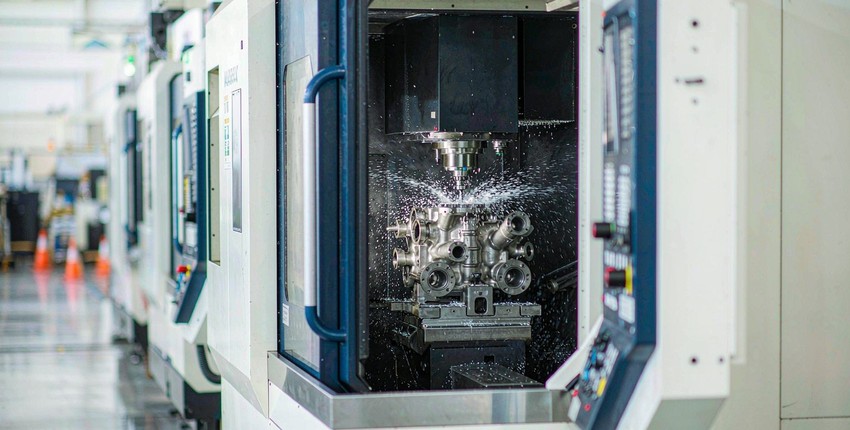
What follows is a coolant and geometry decision more than a speed decision, and it is where a turn mill cell has an advantage, because the cut stays wet through both operations. Through tool coolant at high pressure puts fluid where the edge is, rather than flooding the outside of a part that is already shielding the cut. A positive rake geometry with a sharp, uncoated or lightly coated edge reduces the heat generated in the first place, which matters more on 316 than on 303. And a feed high enough to make a real chip carries heat away with the chip, which is the cheapest cooling method available.
There is also a distortion consequence. Thin wall stainless parts move when the heat is uneven, and the movement shows up after the part cools, not while it is being cut. Rough, let the part cool, then finish is the only reliable sequence for a thin wall, and it is one of the reasons stainless thin wall work carries a different price. Our article on thin wall stainless machining goes further into the fixturing side.
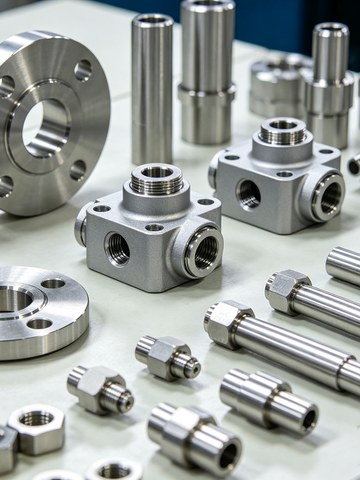
5. How Much Does Grade Choice Actually Cost?
Take a simple turned part, 1,000 pieces, one setup, a few milled flats and a tapped hole. In 303 the cycle time lands around 4.2 minutes. In 316, at a surface speed reduced for tool life and with slower feed to control built up edge, the same part takes about 6.6 minutes, roughly 57 percent longer. Tool consumption per part rises too, because 316 wears an edge faster and needs more frequent changes on a gummy material, so the tool cost per piece is often two to two and a half times the 303 figure.
Put those two effects together and the unit price for the part rises by something close to 30 to 35 percent, before any turning efficiency gains from a better tool path, before any allowance for a higher scrap rate at final inspection. That is the real cost of specifying 316 on a part that only sees clean washdown chemistry. None of this argues against 316 where chlorides are present, it argues for asking the corrosion question before the drawing is released, because the answer is worth a third of the part price.
The same arithmetic explains why 303 is so common in instrumentation and general hardware, and why it is almost absent from anything welded. A welded 303 assembly cracks in the heat affected zone, and no amount of downstream inspection fixes a decision made at material selection.
| Problem | Mechanism | Countermeasure |
|---|---|---|
| Tool fails after a few minutes | Work hardened skin from a rubbing pass | Keep chip load above 0.08 mm per rev, cut under the worked layer, change the insert before it dulls |
| Built up edge and torn surface | Pressure welding of stainless to the edge at low speed | Raise surface speed and feed, sharp positive geometry, reliable coolant delivery |
| Thread galling on assembly | Austenitic surfaces weld under pressure with no lubricant film | Thread mill rather than tap, control flank finish, specify a lubricated assembly and the correct class of fit |
| Bore runs small after machining | Residual stress relief in a cold drawn or heavily machined section | Rough, stress relieve or allow to stabilise, then finish; avoid removing more than needed in one pass |
| Rust appears in service | Free iron contamination from carbon steel tooling or blasting media | Dedicated stainless tooling, no carbon steel brush, passivation after machining |
6. What Happens After Machining?
For stainless, the operation after machining is often as important as the machining itself. Passivation removes free iron and surface contamination and restores the passive oxide layer. It is specified to ASTM A967, and it can be done with citric or nitric chemistry depending on the grade and the customer specification. What it cannot do is fix a surface that was contaminated by carbon steel tooling, because the contamination can be embedded rather than sitting on the surface.
That is why we keep stainless work on dedicated fixtures, separate from carbon steel, and why blasting media is segregated by material. A shop that shares everything produces parts that pass dimensional inspection and fail a salt spray test six weeks later, and the failure is usually attributed to the material rather than to the handling.
Deburring is the other finish operation that gets underestimated, and it is the one that decides whether a specified finish survives handling. A stainless edge that is left sharp becomes a handling injury at the customer's assembly line and a crack initiation site in a vibrating part. Edge break of 0.1 to 0.2 mm is specified on most of our drawings, and where the drawing is silent we ask, because a shop that guesses produces a batch that someone has to inspect by hand.
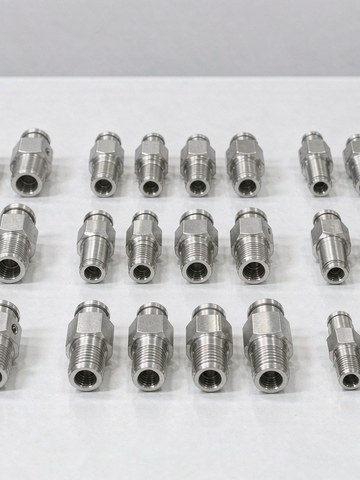
7. What Should You Tell Your Supplier at RFQ?
Grade and condition, stated separately, because 17-4 PH in the solution treated condition and in H900 are two different machining jobs. The corrosion environment, in plain terms: what the part touches, whether it is washed down, whether it sees chlorides or cleaning chemicals. The magnetic requirement, if there is one, because some austenitic grades become slightly magnetic after cold work. The heat treatment and finish specification, including passivation standard. And the tolerance on the features that mate, with the understanding that our standard is plus or minus 0.005 mm and that tighter per feature calls change the process.
With those five answers the grade question usually answers itself, and the quote reflects the real route rather than a guess. Send the drawing and the environment, and a quote is back within 24 hours, with an alternative grade noted where the specified one is carrying cost that the application does not need.
Frequently Asked Questions
Is 303 a good choice for a marine part?
No. The sulfur that makes 303 free cutting also reduces chloride resistance, and a marine environment attacks the exposed inclusions. Use 316L or a duplex grade, and accept the higher machining cost as part of the corrosion requirement.
Can you machine 316 without work hardening it?
Yes, by keeping the tool engaged and the chip load above the minimum, and by cutting under any hardened skin rather than skimming it. The failure mode is almost always a program that was copied from a softer grade with a lighter feed.
Should 17-4 PH be machined before or after aging?
Before aging, in the solution treated condition, with finishing stock left for the aging shrink of about 0.04 to 0.06 percent. Machining after aging is possible at H1150 but slow, and at H900 it becomes a grinding or hard turning operation.
Do you passivate parts after machining?
Yes, to ASTM A967 with citric chemistry as standard, and to the customer specification where one is called out. We also keep stainless tooling and blasting media separate from carbon steel to avoid the contamination that passivation cannot remove.
What tolerance can you hold on stainless?
Plus or minus 0.005 mm is our standard, with tighter per feature where the drawing asks. Thin wall and long slender parts move after cutting, so those are quoted with a rough and finish sequence rather than a single pass.
Can you supply the material certificate?
Yes, to EN 10204 3.1 traceable to heat number, and the certificate is filed against the part number so a question in a later year can be answered from the record rather than from a new test.
This article is general engineering guidance, not a binding offer. Tolerances, cost and lead time depend on part geometry, material, quantity and the drawing package you release. Request a quotation for part specific terms. (c) 2026 KGL Machining & Electronics, Shenzhen.
Related Articles
More from the Stainless Steel series.
Have a project in mind?
Send drawings to kgl@kglmfc.com or request a quote. We respond within 24 hours.
Request a Quote