Aerospace CNC Machining: Flight-Critical Brackets and Turbine Components
AS9100D aerospace CNC machining: wheel and brake brackets, structural fittings and turbine hardware in 7075, 7050 and Ti-6Al-4V, with full FAI traceability.
An aircraft bracket sits in a load path that is analyzed, tested, and certified. A turbine housing steers hot gas at speed. Every part in that chain has to be traceable to its material lot and its process records. KGL machines aerospace structural parts under AS9100D, audited by Bureau Veritas (cert CN059081, valid 2026-2029), and this article covers how flight-critical brackets and turbine components are actually produced and documented.
What AS9100D changes versus a commercial shop
The certification drives four habits. Configuration management, so the part matches the frozen revision. Risk-based planning, so the process anticipates failure instead of reacting to it. Special process control, so surface treatments are done by qualified suppliers with certificates. And full traceability, so a material certificate can be tied to a finished part years later.
First articles are documented per AS9102, with dimensional CMM data, material certificates, and surface-treatment certificates collected into one package. Counterfeit parts prevention is part of the same system: material comes from approved sources with mill test reports.
Brackets and structural fittings
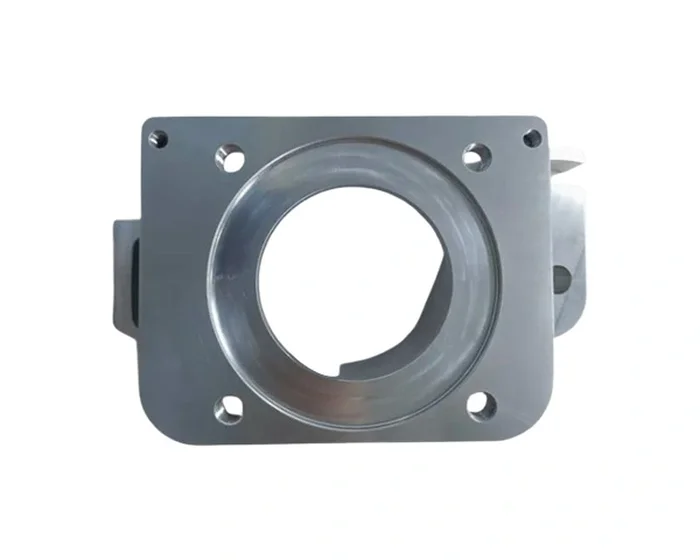
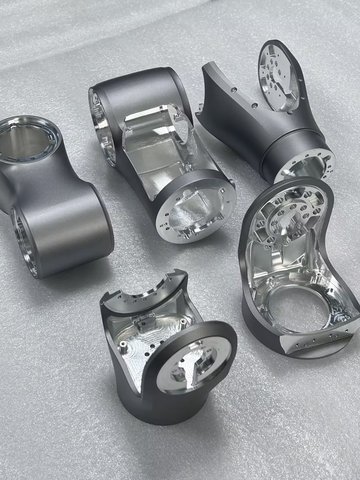
Wheel and brake brackets in landing gear see high loads, vibration, and temperature swings. We machine them from 7075-T6, 7050-T7451, and Ti-6Al-4V on 5-axis and horizontal centers. Standard tolerance is ±0.005 mm, with critical holes held to ±0.005 mm.
5-axis machining matters here because these brackets carry angled faces and deep pockets that would otherwise need several setups. Fewer setups mean the hole pattern stays true to the datum structure, and the thin web sections are cut with consistent tool engagement instead of one risky plunge after another. Material and finish options for these programs are agreed in DFM against your drawing.
Turbine housings and polymer aircraft parts
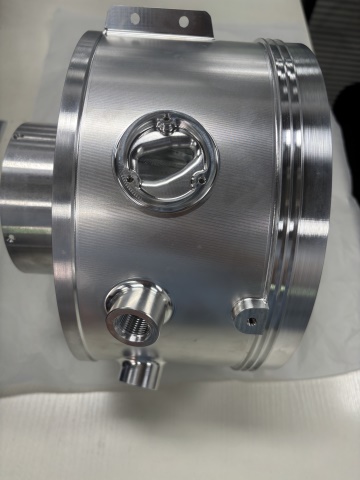
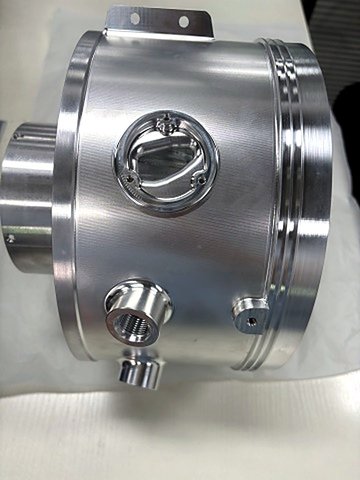
Turbine housings and stator vane assemblies are the harder end of the range. A thin-walled cylinder with internal aerodynamic vanes is machined in one multi-axis setup so every feature shares one origin, holding coaxiality and cylindricity within 0.005 mm. The program background is in the turbine housing case study.
Aerospace work at KGL is not limited to metals. We machine PEI wastewater treatment parts for aircraft systems, for a top-tier European aerospace and defense group, replacing both 3D printing and injection molding. The machined parts hold ±0.02 mm where printed versions held ±0.1 mm, run below Ra 0.8, and carry no layer-bond leakage risk. PEI stock comes direct from Röchling in Germany with full traceability, and the direct sourcing cuts material cost 20 to 30 percent. Details are in the PEI aerospace case study.
What you receive with each lot
| Deliverable | Content |
|---|---|
| First article inspection | Dimensional CMM report per AS9102, material certificate, surface-treatment certificate |
| Production lots | Dimensional report on critical features, lot traceability records |
| Material | Mill test certificates retained per AS9100D, approved-source supply |
| Special processes | Hard anodize, alodine, passivation, and titanium treatments from qualified suppliers |
Frequently asked questions
Which aerospace materials do you machine?
7075-T6 and 7050-T7451 aluminum, Ti-6Al-4V Grade 5 titanium, 17-4PH and 316L stainless steel, plus PEI and PEEK for aircraft system parts.
Do you provide full AS9102 first article reports?
Yes. First articles ship with a dimensional CMM report, material certificate, and surface-treatment certificate assembled into one package.
Can you support development quantities before qualification?
Yes. We run one-piece prototypes and small lots under the same AS9100D process controls, then scale to production when the design is qualified.
Aerospace inquiry
If you have a structural bracket, turbine housing, or polymer aircraft part that needs documented quality, send your drawings to kgl@kglmfc.com. We will review the geometry and return a process assessment and quote within 24 hours.
Have a project in mind?
Send drawings to kgl@kglmfc.com or request a quote. We respond within 24 hours.
Request a Quote