CNC Parts for Semiconductor Equipment: Tolerances, Materials, CMM Verification
Ultra-precision CNC parts for semiconductor equipment: SUS304 thin-wall brackets, lens barrels and ESD-safe plastics, verified on CMM at 0.0015 mm accuracy.
Semiconductor equipment runs wafers worth thousands of dollars through vacuum chambers, precision motion stages, and optical systems. The machined parts inside that equipment must hold geometry under vacuum, thermal cycling, and ESD control, because a failed part stops a line, not just a machine. At KGL we machine thin-wall stainless brackets, lens barrels, and ESD-safe plastic components for semiconductor equipment makers. This article explains the tolerance, material, and verification rules we work to.
The tolerance floor is different here
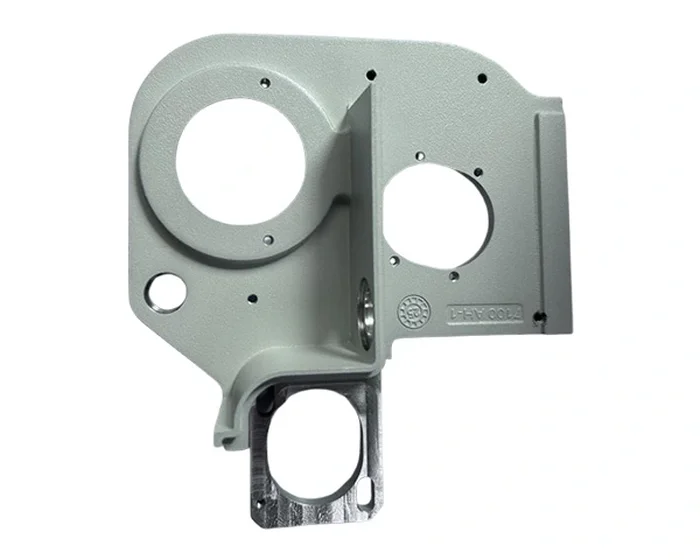
The benchmark part tells the story. In 2025 we delivered a core SUS304 component to the world's leading semiconductor lithography equipment maker. The envelope is 150 x 45 x 6 mm, the thinnest wall drops to 0.3 mm, and micro-holes are 0.1 mm in diameter. Flatness, true position, and coaxiality all hold within 0.01 mm, with surface finish at Ra 0.4 μm.
That part is machined through a five-step route: roughing, natural aging, semi-finishing, stress relief, then finishing. Stress leaves the part between operations, so the final pass cuts a stable surface. Minimum quantity lubrication keeps the cutting zone below 80 C, which protects the 0.3 mm wall from heat distortion. The vacuum-assisted conformal fixture went through 12 design iterations before clamping distortion dropped from 0.015 mm to below 0.003 mm.
Materials: metals and ESD-safe plastics
Common metals are aluminum 6061-T6 and 7075, stainless 316L and 17-4PH. Plastic parts that touch or sit near wafers need controlled static discharge, so we machine PEEK, PEEK1000, PEI, ESD225, ESD420, and conductive nylon. Each material gets its own tooling and coolant plan, because a polymer that melts at the cutting zone looks nothing like a metal chip failure.
Verification on CMM
Every critical dimension is checked, not assumed. Our quality lab runs Hexagon GLOBALS and Zeiss CAPTUM CMMs at 0.0015 mm accuracy, a Keyence IM-8010 image measurement system, and 40+ precision inspection instruments across the lab and shop floor. Dimensional reports are issued against the customer CAD model, and first articles receive full FAI documentation.
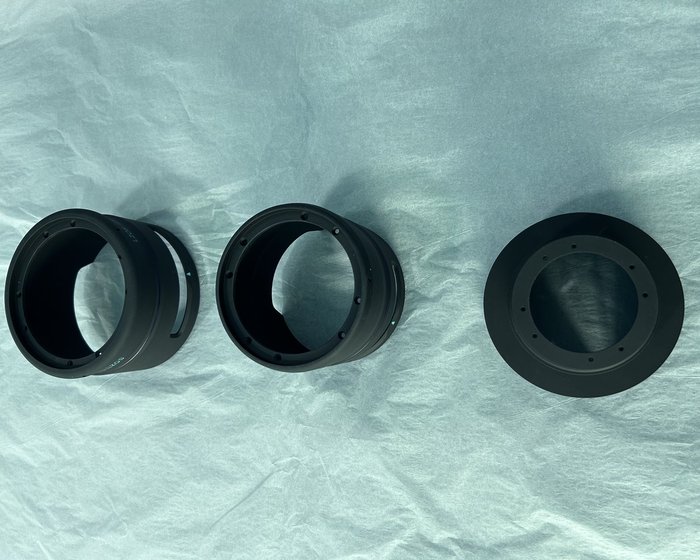
Optical housings follow the same rule. Lens barrels and optical tubes are turned and milled so bores and threads share one setup, holding bore-to-OD concentricity within 0.01 mm and optical bores to Ra 0.8 μm or better. The photoelectric lens barrel product page lists the tolerance ladder, and the thin-wall semiconductor case study covers the fixture and heat control behind the 2025 delivery.
Reference numbers from live programs
| Attribute | Value | Source program |
|---|---|---|
| Thin-wall part envelope | 150 x 45 x 6 mm | SUS304 lithography part |
| Thinnest wall | 0.3 mm | SUS304 lithography part |
| Micro-hole diameter | 0.1 mm | SUS304 lithography part |
| Flatness / position / coaxiality | within 0.01 mm | SUS304 lithography part |
| Surface finish | Ra 0.4 μm | SUS304 lithography part |
| Bore-to-OD concentricity (optical housings) | within 0.01 mm | Lens barrel product line |
| Optical bore finish | Ra 0.8 μm or better | Lens barrel product line |
Frequently asked questions
Which ESD-safe plastics do you machine?
PEEK, PEEK1000, PEI, ESD225, ESD420, and conductive nylon. Each has its own machining plan so the part does not melt, tear, or carry static into the clean process.
What is the thinnest wall you hold in SUS304?
0.3 mm across a 150 x 45 x 6 mm envelope on the lithography program. What is achievable on your part depends on the feature layout and tolerance stack. Send the drawing and we will assess it.
How is geometry verified?
Hexagon and Zeiss CMMs at 0.0015 mm accuracy, plus optical scanning and a Keyence image measurement system. Every lot gets a dimensional report, and first articles get FAI documentation.
Send the drawing
If you have a semiconductor equipment part with thin walls, tight GD&T, or ESD material requirements, send your STEP/IGES files to kgl@kglmfc.com. We will review the geometry and return a process plan and quote within 24 hours.
Have a project in mind?
Send drawings to kgl@kglmfc.com or request a quote. We respond within 24 hours.
Request a Quote