Machining Aluminum Rotary Couplings for Robotics: Material Selection, Thread Precision, and Surface Finishing
How KGL machines aluminum rotary couplings for robot joints: 6061 vs 7075 selection, single-setup 5-axis strategy on Mazak VARIAXIS, and mirror finish with 0.002 mm concentricity.
Key Takeaways
- 5-axis machining completes the cylindrical base, multi-lobe structure and threads of the rotary coupling in one setup, eliminating datum transfer error.
- Concentricity against the primary rotating datum is verified on Zeiss and Hexagon CMMs per batch.
- 6061-T6 with a bright machined finish balances weight, corrosion resistance and cost for robot arm assemblies.
- Batch-to-batch consistency is protected by first-article inspection and in-process gauging on rotating features.
An aluminum rotary coupling with a concentricity error of 0.01mm can induce 0.5N of radial force on a robot joint at 3,000 RPM, accelerating bearing wear by 40%. At KGL, we machine rotary couplings from 6061-T6 and 7075-T651 aluminum on Mazak VARIAXIS C-600 5-axis centers, holding concentricity to 0.002 mm with full CMM verification. This guide covers alloy selection, 5-axis strategies, and surface finishing for automation components.
1. Component Function and Application Context
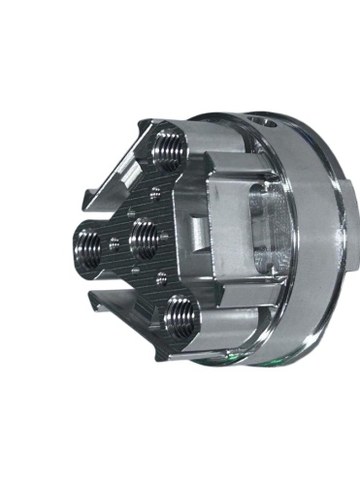
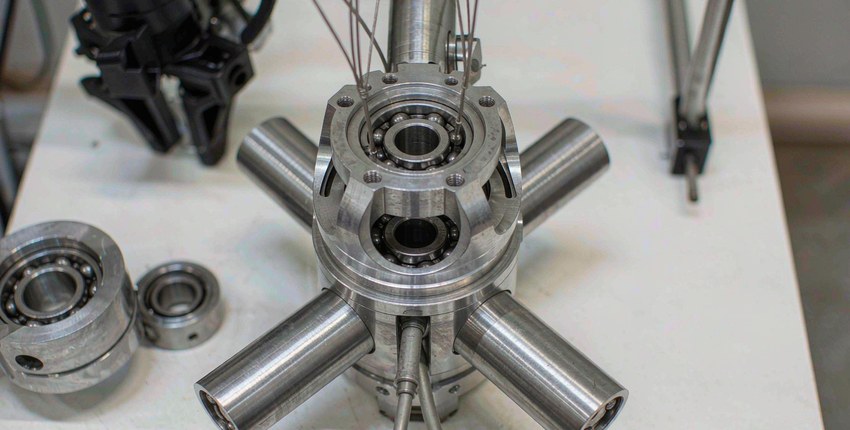
The precision aluminum rotary coupling transmits rotation, maintains alignment, and provides structural connection between rotating and stationary parts in automated machinery. It is widely used in sensor mounts, pneumatic valve seats, robot connector joints, coupling assemblies, and precision instrument housings.
The cylindrical base with multi-lobe structure, precisely machined threaded holes, and grooves allows secure fixing to sensors, pneumatic valves, and robot end-effectors. The mirror bright surface reduces friction during assembly and protects mating components from wear.
2. Aluminum Alloy Selection: 6061 vs 7075
KGL machines rotary couplings from aluminum 6061-T6 and 7075-T651, the two most widely specified grades for precision automation components. The choice depends on the application's strength, weight, and cost requirements.
| Property | Al 6061-T6 | Al 7075-T651 | Test Standard |
|---|---|---|---|
| Tensile Strength | 310 MPa | 572 MPa | ASTM B557 |
| Yield Strength | 276 MPa | 503 MPa | ASTM B557 |
| Elongation | 12% | 11% | ASTM B557 |
| Density | 2.70 g/cm3 | 2.81 g/cm3 | ASTM B311 |
| Brinell Hardness | 95 HB | 150 HB | ASTM E10 |
| Machinability | 190% (vs 2011) | 160% | ASTM E618 |
| Corrosion Resistance | Excellent | Good | ASTM G110 |
| Thermal Conductivity | 167 W/m-K | 130 W/m-K | ASTM E146 |
| Typical Application | Sensor mounts, housings | Robot joints, structural | - |
For most rotary coupling applications, 6061-T6 offers sufficient strength (310 MPa tensile) with better machinability and corrosion resistance. 7075-T651 is specified when the coupling serves a structural function in the robot assembly, requiring 572 MPa tensile strength. KGL's DFM team can recommend the optimal grade based on your load and environment conditions.
3. 5-Axis CNC Machining Strategy
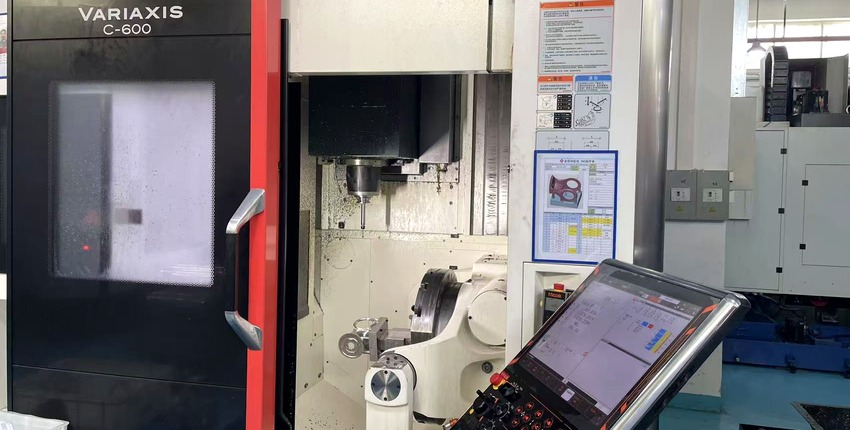
KGL machines rotary couplings on Mazak VARIAXIS C-600 5-axis machining centers, completing the cylindrical base, multi-lobe features, threaded holes, and grooves in a single setup. This approach eliminates accumulated errors from re-clamping and maintains concentricity across all features.
| Feature | Tolerance | Machining Method | Inspection |
|---|---|---|---|
| Cylindrical base OD | ±0.005 mm | 5-axis turning + milling | CMM |
| Critical rotating features | ±0.002 mm | 5-axis precision milling | Zeiss CMM 100% |
| Thread accuracy (M-class) | Class 2B (internal) | CNC thread milling | Thread gauges |
| Concentricity | 0.002 mm | Single-setup 5-axis | CMM |
| Surface finish (mirror) | Ra 0.4 um | High-gloss cutting | Profilometer |
| Groove width/depth | ±0.01 mm | 5-axis milling | CMM + vision |
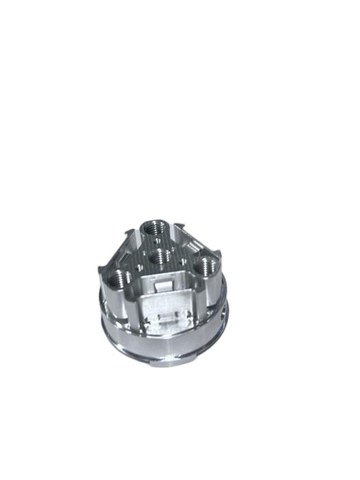
The 5-axis capability is critical for this component because the multi-lobe structure, angled threaded holes, and cylindrical base require access from multiple directions. The Mazak VARIAXIS C-600 provides simultaneous 5-axis movement, and feature-to-feature relationships are held within specification and confirmed by full CMM checks on every production release. Process detail: 5-axis CNC machining; robotics application context: International Federation of Robotics.
4. Surface Finishing and Quality Control
The mirror bright silver surface is achieved through high-gloss cutting with optimized cutting parameters, producing a uniform CNC machining texture with Ra 0.4 um. Optional polishing is available for applications requiring even higher gloss.
| Finishing Stage | Procedure | Result | Standard |
|---|---|---|---|
| High-gloss cutting | Optimized SFM + feed rate | Ra 0.4 um mirror | GB/T 1031-2009 |
| Deburring | Manual + ultrasonic | Burr-free edges | ISO 13715 |
| Optional anodizing | Type II sulfuric anodize | 25-50um oxide layer | MIL-A-8625 Type II |
| Optional polishing | Mechanical + buffing | Ra 0.2 um | Customer spec |
| Final inspection | 100% visual + CMM | Full traceability | ISO 9001:2015 |
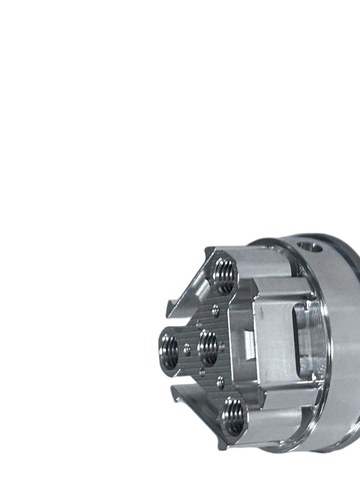
KGL provides complete inspection reports with every batch, verified on Zeiss and Hexagon CMMs (0.0015mm class uncertainty). The ISO 9001:2015, ISO 13485:2016, and AS9100D certifications ensure that the same quality system applies whether the coupling is destined for a medical device, aerospace assembly, or industrial robot.
5. Actionable Checklist for Designers
- Specify 6061-T6 for general automation couplings; reserve 7075-T651 for structural load-bearing joints to optimize cost-to-performance ratio.
- Design threaded holes on accessible faces to enable single-setup 5-axis machining, reducing cost by 20-35% versus multi-setup approaches.
- Specify concentricity relative to the primary rotating datum, not the mounting flange, to ensure functional accuracy.
- Request Type II anodizing (MIL-A-8625 Type II) for corrosion protection in humid environments; skip it for indoor dry applications to save cost.
- Avoid wall thickness below 0.8mm for aluminum to prevent deflection during machining and maintain tolerance integrity.
- Share your 3D model early for DFM review. KGL provides free 5-axis DFM feedback within 24 hours through the quote form.
6. FAQ
Can you machine the rotary coupling from both 6061 and 7075 aluminum?
Yes. We machine both grades per your strength, weight, and cost requirements. 6061-T6 offers 310 MPa tensile with better machinability; 7075-T651 provides 572 MPa for structural applications.
Can you complete the complex multi-lobe and threaded features in one setup?
Yes. Our Mazak VARIAXIS C-600 5-axis centers complete the cylindrical base, multi-lobe features, threaded holes, and grooves in a single clamping, holding concentricity to 0.002 mm with full CMM verification.
What surface treatments do you offer?
Standard parts are delivered with a mirror bright high-gloss surface (Ra 0.4um). Optional services include polishing (Ra 0.2um), Type II anodizing per MIL-A-8625, and powder coating.
What is the minimum order quantity and lead time?
No MOQ. Prototypes start from 1 piece with 5-7 working day lead time. Mass production runs 2-4 weeks depending on quantity.
How do you verify concentricity on the rotary coupling?
Concentricity is measured on Zeiss and Hexagon CMMs against the primary rotating datum, with results reported per batch. Critical rotating features receive 100% verification at 0.0015mm class measurement uncertainty.
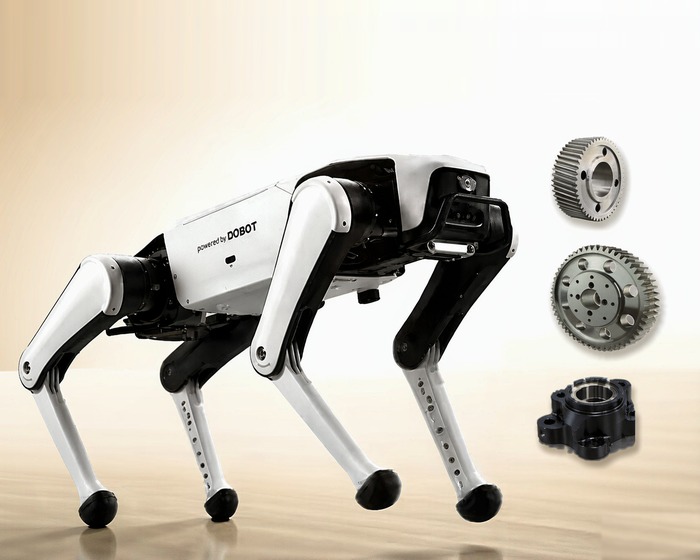
For more robot component work, see our robotics industry page or the 5-axis machining service page, or send your coupling model through the RFQ page.
Have a project in mind?
Send drawings to kgl@kglmfc.com or request a quote. We respond within 24 hours.
Request a Quote