Workholding Decides Your Tolerance Before the First Cut
Why the fixture, not the spindle, decides whether your tolerance arrives: how rigidity, clamp placement and soft jaws change runout, when a custom fixture pays for itself, and what we need on your drawing before the first cut.
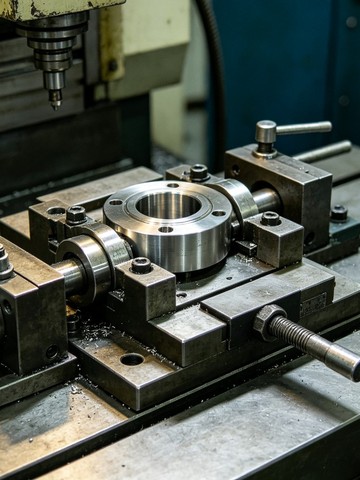
Every tolerance on your drawing is delivered through a chain that starts at the fixture, not the spindle. A machine can position to microns, but if the part shifts 20 microns under cutting force or prints a clamp mark into a sealing face, the accuracy never reaches the drawing. Choosing workholding is therefore the first machining decision, made before any speeds or feeds. This guide covers the vise, fixture and vacuum decision, what soft jaws are actually worth, and what we ask from your drawing so the clamp never fights the feature.
1. Why Does Rigidity Beat Speed?
Cutting force has to go somewhere. In a rigid setup it goes into the machine structure and leaves as chips and heat; in a loose setup it goes into the part as deflection, vibration and chatter, which show up as out of tolerance features and broken tools. The arithmetic is unforgiving: deflection grows with the cube of unsupported length, so a feature sticking out twice as far flexes eight times as much.
That is why experienced machinists spend setup time on support that looks fussy: a riser under an overhang, a toe clamp close to the cut, a parallel packed tight under a flange. The payback is cutting parameters. A rigid setup lets the tool take the depth the material allows; a flexy one forces baby cuts that triple cycle time and still do not hold the tolerance. In alloys that work harden, such as Inconel 718, that gap is the difference between a stable cut and a scrapped part.
2. Vise, Fixture Plate, or Vacuum: Which One?
Most milled parts live in vises with hard jaws for prismatic stock and machined soft jaws for shaped or delicate work. Fixture plates with step and toggle clamps take larger or irregular parts. Vacuum chucks hold thin, flat parts across their whole face with no point pressure, which is the difference between flat and bowled on a 1 mm plate.
The decision variables are geometry, batch size and the features that matter. A sealing face under a clamp bolt is a bad plan; a datum face under a vacuum field is a good one. On production volumes, the fixture earns its design cost back in load time and repeatability, often within the first hundred parts.
3. What Are Soft Jaws Actually Worth?
Soft jaws are aluminum or mild steel jaws bored or milled in place on the machine, so the nest they form is concentric and square to that spindle, not to some average of every spindle in the shop. Holding a turned part in a bored nest moves runout from tens of microns to the single digit range, and it does it in thirty minutes of setup.
The nest also spreads clamp force over the part profile instead of two lines, which is what keeps thin and finished surfaces unmarked. On parts with a critical feature concentric to the OD, boring the jaws in the same setup as the feature, or at least on the same machine, is one of those quiet disciplines that shows up directly in the inspection report.
| Method | Best for | Watch out for |
|---|---|---|
| Hard jaw vise | Prismatic stock, general milling | Marking finished faces; jaws not concentric to bore |
| Machined soft jaws | Shaped parts, concentricity critical | 30 minutes of setup, bored on machine |
| Fixture plate and clamps | Large or irregular parts | Clamp access near the cut |
| Vacuum chuck | Thin flat parts, finish passes | Needs clean seal area; limited side force |
| Trunnion, five axis | Multi face parts | Balance and mass through rotation |
| Dedicated fixture | Repeat orders, high volume | Design cost, amortized fast |
4. When Is a Custom Fixture Worth Designing?
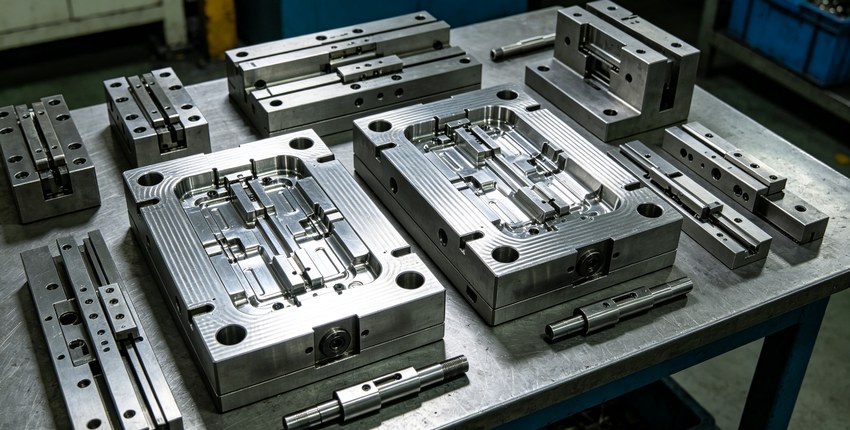
Two triggers: repeat orders and features that cannot be reached any other way. A part that returns quarterly deserves a dedicated fixture with locating pins, a nest and quick clamps, because every setup saved is margin and every repeatable location is a tolerance delivered. A part whose fifth face needs machining while four are hidden needs a fixture that presents it, or a five axis trunnion that makes the question disappear.
Our fixtures follow a simple discipline: locate on the datums the drawing names, clamp over solid material, leave the cutting zone open, and make wrong loading physically impossible. Zero point pallet systems move fixtures between machines without re indication, which matters on our mixed Mazak fleet where a job may start on a three axis VCN and finish on a five axis VARIAXIS.
5. What Changes on Four and Five Axis Machines?
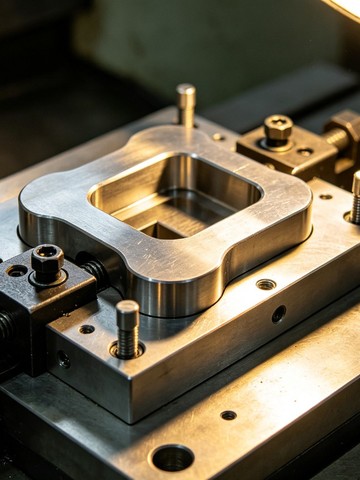
Rotary workholding changes the question from can I reach the feature to how many setups does the part need. A fourth axis with a collet or chuck runs radial features around a shaft in one loading. A trunnion on a five axis center presents five faces of a housing without a reclamp, and the fixture design goal shifts from access to balance: mass and geometry must stay stable through rotation.
Five axis also changes tool choice. With the part tilting to the tool, shorter tools reach features that once demanded long, fragile extended reach cutters, and shorter tools cut the tolerance better. The fixture and the process are designed together, which is why five axis jobs start with the fixture model, not the toolpath.
6. What Should Your Drawing Tell Us About Clamping?
Three things prevent most workholding surprises: which surfaces are datums, which surfaces are cosmetic or sealing, and whether any feature is off limits for contact. With that, the fixture can locate on datums, avoid finished faces, and clamp where it does no harm.
Without it, we ask, and the answer arrives late. If your part has thin walls, our thin wall guide covers the low force options in depth. And if a design change could add a clamp pad or a locating boss that costs minutes in machining and saves hours in fixturing, our DFM feedback will suggest it before the quote, not after the first article.
Frequently Asked Questions
Do custom fixtures cost extra?
Fixture design and build is included in the quote when the job needs it, and amortized on repeat orders rather than charged as a surprise line. For high volume work the fixture usually pays for itself within the first hundred parts in load time alone.
Can you hold concentricity under 0.01 mm?
Yes, routinely, by boring soft jaws in place and machining the related features in the same setup on the same spindle. Our CMM verification reports actual runout values feature by feature.
How do you hold parts with cosmetic or sealing surfaces?
We ask for the surfaces first. Locating moves to datums, clamping moves to non critical areas, and vacuum or nested supports carry thin and finished faces without contact marks.
What if my part cannot be clamped without hiding a feature?
Then it is likely a five axis part. A trunnion or angular head presents the hidden features without a reclamp, which is exactly the kind of answer our DFM feedback gives at quote stage.
This article is general engineering guidance, not a binding offer. Tolerances, cost and lead time depend on part geometry, material, quantity and the drawing package you release. Request a quotation for part specific terms. (c) 2026 KGL Machining & Electronics, Shenzhen.
Related Articles
More from the CNC Milling series.
Have a project in mind?
Send drawings to kgl@kglmfc.com or request a quote. We respond within 24 hours.
Request a Quote