Stainless Steel 304 vs 316 for Machined Parts: What Actually Changes on the Shop Floor
304 vs 316 stainless steel for CNC machined parts compared on corrosion resistance, machinability, surface finish, cost, and the 316 vs 316L decision, from a shop that cuts both every week.
Buyers ask us about 304 and 316 every week, and the question is almost never "which one is better." It is "which one stops my problem." A pump fitting that wept in chloride water, a food-grade manifold that failed a surface inspection, a marine sensor housing that rusted at the thread roots: each one pushes a customer from 304 to 316, or sometimes the other way when cost fights back. Here is how the two grades actually differ when they hit our lathes and mills, not just on a datasheet. For the broader family including 17-4PH, see our 304 / 316 / 17-4PH comparison.
1. What the extra molybdenum buys you
304 is an 18-8 steel: about 18 percent chromium and 8 percent nickel. 316 keeps that base and adds 2 to 3 percent molybdenum. That molybdenum is why 316 resists pitting in chloride environments, which is why the industry calls it marine grade. On paper the two steels look like close cousins. In service they split early: 304 handles most indoor, dry, or fresh-water duty at lower cost, while 316 earns its premium wherever salt, chlorides, or process chemicals show up. If your part lives near a coast, inside a food line washed with brine, or next to a chlorinated water loop, 316 usually pays for itself. Our stainless steel machining guide covers the full grade list.
2. How they cut differently
Both grades are austenitic, and both work harden fast. That is the first thing a new programmer learns the hard way: dwell or light passes let the surface harden, and the next insert edge chips against it. Between the two, 316 is the gummier one. The molybdenum and slightly higher nickel content make chips tougher and stringier, so we run 316 roughly 10 percent slower on surface speed and take deeper, more constant cuts to stay under the work-hardened layer.
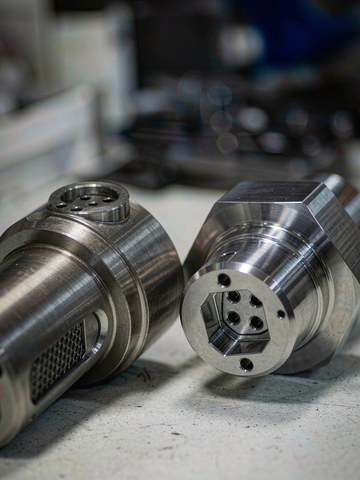
In practice on our floor: a 304 fitting turns at a carbide-friendly pace with good chip control and finishes around Ra 0.8 um without drama. The same geometry in 316 asks for sharper edges, steadier feed, and better coolant, or the finish drifts toward Ra 1.6. Neither is difficult by CNC standards. Both sit well inside our standard ±0.005 mm tolerance on machined features. The difference shows up in cycle time and tool life, which is why honest quotations price the two grades apart.
3. 316 vs 316L: the letter changes the decision
The L stands for low carbon: 316L holds carbon at or below 0.03 percent, against roughly 0.08 percent max for standard 316. Why does carbon matter? In welded assemblies, carbon combines with chromium at grain boundaries and leaves those zones short of corrosion protection. That is sensitization, and it shows up as rust lines beside welds months later. So the rule is simple:
| Situation | Pick |
|---|---|
| Machined part, no welding after machining | 316, lower cost |
| Welded assembly, thick sections | 316L |
| Welded plus extra corrosion duty | 316L |
| Very high strength needed instead | Consider 17-4PH instead of both |
One caution from quoting experience: some buyers specify 316L for parts we never weld, then pay a material premium for nothing. If your drawings come to us before the grade is frozen, we will flag it. Sometimes 316 is the smarter buy even when 316L is the habit.
4. Cost, availability, and the honest trade
316 bar usually runs 10 to 20 percent above 304 in small lot sizes, and the gap widens when nickel prices move. Both are stocked grades for us, so lead time rarely differs. What differs is scrap value and cycle time, and both are visible in the quote rather than buried. For a fitting, the material premium is a few dollars. For a sealed corrosion failure shipped overseas, the premium is nothing. We put that arithmetic in front of customers every week, and we keep 177 customer records in our CRM that let us match grades to the environments their parts actually serve.
5. How we hold tolerance on both grades
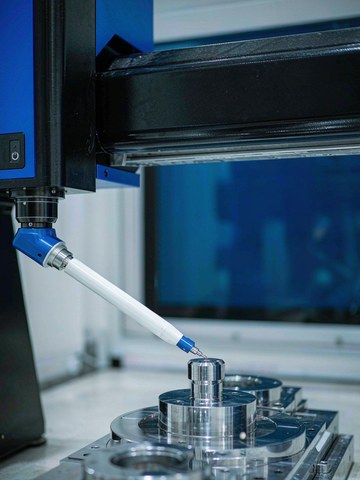
Work hardening punishes repeated re-clamping, so we cut thread, seal groove, and locating features in one setup on Swiss-type or turn-mill centers where the drawing allows. Standard tolerance on machined features is plus or minus 0.005 mm across both grades, with Ra 0.4 to 0.8 um typical on sealing surfaces. Every lot is verified with thread gauges, a vision measuring system, and surface roughness testing, and material certificates travel with the shipment under our ISO 9001:2015 system.
6. FAQ
Can I machine 304 and 316 with the same tooling?
Usually yes. Coated carbide works for both. For 316 we use sharper edge preparations and slightly reduced surface speed to control the tougher chips and protect tool life.
Which grade is food safe?
Both are common in food equipment. 316 is preferred where cleaning uses chlorinated or acidic agents, because it resists pitting that would trap residue on 304.
Is 316 magnetic?
Cold working can make both grades weakly magnetic at machined edges. It is not a defect and does not indicate the wrong alloy; chemistry certificates confirm the grade.
Do you supply both grades with certificates?
Yes. Material certificates accompany every order, and first-article inspection reports are available before batch production.
If you are weighing 304 against 316 on a live part, send the drawing and the service environment to kgl@kglmfc.com or request a quote on our RFQ page. We will confirm the grade, flag any 316L habit that costs you money, and return a quote within 24 hours.
Have a project in mind?
Send drawings to kgl@kglmfc.com or request a quote. We respond within 24 hours.
Request a Quote