How Batch Size Changes CNC Unit Price: A Buyer's Curve
Unit price falls as batch size grows, but not smoothly. Where the curve drops, where it flattens, what pushes it back up, and how to use a price break table in an RFQ.
Key Takeaways
- The first pieces in any batch absorb programming, fixture work and first-article inspection, which is why a single prototype can land three times the per-piece price of a volume run, and why most of the saving is already captured by fifty pieces.
- Most of the savings happen between 1 and 50 pieces; from 50 to 500 the curve still falls but each extra piece buys less.
- Material utilization, tool wear amortization and nesting density keep improving with quantity, while per-piece machine time approaches the floor rate.
- Inventory risk, revision risk and cash-flow drag push the effective cost back up when a batch grows past what the program actually needs.
- Quoting two or three batch sizes side by side turns the curve into a decision table, and stating whether a batch is for validation or production can shift the optimum by 50 percent or more.
Unit price falls as batch size grows, but the curve is not smooth. The first few parts absorb programming, setup, fixture, and first-article inspection. Once those fixed costs are spread across more pieces, the line drops sharply. Then it flattens, because raw material and machine hours become the main drivers. In one of our own repeat programs the same bracket fell from 95 dollars at one piece to 42 dollars at fifty pieces and 29 dollars at two hundred pieces, a 69 percent drop from prototype to monthly run. The shape of that curve matters for buyers deciding when to prototype, when to pilot, and when to commit to volume.
This article walks the curve from the left side to the right: why the first part costs the most, where the price flattens, how material and tooling behave as quantity grows, and when a larger batch stops saving money. It is the quantity companion to our piece on what drives CNC machining cost, and it connects naturally to moving from prototype to production.
1. Why does the first part always cost the most?
Before metal is cut, a batch has already spent money on engineering time. Programming the toolpaths, designing or selecting fixtures, proving the sequence, and running first-article inspection are all fixed costs. Whether the batch is 1 piece or 1,000 pieces, that setup block is roughly the same.
For a typical aluminum bracket with 12 milled features and 4 tapped holes, programming and fixture planning can take 2 to 4 hours. First-article inspection on a CMM adds another 30 to 60 minutes. Spread across one piece, that work dominates the invoice. Spread across 100 pieces, it becomes a small line item. This is the single biggest reason the buyer's curve is steep at the left side.
2. Where does the unit-price curve flatten?
After setup costs are diluted, the slope depends on machine efficiency and material utilization. We usually see four zones on the curve:
- 1-piece to 10-piece prototypes: Programming and first-article inspection still drive the price. The unit price is high and relatively flat across this range.
- 10-piece to 50-piece pilot runs: Setup is now split, but each part still needs individual handling and inspection. The curve drops quickly.
- 50-piece to 200-piece small batches: Operators can run lights-out or semi-automated cycles. Tool changes are grouped, and inspection moves to sampling.
- 200-piece to 500-piece production runs: Material is ordered in economical lots, fixtures are amortized, and machine hours per piece approach the floor rate.
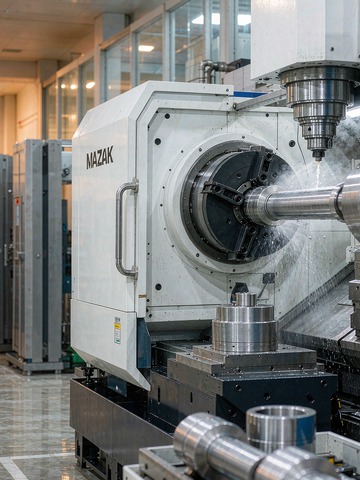
On our shop floor, mill-turn centers are especially useful in the middle zones. A shaft that needs turning, milling, and cross-drilling can stay in one chuck for the whole batch, so the per-piece handling time drops by 30 percent or more compared with moving the part between a lathe and a mill. Fewer setups also mean fewer chances for a datum shift between operations, which is worth as much as the time saving.
3. How do material, tooling, and nesting change the curve?
Raw material is rarely a fixed cost per piece. A buyer ordering 10 pieces of 6061-T6 aluminum plate pays for off-the-shelf stock sizes and higher scrap. A buyer ordering 500 pieces can nest parts from larger sheets or bars, reducing offcut waste by 10 to 25 percent.
Tooling and wear follow the same pattern. A solid carbide end mill may cost 80 dollars and machine 200 pockets before it dulls. On one piece, the tool cost is 80 dollars. On 200 pieces, it is 0.40 dollars per pocket. Coolant, electricity, and tool presetting also spread more thinly as the batch grows.
For flat parts cut from sheet or plate, nesting density is often the hidden driver. Programmers pack more parts into each blank, and the saving arrives in steps rather than smoothly. At low volumes, nesting savings are small because the blank is already a standard size. At 200 or more pieces, custom bar stock or larger plate can drop material cost per piece by 15 percent or more.
4. What is the real difference between 1, 10, and 100 pieces?
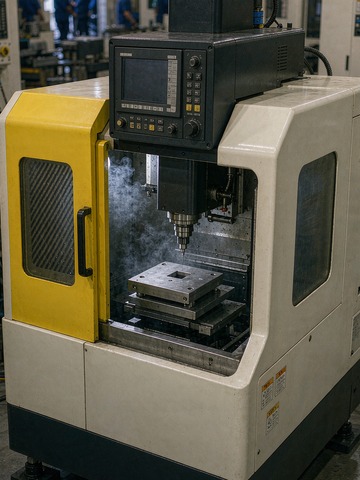
The table below shows a simplified example for a 6061-T6 aluminum bracket with one setup on a 3-axis VMC. Prices are illustrative and shift with geometry, tolerance, and finish.
| Batch size | Setup + programming per piece | Material + machine per piece | Inspection per piece | Indicative unit price index |
|---|---|---|---|---|
| 1 | 100% | 15% | 100% | 100 (baseline) |
| 10 | 10% | 18% | 20% | 48 |
| 50 | 2% | 20% | 8% | 30 |
| 200 | 0.5% | 21% | 3% | 24 |
| 500 | 0.2% | 22% | 1% | 22 |
The index shows that most of the savings happen between 1 and 50 pieces. Moving from 50 to 500 still helps, but the incremental gain shrinks. This is why many buyers choose a 50-piece pilot run before committing to a larger order: it buys real process proof at a price that is already close to the floor.
5. When does a larger batch stop saving money?
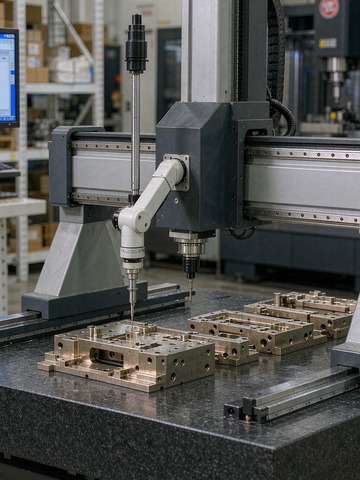
A larger batch is not always the right answer. Three forces push the curve back up if the batch is too large for the program:
- Inventory risk: Capital is tied up, demand may change, and parts can sit on a shelf.
- Revision risk: If the design changes, a 1,000-piece batch becomes expensive scrap.
- Cash-flow drag: Paying upfront for material and a long production block may strain a small team.
We quote multiple batch sizes for the same drawing when a buyer is unsure. A typical set is 10, 50, and 200 pieces. The buyer can see exactly where the next price break sits and decide whether the inventory risk is worth it. Every batch ships with CMM sampling reports from our 40+ inspection instruments, so quality does not change with quantity.
6. How should buyers use the curve in an RFQ?
The curve only works if the supplier has the full picture. When you send an RFQ for CNC machining, include the 3D STEP file, a 2D drawing with tolerances, surface finish, material callouts, and at least two target batch sizes. We return a 24-hour quote with a price break table so the curve is visible before an order is placed.
Also state whether the first batch is for validation or production. A validation batch often needs 100 percent inspection and detailed first-article documentation, which adds cost. A production batch can move to sampling plans once the process is locked. That single piece of information can shift the optimal batch size by 50 percent or more.
From our shop floor: a real batch price curve
One program from 2025 shows the curve better than any index. A European robotics OEM sent us a 6061-T6 robotic arm mounting bracket, 120 x 80 x 12 mm, with 4 x Ø6.5 mm through holes, 2 x M5 threaded holes and a clear anodized finish. The part is simple enough to quote from a drawing, which makes the batch effect easy to isolate.
- 1 piece prototype, 95 dollars. The price carried 3 hours of programming and a full CMM first-article inspection. Nothing was optimized yet, because one part does not justify fixture work.
- 50 piece pilot, 42 dollars per piece. The program was frozen once the first article passed. Changeover time fell from 45 minutes to 8 minutes, and the fixture cost started to amortize.
- 200 pieces per month, 29 dollars per piece. Bulk bar stock cut material cost by 12 percent, and a 4-up fixture on a Mazak VARIAXIS C-600 lifted output from 12 to 28 pieces per shift.
From prototype to monthly run the unit cost fell 70.9 percent. Lead time moved from 10 days on the single piece to 5 days of production plus 3 days of shipping at volume. The design never changed; only the quantity did.
Case study: why 200 pieces beat 100 for a repeat buyer
The same customer has bought this bracket since 2023 and authorized us to publish the numbers without their name. Their first purchase order was 100 pieces per month. Our DFM review pointed to 200 pieces instead. Here is the batch evolution that followed.
| Stage | Batch size | Unit price (USD) | Main cost driver | Lead time |
|---|---|---|---|---|
| Prototype | 1 pc | $95 | 3 hours programming, first-article CMM, trial setup | 10 days |
| Pilot run | 50 pcs | $42 | Program frozen, changeover 45 min to 8 min, fixture amortized | 8 days |
| Monthly run | 200 pcs | $29 | Bulk bar stock (-12%), 4-up fixture on a Mazak VARIAXIS C-600, output 28 pcs per shift against 12 | 5 days production + 3 days shipping |
Why we recommended 200 pieces over 100. Three numbers drove the decision.
- Fixture amortization. The custom 4-up vacuum fixture costs about 12 dollars per piece at 100 pieces and about 6 dollars per piece at 200.
- Material yield. 6061-T6 bar stock comes in 6 meter lengths, and each length yields 48 blanks. Two lengths for 100 pieces leave 4 blanks as scrap. Four lengths for 200 pieces reach 96.2 percent material utilization.
- Machine scheduling. 100 pieces need 2.5 shifts with a setup change in the middle of the run, costing 45 minutes of changeover plus 15 minutes of first-piece re-qualification. That is one hour of non-value time. 200 pieces run 4 shifts without interruption, and OEE rises from 68 percent to 84 percent.
How we handled the inventory concern. A 200 piece batch only saves money if it does not become dead stock, so the plan carried three controls.
- Split delivery: 100 pieces shipped in week 2 and 100 in week 4, keeping the customer work-in-progress flat.
- Consignment stock: we hold two weeks of aluminum bar under consignment, and the customer pays only on shipment.
- Change control: any drawing revision inside the 200 piece batch runs under our AS9100D engineering change procedure. Unchanged parts ship first, and revised parts are re-programmed with a 24-hour turnaround.
Results after six months. The customer saved 13 dollars per piece, 31 percent below the original 100 piece price, which works out to about 31,200 dollars per year across 200 pieces per month. On our side, OEE held at 84 percent, first-pass yield reached 99.2 percent, and no shipment was late. The customer inventory turns moved from 6 to 10 per year.
The lesson is that batch size is a manufacturing engineering decision before it is a purchasing decision. The right quantity lines up material yield, fixture utilization and machine OEE. When a buyer opens the DFM conversation before the purchase order, both sides capture the difference.
Frequently Asked Questions
Does batch size affect machining tolerance?
No. Tolerance is set by geometry, material, machine capability, and inspection method, not by how many parts are on the order. Our standard tolerance band is ±0.005 mm for milled features, and tighter bands are quoted only when full CMM inspection is specified.
What is the minimum order quantity?
There is no MOQ for prototypes. We routinely machine 1-piece samples and first articles. For production, we quote the batch size that makes sense for your demand, whether that is 10, 200, or 2,000 pieces.
How fast can I get a quote for different batch sizes?
For complete 2D and 3D files, we return a quote within 24 hours. The quote includes a price-break table across the batch sizes you request, usually 1, 10, 50, 200, and 500 pieces.
Can you quote three batch sizes at once?
Yes, and we encourage it. Seeing the curve helps buyers avoid over-ordering just to chase a price break, or under-ordering and paying too much per piece.
Does a larger batch always mean a lower unit price?
Usually, but not always. Extremely large batches can introduce inventory holding, obsolescence, and cash-flow costs that outweigh the machining savings. The right batch size sits where the machining cost curve meets your supply-chain risk curve.
This article is general engineering guidance, not a binding manufacturing guarantee. Actual unit prices depend on part geometry, material, tolerance, surface finish, and inspection requirements. Request a formal quotation for your specific project. (c) 2026 KGL. All rights reserved.
Related Articles
More from the Design for Manufacturing series.
Have a project in mind?
Send drawings to kgl@kglmfc.com or request a quote. We respond within 24 hours.
Request a Quote