What Drives CNC Machining Cost? 7 Factors You Control
Seven buyer-side factors that decide CNC machining cost: tolerance callouts, material choice, setup count, quantity, finishing, documentation load, and drawing stability.
Send the same drawing to five CNC machining shops and you will get five different prices, sometimes far apart. Some of that spread is honest variation in overhead and machine parks. Most of it, in our experience, comes from decisions made before the RFQ was ever written: which callouts are tight, which material was chosen, how many setups the geometry forces, what the finishing schedule says. The good news for buyers is that these levers sit on your side of the table. Here are the seven that move a machining quote the most, from the shop that has to price them.
1. How tight are the tolerance callouts?
Tolerances cost money twice. A tight band lengthens the cycle: lighter cuts, more careful tool paths, more in-process checks. It also lowers first-pass yield, because every part that measures a few microns out becomes scrap or rework. Both costs land in the unit price.
The fix is not to avoid tight tolerances. It is to put them only where the function needs them. Our standard band on milled and turned features is ±0.005 mm, with ±0.002 mm available on specific five-axis features under full CMM verification. When a drawing arrives with a tight band on every feature, we ask which features the assembly actually locates on. A housing for a robotics customer came in with one blanket tight callout across all faces; the revision kept it on the two bearing bores and relaxed the rest, and the part got cheaper and more repeatable at the same time. That conversation is free at quote stage and expensive after production starts.
If you are not sure what a band costs, ask the supplier to price the drawing twice, once as drawn and once with the tight features relaxed to the functional minimum. The difference is your tolerance budget, stated in money. Our tolerance guide covers how to make that call feature by feature.
2. Which material, and which temper?
Material moves the price three ways: the stock itself, how fast it cuts, and how available it is. 6061-T6 is the workhorse of aluminium machining for a reason. Move to 7075-T651 and stock costs more; move to 316L stainless or titanium and cutting time climbs steeply. None of that is a reason to avoid a material, but it is a reason to make the choice deliberately instead of by habit.
Temper and stock form matter more than buyers expect. A part designed around a standard plate thickness can be cut from shelf stock; the same part drawn 3 mm thicker may force a special order and weeks of lead time. We keep common aerospace grades on the floor, including 2219-T851, so the schedule never waits on metal. Our aluminium overview compares the grades we machine most. If your part does not actually need the exotic grade, saying so at the drawing stage is the easiest cost saving available.
3. How many setups does the part really need?
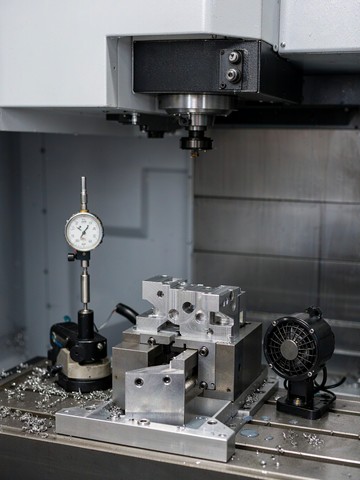
Every additional setup adds handling, a new datum, and a new chance for accumulated error. A part that flips across three operations on a three-axis mill pays for three fixturings and three alignment cycles. The same part, redesigned around one five-axis cycle, is clamped once and finished with all features in a single coordinate system.
That is why a five-axis quote is sometimes lower than a three-axis quote for the same part, even at a higher machine rate. Fewer setups also tighten quality, because the features that matter to each other get machined in the same holding. When we see multi-setup geometry, we price both routes and say which one we would run. Our five-axis machining page shows the machine park behind that option: Mazak VARIAXIS C-600 centers among 11 five-axis machines on a floor of 100+ CNC machines.
4. What quantity are you actually buying?
A machining quote has two parts: a one-time pool and a per-part cost. Programming, fixturing, first article inspection, and the initial setup all sit in the pool. On ten parts the pool dominates. On a thousand parts it fades to a small line. This is why quantity honesty matters: a quote built for 500 pieces falls apart at 50, and the supplier discovers that after the PO.
Quote quantity bands, not a single number. When a buyer gives us realistic bands, we can pick the right process for each band and show where the breakpoints sit. Sometimes the honest answer is that a batch of 40 does not justify dedicated fixtures, and the unit price reflects that instead of hiding it. Our prototype to production guide explains how the two price structures differ and why they should be quoted separately.
5. What does the finishing and secondary operations schedule look like?
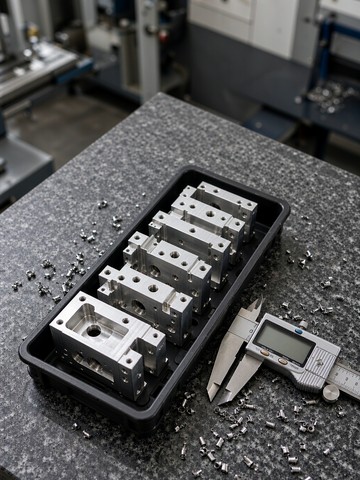
Machining is often the smallest line on the quote. Finishing and secondary operations add handling, transport, and queues: anodize with masking, passivation, engraving, assembly of inserts, custom packaging. Each trip off the machine adds lead time as well as cost.
Two habits keep this line honest. First, specify the finish where it is needed and say "none" where it is not; anodizing a face that bolts against another anodized face can hurt the fit as well as the budget. Second, define cosmetic requirements on cosmetic faces only. A scratch-free callout across every surface turns a functional part into a decorative one, and the price follows. Our anodizing guide breaks down the common finish types and what each one is for.
6. How much documentation does the order carry?
Evidence costs labor, and it should. A first article inspection with a ballooned drawing, per-lot material certificates, dimensional reports, and full traceability each take real hours in the lab and in the office. On aerospace and medical work that documentation is part of the product, and we build it into the plan under our AS9100D and ISO 13485 scopes rather than treating it as overhead to hide.
The buyer's lever is to order only the documentation the program needs, and to say so at RFQ. A prototype for design validation may need a dimensional report and nothing more. A production lot for a flight program needs the full file. Pricing both the same way serves nobody. Our inspection page lists what ships by default and what is available on request.
7. How stable is the drawing?
The most expensive change in machining is a revision that arrives after fixturing exists. The fixture is cut around revision A; revision B moves a feature; the fixture is reworked or rebuilt, and every unit price assumption with it. Most of this cost is avoidable with one discipline: freeze the drawing after prototype validation, fold the lessons into a released revision, and let production start from a stable definition.
Change is sometimes necessary, and a good supplier will price a revision transparently instead of absorbing it quietly. But a program that revises weekly pays for that habit in every quote line. If you want to go one level deeper on the design side, our companion piece on designing for machining cost reduction covers the geometry decisions that keep parts cheap to cut.
Taken together, these seven factors explain most quotes that surprise people: a tolerance that was tighter than the function, a grade that was dearer than the duty, a setup count the geometry forced, a quantity nobody stated, a finish applied everywhere, documentation nobody reads, or a drawing that would not sit still. None of them requires a cheaper shop to fix. They require a conversation at quote stage, which is why we answer RFQs with questions when the drawing raises one. Send yours through the RFQ page and you will have a priced, reasoned answer within 24 hours.
Frequently Asked Questions
Does a tighter tolerance always cost more?
It costs more when the band goes beyond what the process holds by default, because cycle time rises and first-pass yield falls. Within the shop's standard band, the cost impact is small. The expense starts when every feature carries the tightest band on the drawing whether it needs it or not.
Why do quotes for the same drawing differ so much between suppliers?
Different shops read different risks into the same part: one assumes dedicated fixtures, another assumes general-purpose ones; one prices the tight features, another skips them; one includes full documentation, another quotes bare parts. Comparing quotes line by line usually shows the assumptions, not just the prices.
Can I reduce machining cost without changing the design?
Often, yes. State realistic quantity bands, relax non-functional finish requirements, confirm which certificates the program actually needs, and lock the drawing revision. None of these touches geometry, and together they routinely move a quote.
Do you charge for design feedback or DFM review?
No. Reviewing the drawing for manufacturability is part of quoting, and it is where most cost is saved: a question asked at quote stage is free, while the same question after production starts costs a fixture. We answer RFQs with questions when the drawing raises one.
What is the fastest way to get an accurate CNC machining quote?
Send a complete 2D drawing with tolerances and a 3D model, state the material or accept a recommendation, give realistic quantity bands, list the finishing and the documentation the order carries, and mention any certification scope. With that in hand we return a reasoned quote within 24 hours.
This article is general engineering guidance, not a binding manufacturing guarantee. Tolerances, lead times, and pricing are confirmed per part based on drawings, materials, quantities, and process review. Request a formal quotation for part-specific terms. (c) 2026 KGL. All rights reserved.
Related Articles
More from the Design for Manufacturing series.
Have a project in mind?
Send drawings to kgl@kglmfc.com or request a quote. We respond within 24 hours.
Request a Quote