CNC Machining or Sheet Metal? The Crossover Zone Decides
Where the boundary between CNC machining and sheet metal actually sits, what the cost crossover looks like at real batch sizes, how bend tolerance compares with machined tolerance, and when the right answer is a hybrid part.
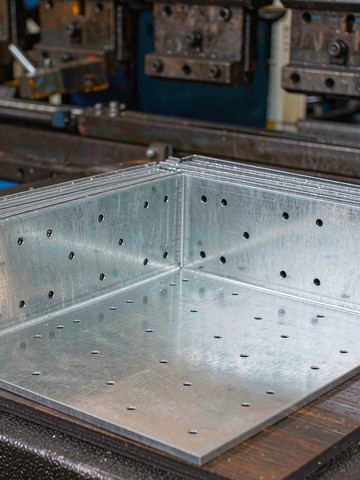
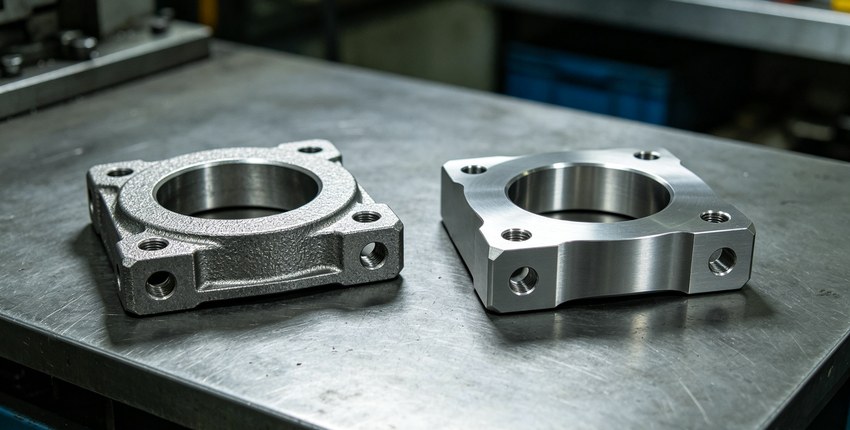
Most parts do not live clearly in machining or sheet metal. They live in a crossover zone where both processes can make something that works, and the choice is decided by geometry, batch size and which tolerance actually matters. Pick wrong and you either pay machining prices for a part a press brake could make, or inherit bend tolerance on a feature that needed machined precision. This guide maps the boundary, prices the crossover, and shows where the two processes combine on one part.
1. Where Is the Boundary Between the Two Processes?
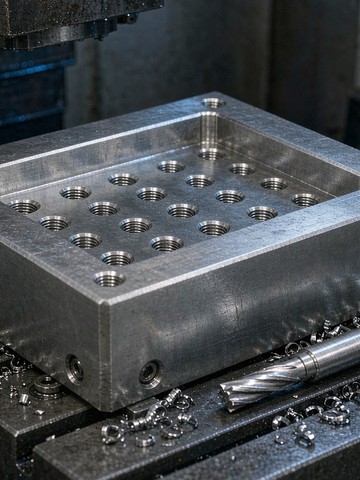
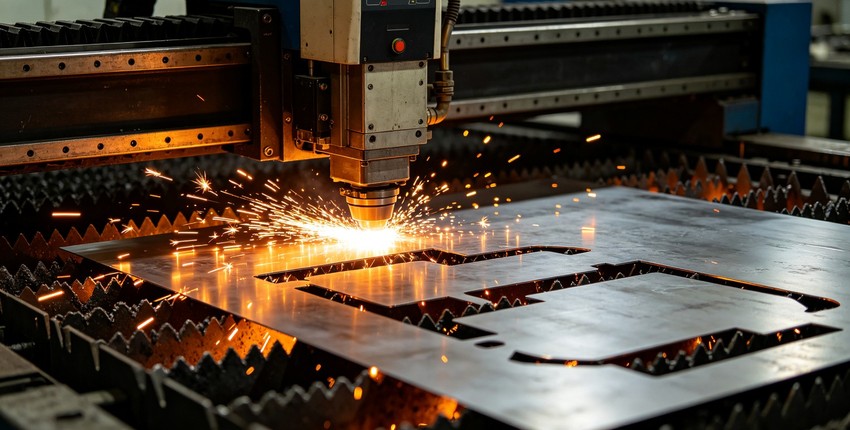
Sheet metal starts as flat stock, typically 0.5 to 6 mm, and earns its keep by folding: brackets, enclosures, panels, anything whose third dimension is a bend. Machining starts as solid billet and earns its keep by removing material in three dimensions: pockets, precise bores, sealing faces, features that folding cannot create.
The boundary features are easy to spot. If the part needs a flat pattern, it is sheet metal. If it needs a feature on a non flat face, or a tolerance tighter than about 0.1 mm, or threads into thick stock, it is machining. Between those poles lies the crossover zone where the honest answer depends on quantity and cost math rather than geometry.
2. What Does the Cost Crossover Actually Look Like?
Sheet metal has low setup and simple tooling: a program and a bend setup, so small batches are cheap but each bend adds variance. Machining has a higher setup floor per configuration but scales predictably, and no tooling exists to amortize or preserve.
As a rule of thumb, one off prototypes of simple brackets favor sheet metal, a few hundred folded parts still favor it, and the crossover to machining arrives when the design needs machined features on a folded part, when thickness exceeds the brake range, or when batch complexity means the sheet version needs welding and straightening that erase its price advantage. Our batch size pricing guide covers the general curve that governs both processes. The same logic drives our comparisons of CNC machining vs injection molding and CNC machining vs 3D printing for metal parts.
3. How Do Tolerances and Repeatability Compare?
Sheet metal tolerances are dominated by the bend: angular variation and flange length variation are inherent to the process, typically around plus or minus 0.2 to 0.5 mm on practical parts, with springback compensated by tooling and experience. Machining holds plus or minus 0.005 mm as our standard, tighter feature by feature.
That gap decides architecture more often than cost does. A precision face that mounts a sensor or a bearing cannot be a bent flange; it is either machined from solid or folded and then machined on the critical face. Repeatability matters too: machined features repeat batch to batch from the program, while bends repeat within the capability of the setup and the operator's compensation.
4. Where Do the Two Processes Combine on One Part?
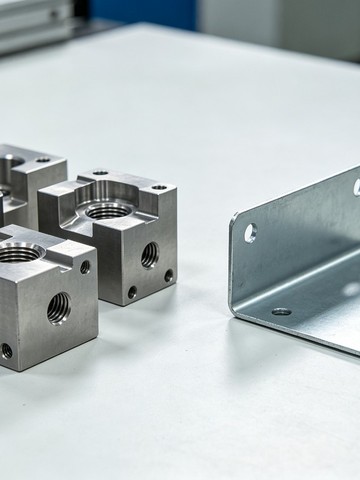
The strongest parts in the crossover zone are hybrids: a folded chassis that carries structure and weight, with machined pads or bosses bonded, welded or fastened where precision interfaces live. Electronics and robotics assemblies use this constantly, because folded structure is cheap stiffness and machined interfaces are where accuracy pays.
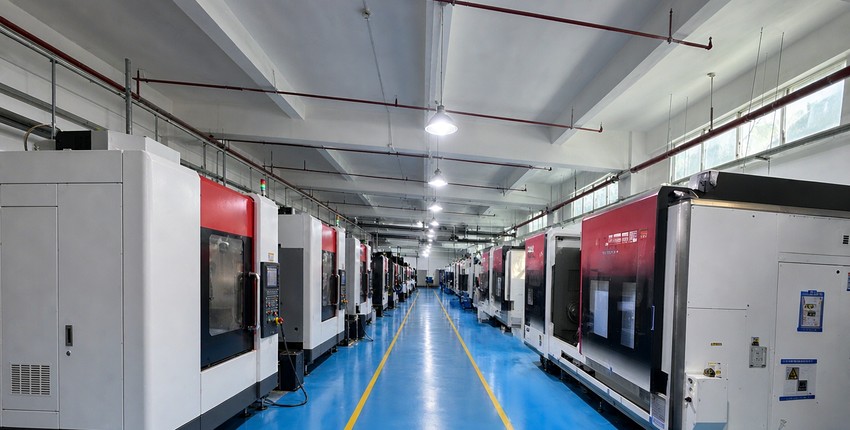
Our shop runs both under one roof: sheet metal fabrication for the folded structure, CNC machining for the precision interfaces, which removes the coordination cost of managing two suppliers for one assembly. The hybrid decision is usually made at DFM stage, where a boss can become a folded tab or a tab can become a machined pad depending on which tolerance is real.
5. How Do Lead Times and Design Changes Compare?
Sheet metal responds fast to change: edit the flat pattern, cut and fold again, no tooling to revise unless forms change. Machining changes cost a program edit and setup change, also tooling free, but material removal means a design that grows may need a bigger billet and a repriced part.
For prototyping, both beat molding and casting on iteration speed. The deciding factor is usually which process lets the design converge: folded designs iterate cheaply on flange geometry, machined designs iterate cheaply on pocket and feature geometry. Our prototype to production guide covers what changes when volume arrives, whichever process wins.
| Factor | CNC machining | Sheet metal |
|---|---|---|
| Starting form | Solid billet | Flat stock 0.5 to 6 mm |
| Best geometry | Pockets, bores, 3D features | Folds, flanges, panels |
| Standard tolerance | Plus or minus 0.005 mm | About 0.2 to 0.5 mm on bends |
| Tooling | None | Simple tooling, bend setups |
| Batch sweet spot | All sizes; strong at low volume | Small to large folded runs |
| Hybrid use | Precision interfaces on folded chassis | Structure around machined pads |
6. Which Process Should Your Part Use? A Short Checklist
Answer five questions: Does the part fold from flat without machining features on non flat faces? Is any tolerance tighter than 0.1 mm? Does any face seal or mount a precision component? What is the real batch size? Does the assembly combine structure and precision interfaces?
Two or more yes answers on the precision side point to machining or a hybrid. All structure and loose tolerances point to sheet metal. Send the drawing either way: quoting both routes on crossover parts is something we do routinely, and the quote shows the honest price of each rather than the price of the process we happen to prefer selling.
Frequently Asked Questions
Can you make a part that is half folded and half machined?
Yes, and it is often the right answer. Folded structure carries load cheaply; machined pads carry the precision interfaces. Because we run both processes in house, the assembly is quoted and built as one order.
At what tolerance does sheet metal stop working?
Around 0.1 mm is the practical floor for folded features. Anything tighter, especially across a bend, should be machined or moved to a machined pad on the folded part.
Which process is cheaper for 100 parts?
For a simple bracket, sheet metal usually wins at 100 parts. The crossover moves when the design needs machined features, thickness beyond the brake range, or welding that erases the price advantage. Send the drawing and we will price both.
Can you hold sheet metal bend angles tighter than standard?
We compensate springback per part and batch, but bend angle is inherently a looser tolerance than machined features. Where a bend must land precisely, we design a machined interface instead and say so at quote stage.
This article is general engineering guidance, not a binding offer. Tolerances, cost and lead time depend on part geometry, material, quantity and the drawing package you release. Request a quotation for part specific terms. (c) 2026 KGL Machining & Electronics, Shenzhen.
Related Articles
More from the Design for Manufacturing series.
Have a project in mind?
Send drawings to kgl@kglmfc.com or request a quote. We respond within 24 hours.
Request a Quote