CNC Machining or Investment Casting? A Volume Based Break Even
Wax die cost, casting tolerance and porosity risk weighed against machining from solid, with the annual volume where each route becomes cheaper
The argument between machining from solid and investment casting is usually settled by a single number: annual volume. That number is real, but it is not the only one. A part that is cheap as a casting at 5,000 pieces a year can still be the more expensive decision if the sealing face has to be machined anyway, if the wall is too thin for the wax to fill, or if porosity turns up at the last operation on a tenth of the batch.
This guide lays out both routes from the inside: how a wax pattern becomes a steel part, what each route costs and how the cost behaves as volume changes, what casting tolerance actually holds, and how a buyer can run a comparison that reflects the total route rather than the piece price. It ends with the hybrid option, which is where most production parts in this sector actually land.
At a glance
- Casting buys shape. Machining buys fits. Almost every production part uses both, and the question is how much of each.
- Wax tooling is a fixed cost, so the casting route improves with volume while the machining route barely changes.
- Investment casting tolerances sit in the tenths of a millimetre on small features and around a millimetre on a 100 mm dimension, depending on grade. Any feature at plus or minus 0.05 mm will be machined.
- Porosity is a yield problem. A pore that opens during the final bore can scrap a part that is already 90 percent complete.
1. How Does Each Route Build a Part?
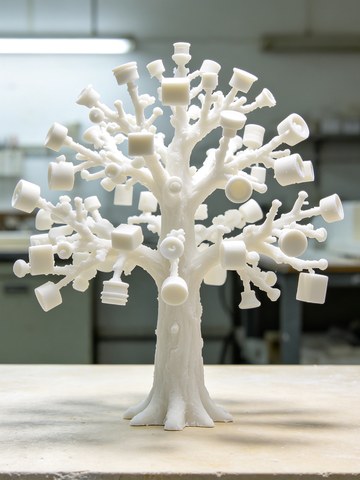
Investment casting starts with a metal die, usually aluminum, machined to the shape of the wax pattern including the shrinkage allowance. Wax is injected into that die, the patterns are assembled onto a runner tree, and the tree is dipped repeatedly in ceramic slurry and stucco until a shell of five to seven layers has built up. The shell is dried, the wax is melted out in an autoclave at around 6 to 8 bar, and the resulting cavity is fired. Molten metal is poured in, the shell is broken away, and the castings are cut from the tree, ground and inspected. For steel, the pour happens around 1,550 to 1,600 degrees Celsius, and the whole cycle runs several weeks because the shell build and dry stages cannot be compressed without risking a defect.
CNC machining starts from bar, plate or a near net blank. The stock is sawed, faced, roughed, finished, inspected, and in most cases shipped in one to three weeks once the program and fixtures exist. There is no tooling to pay for beyond fixtures and programming, which is why CNC machining is competitive at low volume, why a design change is cheap before the first cut and expensive after the wax die exists, and why prototyping almost always starts from solid.
The two routes therefore trade a fixed cost against a variable cost. Casting pays up front for tooling and pays less per piece at volume. Machining pays almost nothing up front and pays more per piece forever, because every part starts as material that has to be removed.
| Stage | Investment casting | CNC from solid |
|---|---|---|
| Tooling | Wax die, typically 1,500 to 8,000 USD depending on size and parting | Fixtures and program only |
| Lead time to first part | 4 to 8 weeks including die and first article | 1 to 3 weeks |
| Shape capability | Complex internal passages, undercuts, thin sections to about 1.5 mm | Anything a cutter can reach, no internal closed passages |
| As supplied tolerance | ISO 8062 CT4 to CT6 depending on grade and size | Plus or minus 0.005 mm standard |
| Surface | As cast, typically Ra 6 to 12 micrometres, needs finishing where it seals | Ra 0.4 to 0.8 as machined, better where specified |
| Design change | Wax die modification or replacement | Program change |
| Typical use | Pump and valve bodies, impellers, brackets, medical and aerospace shapes | Precision interfaces, low volume, tight tolerance, prototypes |
2. Where Does the Money Actually Go?
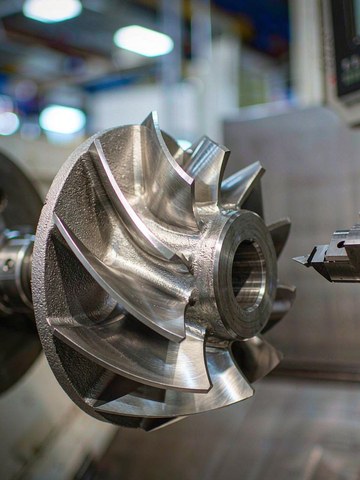
A worked example makes the trade concrete. Take a 316 stainless impeller, 120 g finished, 180 g as cast, with a bore, a face seal and a hub diameter that all have to be machined either way. The figures below are illustrative of the structure rather than a quotation, but the shape of the curve is what matters and it repeats across most parts we quote.
| Annual volume | Cast route, all in | Machined from bar, all in | Lower cost route |
|---|---|---|---|
| 100 pieces | 40.00 tooling share + 9.50 casting + 11.00 machining = 60.50 | 4.20 material + 20.30 machining = 24.50 | Machining by a wide margin |
| 500 pieces | 8.00 + 9.50 + 11.00 = 28.50 | 24.50 | Machining, narrowly |
| 2,000 pieces | 2.00 + 9.50 + 11.00 = 22.50 | 24.50 | Casting |
| 5,000 pieces | 0.80 + 9.50 + 11.00 = 21.30 | 24.50 | Casting, clearly |
For this part the lines cross somewhere around 700 to 900 pieces a year, and the crossover moves with wall thickness, feature count and how much machining the casting still needs. The same volume logic appears in our batch size pricing note. Two adjustments are worth stating because they catch people out. First, the casting route still carries machining cost, so a casting that needs a lot of fixturing and five operations can lose to bar stock well beyond the crossover. Second, the casting route carries a yield risk that does not appear in the piece price: if 3 percent of castings are scrapped after machining, the effective unit cost rises, and that cost is borne by the buyer in the long run whatever the purchase order says.
3. What Do Tolerance and Material Reality Say?
Investment casting is a precise process by casting standards and a loose process by machining standards. ISO 8062 defines tolerance grades, and a typical commercial investment casting lands in the CT4 to CT6 range: on a 10 mm feature that means a few tenths of a millimetre, and on a 100 mm dimension it can approach a millimetre depending on the grade selected. Wall thickness varies for the same reasons, because the shell and the pour do not reproduce a thin section exactly.
The practical consequence is simple to apply. Any feature that has to hold plus or minus 0.05 mm, any sealing face, any bearing bore, any thread and any datum that another part locates against will be machined. What the casting contributes is the shape around those features and the material where it is needed, not the accuracy. A drawing that calls a sealing face at 0.05 mm flatness and expects the foundry to deliver it as cast is a drawing that will be quoted twice.
Material properties differ as well. A cast 316, designated CF8M under ASTM A351, is not the same as wrought 316 bar. Elongation and impact toughness are typically lower, and the cast structure carries more variation from pour to pour. For a pressure retaining body that is fine, and the design codes account for it. For a part that relies on fatigue strength in a thin section, the wrought route or a forging is usually the better answer, and the machining cost difference is small compared with the risk.
4. What Does Porosity Do to Your Yield?
Porosity is the reason casting quotes and machining quotes are not directly comparable. A pore near the surface may be invisible on the as cast part and open up when a bore is machined into it, or when a sealing face is faced off. At that point the part is 90 percent complete, the material and the casting cost are already spent, and the loss includes the machining time as well.
The controls are well known and worth specifying. Radiographic inspection to a defined severity level, commonly ASTM E505 for steel castings, before machining rather than after. The first article then confirms that the first machined parts are representative. A foundry that pours with a documented gating and riser design rather than by habit. A wall thickness that the wax and the shell can actually reproduce, because a section that is too thin produces misruns and a section that is too thick produces shrinkage. And where the service is critical, hot isostatic pressing, which closes internal porosity and adds cost but converts a casting into something closer to a wrought part in integrity.
5. When Does the Hybrid Route Win?
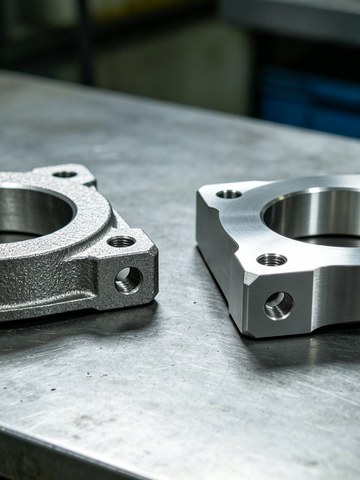
Most production parts are not one route or the other. They are a casting with machined interfaces, and the design question is how much stock to leave and where to locate from. The usual allowance is 1.5 to 3 mm per machined surface, enough to clean up the casting variation and to remove the decarburized or contaminated skin at the surface.
Datum strategy decides whether the hybrid works. Locating on a raw cast surface transfers the casting variation into the machined features, and the result is a part that is dimensionally correct and functionally wrong, because the bore is not where the mating part expects it. The reliable sequence is to machine a datum first, then locate from that datum for everything else, which may mean an extra operation but produces a part whose features are related to each other rather than to the casting.
The cost logic of the hybrid is that the casting removes the roughing, which is the part of machining that consumes the most time per unit of material removed. A near net casting that needs only finishing can cut machining hours by half or more, and it does so without asking the foundry to hold a tolerance it cannot hold.
6. What About Sand Casting, Forging and Fabrication?
Investment casting is not the only alternative to bar stock, and the comparison is often drawn too narrowly. Sand casting is cheaper for large, simple shapes with generous tolerance, and it is usually machined all over. Forging gives better mechanical properties than casting in the same alloy and is the right answer for highly stressed parts, at the cost of more machining stock and higher tooling, and it is often compared against additive routes for the same reason. The same comparison runs alongside the plastic route in our machining against molding article. Fabrication from plate and standard sections, through sheet metal and welding, is competitive for frames and brackets where a weldment is acceptable, and it avoids tooling entirely.
| Route | Tooling | Tolerance as supplied | Best volume | Watch out for |
|---|---|---|---|---|
| CNC from bar or plate | Fixtures only | Plus or minus 0.005 mm | 1 to a few hundred | Material cost and roughing time on large parts |
| Investment casting plus machining | Wax die, 1,500 to 8,000 USD | ISO 8062 CT4 to CT6 | Hundreds to tens of thousands | Porosity, wall thickness, die lead time |
| Sand casting plus machining | Pattern, lower cost | Coarser than investment | Large parts, low count | Machining stock and cleanup risk |
| Forging plus machining | Dies, highest | Loose, machined all over | High stress parts at volume | Stock removal time, die cost |
| Fabrication plus machining | Fixtures and weld tooling | Dependent on the weldment | Frames, brackets, one offs | Distortion, stress relief before finish machining |
7. How Do You Run the Comparison Properly?
A fair comparison needs four inputs from the buyer: the drawing with all tolerance and finish callouts, the annual volume and the expected life of the program, the material and any NDT requirement, and the date the first production part is needed. With those, both routes can be priced on the same basis, and the comparison becomes arithmetic instead of preference.
Three things are worth insisting on. Ask for the blank assumption in writing, because a machining quote that assumes bar stock and a casting quote that assumes a near net shape are not quoting the same part. Ask for the scrap and rework policy, because a casting route that hides a 3 percent loss in the piece price is not comparable with one that states it. And ask for the lead time of each route from drawing release, not from purchase order, because the wax die sits on the critical path and the machining route often does not.
We quote both, on the same drawing, with the process route and the blank assumption stated on the quote, and the low volume option is priced through our low volume cell. Where the honest answer is that a casting plus finishing is cheaper, the quote says so, and where the tolerance on the drawing will force machining on every part regardless of the blank, that is stated too. Send the package and a quote is back within 24 hours.
Frequently Asked Questions
At what volume does investment casting become cheaper than machining from solid?
It depends on the part, but the crossover usually sits between a few hundred and a thousand pieces a year for parts of this size, because the wax die has to amortise. Parts with a lot of internal geometry move the crossover lower; parts that need extensive machining after casting move it higher.
Can an investment casting hold a sealing face without machining?
Not at the flatness and finish a seal needs. As cast surfaces sit around Ra 6 to 12 micrometres with tenths of a millimetre of form variation, so sealing faces, bearing bores and threads are machined on every part.
How much machining stock should be left on a casting?
Typically 1.5 to 3 mm per machined surface, enough to clean up casting variation and remove the surface skin. More stock costs machining time, less risks a part that does not clean up.
Is a cast 316 part as strong as a machined 316 part?
Generally no. CF8M castings have lower elongation and impact toughness than wrought 316, and more variation between pours. For pressure retention that is normally acceptable under the relevant code; for fatigue critical thin sections, wrought or forged material is the safer choice.
How is porosity controlled?
By gating and riser design at the foundry, by radiographic inspection to a stated severity before machining, and by hot isostatic pressing where the service justifies it. Inspecting after machining is too late, because the pore has already damaged a nearly finished part.
Can you quote both routes at once?
Yes. Send the drawing, annual volume, material and NDT requirement, and the quote comes back within 24 hours with both routes priced on the same blank assumption so the comparison is like for like.
This article is general engineering guidance, not a binding offer. Tolerances, cost and lead time depend on part geometry, material, quantity and the drawing package you release. Request a quotation for part specific terms. (c) 2026 KGL Machining & Electronics, Shenzhen.
Related Articles
More from the Design for Manufacturing series.
Have a project in mind?
Send drawings to kgl@kglmfc.com or request a quote. We respond within 24 hours.
Request a Quote