CNC Machining Titanium vs Aluminum: What the Numbers Decide
A shop-floor comparison of Ti-6Al-4V against 6061-T6 and 7075-T6 aluminum. Thermal behavior, tool wear, cutting parameters, tolerance drift, and the real cost gap.
Choose between titanium and aluminum and you are really choosing which problems you want to manage. Titanium burns through tooling and pays you back with strength per weight, corrosion resistance, and a stable tolerance window. Aluminum cuts fast and cheap, then drifts on you when the part warms up or the tool rubs instead of shears. Both alloys sit on our floor every week, so this comparison comes from process sheets and inspection data rather than from a brochure.
The four numbers that decide everything
Four material properties explain most of the machining difference. Thermal conductivity decides where the cutting heat goes. Thermal expansion decides whether the part stays the size you cut it. Elastic modulus decides how much the material flexes and springs back under the tool. Hardness and strength decide how fast the edge wears. Here is how the three common grades line up.
| Property | Ti-6Al-4V (Grade 5) | Al 6061-T6 | Al 7075-T6 |
|---|---|---|---|
| Density (g/cm3) | 4.43 | 2.70 | 2.81 |
| Tensile strength (MPa) | 950 | 310 | 572 |
| Thermal conductivity (W/m.K) | 6.7 | 167 | 130 |
| Thermal expansion (um/m.C) | 8.6 | 23.6 | 23.6 |
| Elastic modulus (GPa) | 114 | 69 | 72 |
| Hardness | 36 HRC | 95 HB | 150 HB |
Read the row that matters for your drawing. Conductivity: titanium conducts 25 times worse than 6061, so the heat stays in the cutting zone instead of leaving with the chip. Expansion: aluminum grows about three times more per degree, which means a 200 mm aluminum part changes 0.047 mm for a 10 C shop swing while titanium changes 0.017 mm. Modulus: the lower number on aluminum means more elastic recovery behind the cutting edge, and that shows up as rubbing, chatter, and undersized bores.
One rule never changes at our incoming dock. Titanium bar arrives against ASTM B348 (AMS 4928 for forgings on aerospace work) and aluminum bar against ASTM B211, and the certificate follows the material into the job traveler. No cert, no cutting.
How each alloy wears out a tool
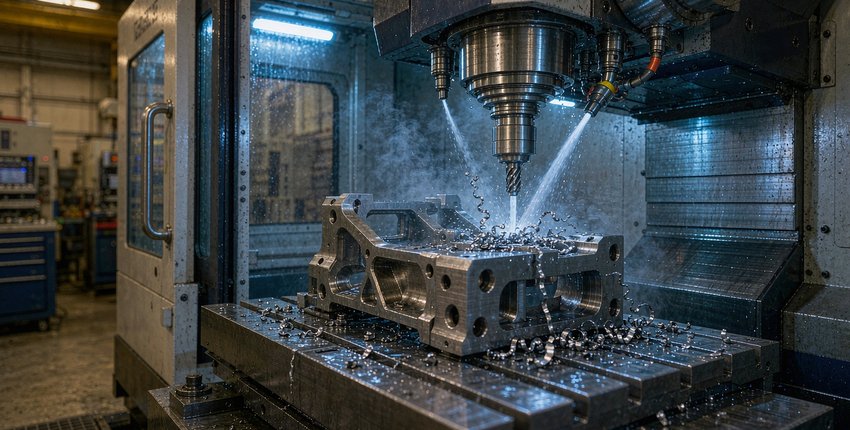
Titanium fails tools through heat. Over 80 percent of the energy of the cut stays at the edge, insert temperatures climb past 700 C on roughing passes, and the work material welds to the carbide chemically at those temperatures. The edge goes, the coating peels, and the finish follows within minutes.
Aluminum fails tools through adhesion and geometry instead. The chip welds to the edge and breaks off irregularly, which is why 6061 with its higher silicon content needs a polished flute and enough chip clearance. And 7075-T6, for all its strength, machines harder than 6061 because the copper-rich precipitates that give it strength also add abrasive wear.
Process windows we run on the floor
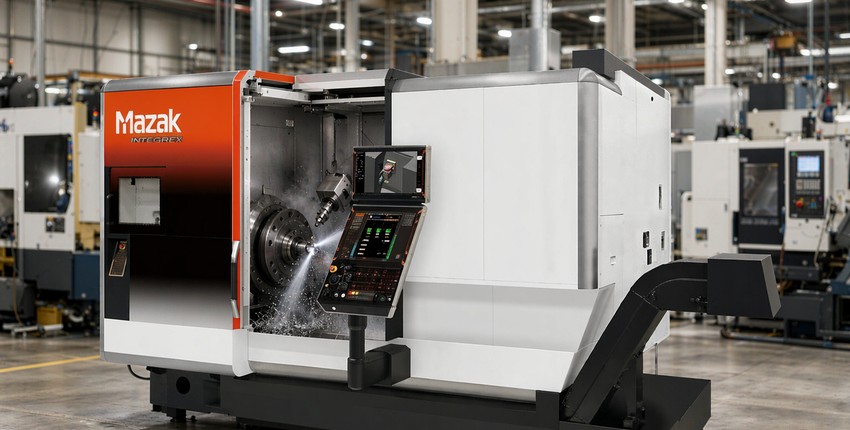
The parameters below are starting points from our process sheets on Mazak VARIAXIS five-axis centers and INTEGREX class turn-mills, locked per program after first-article runs.
| Parameter | Ti-6Al-4V | Al 6061-T6 | Al 7075-T6 |
|---|---|---|---|
| Cutting speed (m/min) | 30-60 | 200-500 | 150-300 |
| Feed per tooth (mm/tooth) | 0.05-0.15 | 0.05-0.25 | 0.05-0.20 |
| Depth of cut, roughing (mm) | 0.5-2.0 | 1.0-5.0 | 1.0-3.0 |
| Depth of cut, finishing (mm) | 0.1-0.5 | 0.1-1.0 | 0.1-0.8 |
| Coolant | 70-100 bar through-spindle | 20-40 bar flood | 20-40 bar flood |
| Typical tool life, finishing (min) | 30-45 | 200-400 | 150-300 |
High-pressure through-spindle coolant is not optional on titanium. The 70-100 bar stream breaks the chip, clears the hot zone, and keeps the edge below the temperature where diffusion welding starts. Run the same alloy dry and a good insert dies in 5-10 minutes instead of 30-45. Aluminum only needs flood coolant, because the chip itself carries most of the heat away.
Tolerance: the drift is the story
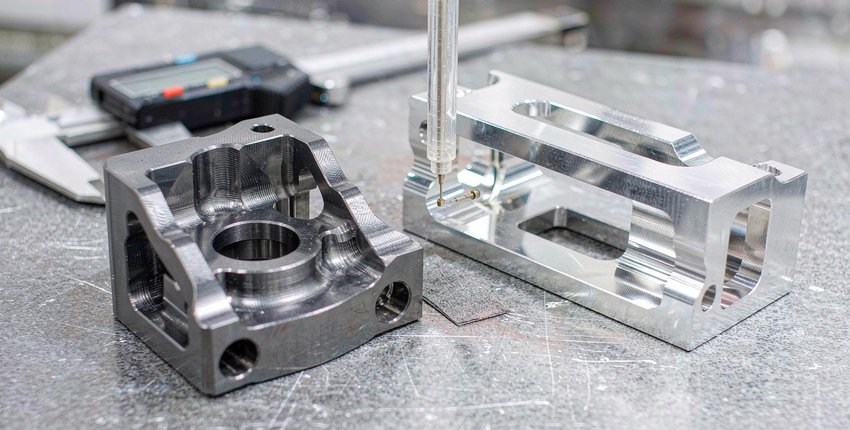
Both material families hold tight numbers. The process windows around those numbers are what differ. Titanium is stiff and moves little with temperature, so once tool wear is under control, dimensions stay put. Aluminum is the deceptive one. Cut a 50 mm bore to nominal in 6061-T6 and elastic recovery can close it by 0.01-0.015 mm after the tool retracts, which is why our programmers compensate the path instead of trusting the first cut.
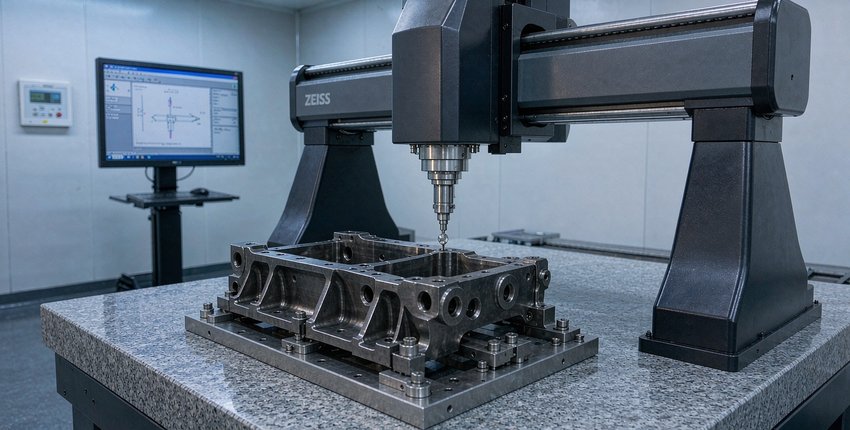
On inspection, temperature again separates the two. We equilibrate aluminum parts for two to four hours before final CMM layout because a 5 C shift in the room moves a 200 mm aluminum part by about 0.024 mm, more than ten times the 0.0015 mm rated uncertainty of our Zeiss and Hexagon CMMs. Titanium equilibrates in 30-60 minutes. Our standard quoted tolerance is plus or minus 0.005 mm, verified by first-article CMM before production releases.
Where the cost gap actually comes from
Tool life is the honest starting point. The table above says a finishing tool lives 30-45 minutes in titanium against 200-400 minutes in 6061. Roughly, that is a five to eight times difference in consumables per part, before you add slower speeds and the high-pressure system. Raw material widens the gap further: titanium bar stock costs several times more per kilogram than 7075 plate, so on a part machined from a billet the material line alone can exceed the total machining cost of the same geometry in aluminum.
None of this makes titanium wrong. It makes titanium right only where the service justifies it. We machine it for implant-grade biocompatibility (ASTM F136), for airframe brackets that carry load at temperature, and for thin-wall parts where aluminum would flex and fatigue. We machine aluminum where the part can use the weight saving and the cost structure matters more.
Choosing with the drawing in front of you
Ask four questions before the material gets specified. Does the part see temperatures above 150 C, body contact, or corrosive service? Titanium or a coated steel usually wins. Is stiffness per weight the driver, like a long structural arm? Both alloys flex; geometry does more than grade selection. Is the tolerance below plus or minus 0.02 mm on a feature that spans more than 100 mm? Then plan for the thermal budget, whichever alloy you pick. And is the part a prototype that will iterate? Aluminum cuts the iteration cost by an order of magnitude.
Send us the drawing and we will quote both routes with a note on where the difference lives. Our titanium and aluminum material pages cover the supply side, and the five-axis machining page shows the geometry classes we run in each.
Frequently asked questions
Is aluminum harder to hold to tolerance than titanium?
Often yes, in a specific sense. Aluminum's higher thermal expansion and elastic recovery mean a dimension can move between the cut and the measurement. Titanium is thermally stable once tool wear is controlled, so its process window is actually wider on tight geometric callouts.
Why does titanium cost so much more per part?
Three compounding reasons: slower cutting speeds, tool life measured in tens of minutes instead of hours, and raw stock that costs several times more per kilogram. On a typical aerospace bracket the finished-part price lands five to eight times above the same geometry in 7075.
Can you machine both in the same program or batch?
Yes, but we keep them on separate machines and tooling. Titanium residue and chip contamination are hard to fully remove, so mixing materials on one spindle risks nothing good. Each job carries its own material cert through the traveler.
What tolerances do you guarantee in each material?
Our quoted standard is plus or minus 0.005 mm in both families. The difference between the alloys shows up in process development time, not in the number we commit to.
Have a project in mind?
Send drawings to kgl@kglmfc.com or request a quote. We respond within 24 hours.
Request a Quote