ESD Plastics for Semiconductor Fixtures: ESD225 vs Conductive Nylon
ESD225 acetal and conductive nylon both protect semiconductor parts from static, but they machine and behave differently. A practical comparison for fixture buyers, from resistivity bands to moisture control.
Two plastics dominate the fixture racks in most electronics and semiconductor plants: an acetal-based dissipative grade usually called ESD225, and carbon-filled conductive nylon. Both move static charge away from sensitive devices. They are not interchangeable, and picking the wrong one usually shows up months later as dimensional drift, warped trays, or a static event that should never have happened. This comparison comes from machining both materials for wafer handling, test and automation fixtures, and it stays at the level a buyer or process engineer can act on.
What do the resistivity bands actually mean?
Surface resistivity decides how fast a material bleeds charge. ESD225 sits in the dissipative band, roughly 109 to 1010 ohms per square, so it drains static in milliseconds without ever becoming a conductor. Conductive nylon, filled with carbon fiber or carbon powder, sits in the 104 to 106 band and behaves close to a semiconductor itself.
Neither band is better in the abstract. Dissipative stock is the safer default around powered test electronics, because a slipped conductive tray that bridges two probe points can short a board. Conductive stock earns its place where charge must vanish fast: high-speed part transfer, places with strong charging from film release or air flow, and equipment built to a conductive specification. Match the band to the environment instead of copying whatever the neighboring line uses.
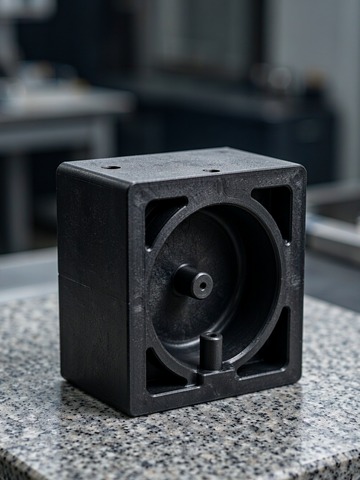
Where ESD225 wins: stability and clean machining
ESD225 is inherently dissipative, meaning the conductivity comes from the polymer compound itself rather than a filler or a surface treatment that can wear off. That makes its electrical behavior stable over the life of the part. The base polymer is acetal, so it machines almost like Delrin: sharp tools, predictable chips, clean walls, and no abrasive filler chewing up cutters. Long-term service temperature is modest, around 82 C, which is comfortable for assembly and handling fixtures but not for reflow-adjacent tooling.
The trade-offs are moisture and heat. Acetal absorbs some water, and ESD225 grades vary between roughly 0.2 and 2 percent depending on the datasheet and conditioning, so flat parts that live in humid cleanrooms need stock conditioned to match the working environment before final cuts. It also softens well below the ratings of high-temperature grades, so it is the wrong pick near soldering or curing heat.
Where conductive nylon wins: speed, heat and toughness
Conductive nylon drains charge orders of magnitude faster and typically handles higher continuous temperatures than ESD225. It is also tougher: nylon flexes and recovers instead of cracking, which suits nest trays, clamping inserts and end-effector pads that take repeated impact. In test sockets and contactor nests where devices move fast and friction is constant, the conductive band plus wear resistance is the usual spec.
The cost is moisture. Nylon is one of the most hygroscopic machining plastics in common use, and carbon fill does not change that. Stock that leaves the box dry will gain weight, swell and drift in dimension over weeks in a humid plant. We dry and condition conductive nylon before finish machining, machine critical features with the expected humidity in mind, and warn buyers that a part measured at 50 percent relative humidity will not measure the same at 80. Where that drift is unacceptable, the fix is a lower-absorption grade or a design that tolerates it.

How machining differs on the shop floor
On our floor the two materials run different recipes. ESD225 behaves like the rest of the acetal family: standard carbide, moderate speeds, sharp edges, and attention to chip evacuation in deep pockets. Internal stresses in extruded stock are the main enemy, so we rough both sides equally and leave a finishing allowance, then stress-relieve and finish. Tolerances of ±0.005 mm are routine, and ±0.002 mm is realistic on selected features with 5-axis finishing and full CMM verification.
Conductive nylon brings two complications. Carbon fill is mildly abrasive, so tool life planning matters on long runs. And the moisture story means the part you finish is not the part you shipped: we condition blanks, machine in one climate, and pack with desiccant for transit when the destination differs. Thin webs and deep pockets, common in wafer handling, amplify both effects. This is the same discipline we apply to other hygroscopic plastics, and our guide to CNC machining plastics covers the shared fundamentals. For PEEK-based ESD parts, see our breakdown of machinable PEEK grades, which covers carbon-filled ESD PEEK for higher-temperature fixture work.
Which one should your fixture use?
A short decision path covers most cases. If the fixture touches devices in assembly, inspection or wafer handling at room temperature and nothing powers through it, ESD225 is the default: stable, clean to machine, economical. If charge must clear fast, temperatures run above about 80 C, or the part takes impact, conductive nylon takes over, and you accept a moisture-control plan as part of the design. If heat climbs further, carbon-filled ESD PEEK or a PEI-based dissipative grade is the next step up, at a higher price per blank.
Most fixture programs we quote end up with both materials in the same cell: ESD225 nests and combs, conductive nylon trays and pads. Sending both part families through one RFQ keeps the materials, tolerances and inspection plans consistent, and the semiconductor industry page shows the fixture classes we run most often. If you want tolerances and material options priced together, start at the RFQ page with the drawing and the resistivity band your equipment standard requires.
Frequently Asked Questions
What does ESD225 actually consist of?
It is an acetal (POM) based stock shape compounded to be inherently static dissipative, sold under trade names including Semitron ESd 225. The dissipation does not depend on a coating or a humidity-activated surface layer, which is why its electrical behavior stays stable over the part's life.
Is conductive nylon safe around powered test equipment?
Treat it as conductive, not just dissipative. In the 104 to 106 ohm band it can bridge exposed conductors the way a weak resistor would. Around live probe cards or exposed boards, dissipative grades in the 109 band are the safer choice unless your equipment standard explicitly calls for conductive stock.
How much does moisture change conductive nylon dimensions?
Nylon can absorb a few percent of its weight in water at saturation, and dimensions move with it, most visibly on flat parts and press-fit features. Conditioning the blank to match the working environment before final machining keeps the drift predictable. That is why we ask where the part will actually live, not just what it must measure.
Can ESD plastic parts hold tight tolerances?
Yes, with discipline. We hold ±0.005 mm as standard and ±0.002 mm on selected features after stress relief and finishing, verified on CMMs under controlled temperature. The bigger risk is not the machine pass but the environment: measure the part in the climate it will be inspected in downstream, or the numbers will argue.
Do you fabricate fixtures from customer-specified ESD grades?
Yes. We machine customer-supplied stock or procure the grade the drawing names, and we will flag material risks such as moisture drift or temperature limits before cutting. Send the drawing with the resistivity requirement and the working environment, and the quote comes back with the machining plan attached.
This article is for informational purposes only. Material properties cited are typical published values for the grade families discussed; verify against the datasheet of the exact stock you purchase and validate grade selection against your application and equipment standards before production. (c) 2026 KGL. All rights reserved.

Have a project in mind?
Send drawings to kgl@kglmfc.com or request a quote. We respond within 24 hours.
Request a Quote