CNC Prototyping vs 3D Printing: Which One for Your First Parts?
A founder's comparison of CNC prototyping and 3D printing: tolerance, materials, surface finish, cost crossover, and a decision table for your first production-intent parts.
Every hardware team hits this fork on the first serious part. Print it tonight and hold something in your hand by Friday, or cut it from the real material and hold something that behaves like production. I have sat on both sides of this decision, as a customer sourcing parts and now running a shop that machines prototypes for robotics, medical, and semiconductor teams. The honest answer is that the two processes answer different questions, and the mistake is asking one of them the other's question.
1. What each process actually promises
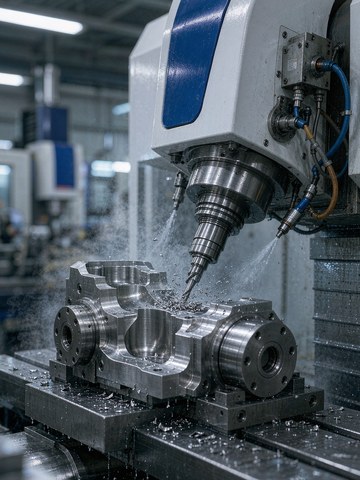
3D printing builds a part layer by layer from a filament or resin. Its strengths are geometry and speed: internal channels, lattices, and shapes no cutter can reach, with no fixturing and no program. CNC machining cuts the part from solid bar or plate stock with a cutting tool. Its strengths are fidelity: real engineering materials, repeatable dimensions, and surfaces that behave like production.
| Factor | CNC Prototyping | 3D Printing (FDM/SLA) |
|---|---|---|
| Materials | Any genuine grade in bar or plate: 6061/7075 aluminum, 304/316/17-4PH stainless, Ti-6Al-4V, PEEK, PEI, POM | Printer-specific filaments and resins; filled and engineering grades exist but properties differ from stock material |
| Typical tolerance | Plus or minus 0.005 mm standard on machined features at a precision shop, plus or minus 0.002 mm on critical 5-axis features; plus or minus 0.1 mm is routine everywhere | Commonly plus or minus 0.1 to 0.3 mm, layer- and orientation-dependent; SLA somewhat tighter but resin-dependent |
| Surface finish | Ra 0.4 to 0.8 um held steady on precision passes, anodize- and seal-ready | Ra 6 to 12 um on as-printed surfaces, visible layer lines; supports leave witness marks, so sealing surfaces need post-processing |
| Mechanical behavior | Isotropic, matches the wrought stock datasheet | Anisotropic on FDM; layer direction is the weak direction under load |
| First-part speed | Quoted in 24 hours, simple parts in about 3 to 7 working days | Hours to a day for simple parts, no setup |
| Cost curve | Flat per part as quantity grows; drops fast at 10 to 100 pieces | Nearly flat per part but with a ceiling on material performance |
Read that table against your purpose, not against the part. The tolerance row is the one that quietly decides most engineering questions. A printed part that reads plus or minus 0.2 mm cannot tell you whether your production part will assemble at plus or minus 0.05 mm, because it is not measuring the same thing. There is a second quiet difference: machined parts can be specified against a general-tolerance table such as ISO 2768-m for everything non-critical, which gives every undefined dimension a defined band. A printed part has no such fallback.
2. Where printing wins, without qualification
Printing is the right call when geometry is the question. Cooling ducts with internal passages, conformal grip surfaces, enclosure studies for a design review, a form model to hand a surgeon before any cutting happens: these are printing jobs and a machine shop should say so. Printing also wins on the first 24 hours. If your milestone tomorrow is about shape and fit in a non-critical region, print it, and do not feel that you compromised.
3. Where CNC wins, and why it matters more than it looks
CNC wins when the prototype has to predict production, and that is a stronger requirement than it first appears. Three reasons from our floor:
- The material is the real material. A 7075-T6 prototype cut from certified bar carries the datasheet properties of 7075-T6. A printed equivalent tells you about the filament, not the alloy.
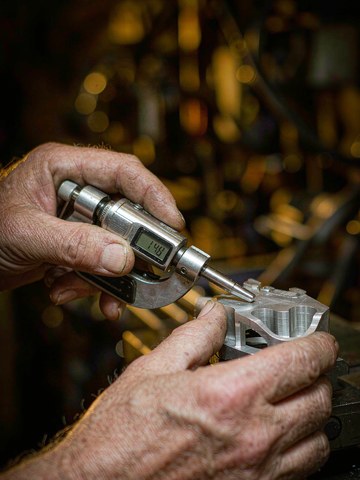
- The tolerances are production tolerances. Our standard is plus or minus 0.005 mm with critical features verified on Zeiss and Hexagon CMMs, so the prototype test rig measures what the production part will be, not a coarser approximation of it.
- The finish is finish-ready. A machined face takes Type II or Type III anodize, seals against an O-ring, and bolts to a mating part the way production will. Layer lines and support marks do not.
For functional prototypes, test fixtures, and any part that goes near a customer, machined parts answer questions that printed parts cannot raise their hand for.
4. The cost crossover, in plain terms
One part, no urgency beyond a day or two, non-critical geometry: printing usually costs less and arrives sooner. The picture changes with quantity and with material. Machining has a setup that amortizes, so the tenth piece costs a fraction of the first, and by the time a program needs ten or more functional parts, machined parts typically undercut printing per part while outperforming it. There is also the cost nobody quotes: a printed part that fails a load test or a seal test sends you back to square one, and that loop costs more weeks than the machining quote ever did. Our low-volume machining page explains how the pricing steps down from prototype to production quantities.
5. The hybrid path most teams end up taking
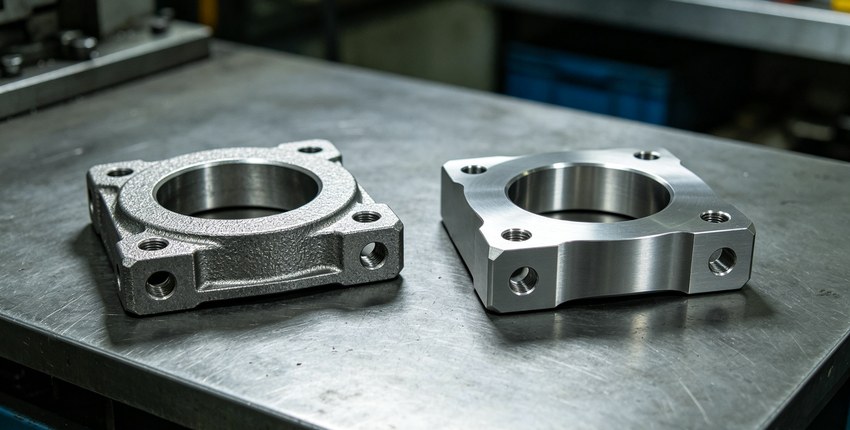
The mature pattern we see across robotics and medical customers is not CNC versus printing. It is sequencing, and increasingly it is a true hybrid on the same part. Printing is unbeatable for complex internal channels and topology-optimized forms, but its as-printed surfaces land at Ra 6 to 12 um with plus or minus 0.1 to 0.3 mm on dimensions, which no bearing seat or seal face will accept. CNC reaches Ra 0.4 to 0.8 um and plus or minus 0.005 to 0.01 mm, but no cutter reaches every internal channel. So we combine them: print the part near-net-shape, then finish the functional surfaces by machining.
On a lightweight robot structural part, that means the topology-optimized outer form comes off the printer and the bearing seats, threaded holes, and mounting datums are 5-axis milled to final size. The printed near-net shape removes 60 to 70 percent of the roughing work and the material waste that roughing produces, the finished part comes out 30 to 40 percent lighter than a fully machined equivalent, and assembly precision lives exactly where it needs to. On complex parts this hybrid sequencing has cut delivery time by more than 40 percent compared with machining the same geometry from solid. For the simpler split, print the enclosure study and the form model this week, and send the functional core, the joint, the seal housing, the fixture, for machining from the real material in parallel. When the machined parts land and pass, the same programs carry you into production through our prototype-to-production path without re-fixturing or re-qualification.
| Your Situation | Recommended First Move | Why |
|---|---|---|
| Form and fit study for a design review | 3D print | Speed and geometry freedom, tolerances irrelevant |
| Functional test of a load-bearing part | CNC from the production alloy | Datasheet properties and production tolerance |
| Sealing, vacuum, or pressure interface | CNC plus machined finish control | Surface finish and flatness decide the seal |
| 10 to 100 units of a real part | CNC, quoted as low-volume | Setup amortizes; per-part cost drops below printing |
| Internal channels or lattices in a non-structural part | 3D print | Geometry no cutter can reach |
| Topology-optimized lightweight structural part | Hybrid: print near-net-shape, CNC finish critical features | 60 to 70 percent less roughing, 30 to 40 percent lighter, production tolerance where it counts |
| Part that must survive an audit or customer demo | CNC | Appearance, finish, and material certificates |
6. FAQ
How fast can you deliver a machined prototype?
You get a quote with DFM feedback within 24 hours of sending files. Simple turned or milled parts ship in about 3 to 7 working days; complex 5-axis work runs longer. No MOQ, so a one-piece prototype is a normal order for us.
Can you match a printed prototype I already have?
Yes. Send the printed part or the CAD, and we machine the production-intent version from the real material, matching or improving the critical dimensions so your test data carries over.
Is CNC prototyping expensive for a single part?
For simple geometry in common materials, single-piece prototypes are usually affordable because programming and setup are modest. The quote is free, so send the drawing and decide with numbers instead of assumptions.
Which process should I choose for a part that will later be injection molded or die cast?
Machined prototypes in a moldable-grade material predict the production article far better than printed ones, especially for snap fits, threads, and sealing surfaces. Keep printing for the styling models.
Do you provide material certificates with prototypes?
Yes. Mill certificates follow the material into the job traveler, and we provide CMM inspection reports on request. See our rapid prototyping service page for the full deliverables list.
If you have a first part to build, send the drawing through the RFQ page or write to kgl@kglmfc.com. We will quote it as machined, tell you honestly if printing is the better first move, and help you sequence the two when both have a job to do. For the material decision behind a specific alloy, our DFM checklist covers what to check before you send any drawing.
Related Articles
More from the Design for Manufacturing series.
Have a project in mind?
Send drawings to kgl@kglmfc.com or request a quote. We respond within 24 hours.
Request a Quote