CNC Machining or 3D Printing? How We Help Customers Choose
CNC machining vs 3D printing compared on materials, tolerance, surface finish, strength, volume, and cost crossover, with the decision rules we use when quoting new parts.
Every new part starts with the same question: cut it or print it? Both routes turn a model into a physical object, and both have a sales story. After thirteen years of quoting precision parts in Shenzhen, our answer has stayed stable: for functional parts that carry load, seal, or hold a fit, machining wins; for fast form checks and geometry no cutter can reach, printing wins. We have written before about prototyping specifically and about metal parts specifically. This page is the decision framework we walk through with customers when the drawing is still open.
1. Two processes, two physics
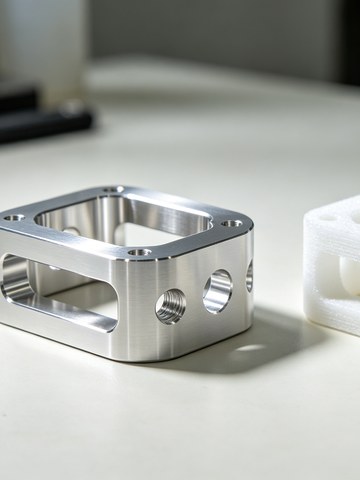
CNC machining is subtractive: rotating tools cut features out of solid metal or plastic. The part inherits the properties of the billet, uniform in every direction, with surfaces the tool finished rather than layers that stacked. Milling covers prismatic and contoured work; turning covers round parts, and our turning and mill-turn guide shows the split.
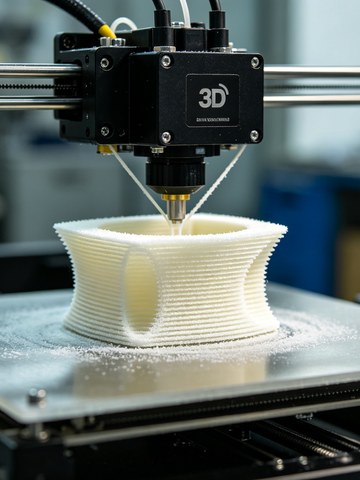
3D printing is additive: material piles up layer by layer from filament, resin, or powder. No tooling, no fixturing, and access to internal channels and lattices a cutter cannot reach. The trade is anisotropy, visible layer lines, and properties that depend on print direction.
2. The comparison that matters when quoting
| Dimension | CNC machining | 3D printing |
|---|---|---|
| Materials | Wide range of metals, alloys, and engineering plastics | Mostly polymers and resins; some metal systems |
| Precision | High: plus or minus 0.005 mm standard for us | Moderate: typically plus or minus 0.1 mm or coarser |
| Surface finish | Smooth machined finish, Ra 0.8 um and below | Visible layer lines; post-processing usually required |
| Strength | Solid, uniform in every direction | Direction dependent, generally lower |
| Volume | Prototype to production | Prototypes and small batches |
| Lead time | Setup driven; fast for standard jobs | Fast for single parts, no tooling |
| Unit cost | Drops quickly with quantity | Stays high per unit |
| Best for | Functional parts, tight tolerances, metal parts | Concept models, internal features, iteration |
3. When machining is the right call
Choose machining when the part has to work, not just look like the model. If it fits into an assembly, seals fluid or gas, or transmits load, tolerance and material properties decide success, and those are machining strengths. Metal parts for structural duty are machined almost without exception; our aluminum and stainless guides cover the common choices. And once quantities move past a handful, setup costs amortize and the per unit price falls fast, which is why production orders come to machines, not printers. Where customers overspend, it is usually drawing driven, and our cost reduction checklist recovers most of it before the first chip.
4. When printing earns its place
Printing wins three situations. Early iteration, where designs change daily and waiting for programming would stall the project. Internal geometry, where conformal channels or lattices are the point of the part. And genuine one-offs, spare parts, and fixtures, where tooling-free means the only cost is the print itself. We say this plainly to customers: if your part is a form study, do not pay machining prices for it.
5. The hybrid route most products actually take
In practice the two processes are sequential, not competing. Print the first revision to prove form, fit, and ergonomics within days. Freeze the design, then machine the functional parts with real materials and tolerances. We support both stages so the customer does not change suppliers mid-project, and the quote states which stage each part number belongs to. The failure mode to avoid is carrying a printed prototype's loose tolerances into the production drawing, or carrying a production drawing's tight tolerances back onto a print run that never needed them.
6. FAQ
Can you machine a part I already 3D printed?
Yes, for finishing critical faces on printed blanks, and we quote it honestly: sealing surfaces, bores, and datum faces machine well; printing the whole part to printing tolerances then hoping is not a plan.
At what quantity does CNC become cheaper?
It depends on size, material, and how much material gets removed, so we do not quote a magic number. For small metal parts the crossover usually arrives within the first tens of units; send the model and we will show both prices side by side.
Which process for metal parts?
Machining, for anything structural. Metal printing exists but is expensive per part and needs post processing for critical surfaces; our metal comparison post covers the exceptions.
How fast can I get machined prototypes?
Send complete 2D and 3D files and you get a quotation within 24 hours and engineering feedback with the quotation, within 24 hours. No MOQ, one-piece sampling supported.
If you are deciding between the two processes on a live project, send your STEP or IGES models and 2D drawings to kgl@kglmfc.com or request a quote on our RFQ page. We will price the machining route, tell you plainly if printing is the better first step, and return the quote within 24 hours.
Related Articles
More from the Design for Manufacturing series.
Have a project in mind?
Send drawings to kgl@kglmfc.com or request a quote. We respond within 24 hours.
Request a Quote