CNC Machining vs 3D Printing for Metal Parts: Which One and When
CNC machining vs metal 3D printing compared on materials, tolerances, surface finish, strength, and cost per part by volume, plus the routing we use for metal components.
Buyers ask us this weekly: should this metal part be machined or printed? The honest answer is that both processes are mature, both make good parts, and the decision usually comes down to material, tolerance, quantity, and geometry. We covered the general prototype question in CNC prototyping vs 3D printing. This article stays on metal parts and gives you the comparison we actually use when a customer sends us a drawing and asks for a straight recommendation.
1. What each process actually is
CNC machining cuts a part from wrought or cast stock. The material arrives with its properties already set by the mill: 6061-T6 is 6061-T6 before the first chip is made, and the finished part keeps that certification trail. Our floor runs a five axis Mazak fleet alongside 3 and 4 axis mills and turning centers, so a machined part inherits the full mechanical data sheet of its alloy.
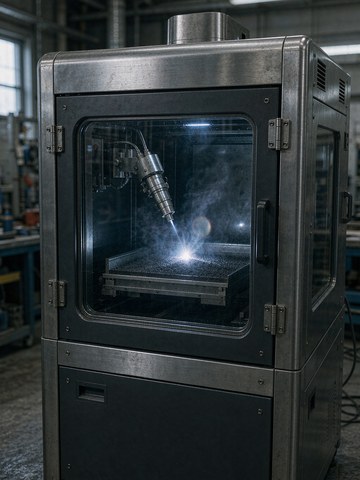
Metal 3D printing, usually powder bed fusion, builds the part layer by layer from melted powder. Its strengths are geometric: internal channels, lattice structures, consolidated assemblies that would otherwise be brazed from five pieces. Its costs are equally real: the machine time is slow, suitable alloys are a shorter list, parts need support removal and surface conditioning, and critical features usually get machined afterward anyway.
2. The comparison that matters for metal parts
Here is how the two processes line up on the properties buyers actually test.
| Factor | CNC machining | Metal 3D printing |
|---|---|---|
| Material selection | Essentially any wrought or cast alloy; mill certs trace every lot | Narrower list: 316L, AlSi10Mg, Ti6Al4V, Inconel 625 and similar printable powders |
| Material properties | Wrought stock, isotropic, matches the data sheet exactly | Anisotropic; properties depend on build direction and parameters, need testing to trust |
| Tolerance | Standard work in the hundredths of a millimeter; critical features to ±0.005 mm on our floor | As built, roughly ±0.1 mm; tight features must be machined after printing |
| Surface finish | Ra 0.4 to 1.6 achievable directly; ready for anodize or passivation | Rough and grainy as built; internal channels can only be bead or flow finished |
| Part size | Limited by machine envelope, meters possible across our fleet | Limited by powder chamber, typically tens of centimeters |
| Internal geometry | Cannot reach sealed internal channels or lattices | Prints them natively; this is its reason to exist |
| Cost at 1 piece | Programming plus setup plus machine time; moderate | Slow build; often higher per part, sometimes justified by geometry |
| Cost at 100 pieces | Fixture amortizes, cycle time drops, per part cost falls sharply | Per part cost barely falls; each layer costs what it costs |
| Lead time | Days; we quote in 24 hours and ship expedited samples on a scheduled window for standard work | Days to weeks including powder sourcing, heat treatment, and post machining |
3. How each process behaves on real parts
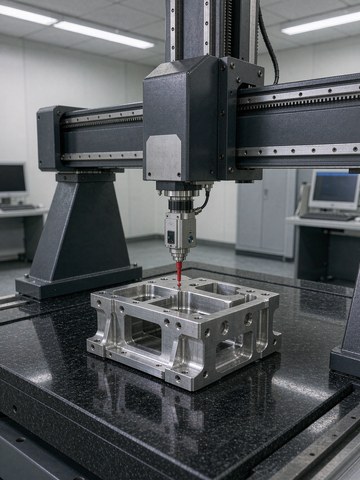
A machined metal part starts strong and stays that way. Wrought aluminum and stainless cut cleanly, hold dimension through temperature changes, and go straight to the CMM for verification. When a customer needs a housings batch with bore positions that must line up across an assembly, machining gives tolerances the drawing can actually depend on, and our first article workflow proves it before the batch runs.
A printed metal part trades that certainty for geometry. If the design needs a conformal cooling channel buried inside a mold core, no cutter reaches it, and printing is the only answer. The catch is what happens after the build: supports come off, the surface gets conditioned, sealing faces get machined, and the part gets stress relieved or HIPed if fatigue matters. Printed does not mean finished; it means one operation done.
4. How we route a drawing to one process or the other
| Situation | Our route | Why |
|---|---|---|
| Structural part, 1 to 1,000 pieces, standard alloy | CNC machining | Certified wrought properties, tight tolerances, cost falls with quantity |
| Sealed internal channels or lattice inside | Print, then machine critical features | Geometry unreachable by tools decides it |
| Thin wall shell under 0.5 mm in metal | CNC with fixturing strategy, or print if walls go below machining limits | We cut 0.3 mm walls with staged fixturing; below that, printing wins |
| Fluid manifold, dozens of passages | Print the blank, machine the ports | Consolidates what would be a brazed assembly |
| Prototype needed this week for a metal housing | CNC from plate stock | No powder sourcing, no post processing chain, material matches production intent |
| Ti6Al4V implant style geometry, low volume | Print, then finish machine and inspect | Buy to fly ratios favor printing when machining would remove most of the stock |
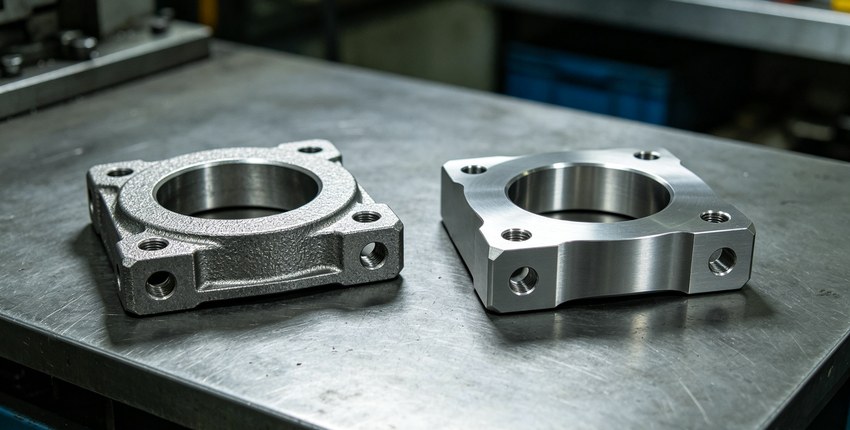
The honest summary: if the part is a block, housing, shaft, plate, or bracket in a standard alloy, machining wins on properties, tolerance, and cost almost every time. If the value of the part lives inside its geometry, printing earns its keep. Most real programs we see are hybrids: a printed blank with machined sealing faces, or a machined body with a printed insert.
5. What it costs, in plain numbers
For a typical 6061 housing the size of a deck of cards: machining runs one setup on a 3 axis mill, roughly 20 minutes of cycle time, and the per part price drops by half or better between 10 pieces and 100 pieces as the fixture and program amortize. The same part printed in AlSi10Mg carries slow layer by layer build time, heat treatment, support removal, and port machining afterward, and that chain does not get cheaper with quantity because the build time is fixed per plate.
The crossover flips only when geometry forces it. Consolidating five machined and brazed pieces into one printed body removes brazing fixtures, leak testing of joints, and assembly labor, and that accounting can favor printing even at slow build speeds. Run the comparison on total assembled cost, not on per piece machine time, and the answer usually becomes obvious. Our cost factor breakdown covers the machining side of this math in detail.
6. Where we land
Send us the drawing and we will tell you honestly which process fits, even when the answer sends work to someone else's printer. For everything that routes to cutting, our five axis and milling teams quote it through the RFQ page within 24 hours, and you can browse how we handle titanium, stainless, and aluminum on the material pages. Write to kgl@kglmfc.com if you want the routing opinion before the quote.
Is a machined metal part always stronger than a printed one?
Not always, but it is predictable. Wrought stock matches its data sheet in every direction. Printed parts can match or approach wrought properties in the build plane yet fall short along the build direction unless parameters and heat treatment are controlled. For flight or fatigue critical work, buyers either machine from wrought or test printed coupons per build.
Can you hold ±0.005 mm on a printed part?
Not as printed. As built tolerance on powder bed fusion sits near ±0.1 mm. The workable route is printing the blank oversize and finish machining the critical features, which is standard practice and part of why printed and machined are partners rather than rivals.
Which process is faster for one metal prototype?
For a part with standard geometry, machining. There is no powder to source and no post processing chain, and we quote in 24 hours with expedited sample shipping on a scheduled window for standard work. Printing gets faster only when the geometry would need multiple machining setups or special fixtures.
Do you offer metal 3D printing in house?
No. We are a machining house and we say so up front. When a project genuinely needs printing, we tell the customer during quoting and machine the critical features afterward if asked. What we will not do is quote printing work as machining work and surprise you later.
If your metal part is sitting on the fence between the two processes, send the drawing through the RFQ page. We will route it, state the machining plan, and give you numbers you can compare.
Related Articles
More from the Design for Manufacturing series.
Have a project in mind?
Send drawings to kgl@kglmfc.com or request a quote. We respond within 24 hours.
Request a Quote