CNC Machining vs. Injection Molding: How to Choose the Right Manufacturing Process
CNC machining vs injection molding compared across tooling cost, unit price, lead time, materials, and tolerances, with a break-even logic for deciding when each process wins and a free DFM review to confirm it for your part.
When a plastic or metal part moves beyond prototyping into production, one of the biggest questions is: CNC machining or injection molding? Both processes can produce functional parts, but they follow fundamentally different economics. CNC machining offers precision and flexibility with no tooling investment, while injection molding delivers very low unit costs at high volumes, at the price of an expensive mold up front. Choosing correctly can save your project a significant amount of time and money.
1. How the two processes work
CNC machining: flexible subtractive production
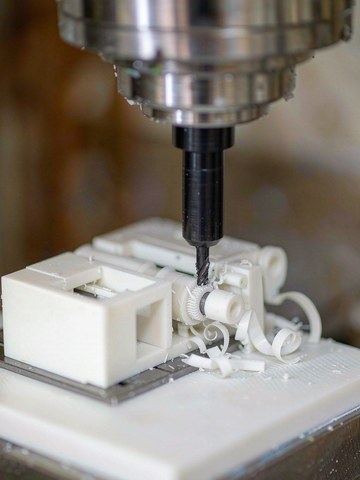
CNC machining removes material from solid stock using rotating cutting tools. CNC milling and CNC turning can produce parts directly from a CAD model with no tooling, which makes the process inherently flexible: geometry changes require only a program update, not a new mold.
Injection molding: tooling-based mass production
Injection molding melts thermoplastic pellets and forces the material into a steel or aluminum mold under high pressure. Once the mold is built, parts are produced rapidly and repeatably, but every design change requires modifying or rebuilding the mold, a significant investment in both time and money.
2. Cost: tooling investment vs. unit price
Upfront investment in tooling
Injection molding requires a mold that typically costs thousands to tens of thousands of dollars and takes weeks to manufacture. CNC machining requires no tooling at all, so the first part can be produced immediately after the program is ready.
Unit cost and economies of scale
Once the mold exists, injection molding produces parts in seconds with minimal labor, driving unit cost far below machining at high volumes. CNC machining has no mold cost but consumes machine time for every part, so its unit cost falls more slowly with quantity.
Finding the break-even quantity
As a rule of thumb, CNC machining is usually the better value for quantities up to a few thousand parts, depending on size and complexity; beyond that range, injection molding often becomes cheaper per part. The exact crossover depends on part geometry, material, and tolerance requirements.
The table below summarizes the key differences:
| Dimension | CNC machining | Injection molding |
|---|---|---|
| Tooling investment | None | High (mold cost, weeks of lead time) |
| Unit cost | Moderate; falls slowly with volume | Very low at high volume |
| Typical quantities | Prototype to a few thousand | Thousands to millions |
| Lead time to first part | Days | Weeks (tooling) plus days |
| Material range | Metals and plastics | Mostly thermoplastics |
| Design changes | Fast and inexpensive | Slow and expensive (mold modification) |
| Best for | Precision, low/medium volume, metals | High-volume plastic parts |
3. Lead time and design flexibility
Time to first part
CNC machining delivers first articles in days, which is ideal when you need parts quickly, whether for validation, testing, or a fast product launch. Injection molding cannot start production until the mold is designed, cut, and trialed, which typically adds weeks to your schedule.
Design changes and iteration
Products in development change. With CNC machining, a design revision is simply a new program; with injection molding, even a small change can mean an expensive mold modification. That is why rapid prototyping followed by CNC machining is the standard path for iterating toward a final design.
4. Materials, tolerances, and quality
Material range
CNC machining handles metals (including aluminum and stainless steel) as well as engineering plastics; see our plastics machining guide for the polymer side. Injection molding is essentially limited to thermoplastics, so metal parts can only be produced by machining (or casting).
Tolerances and surface finish
CNC machining routinely holds tolerances of ±0.005 mm with machined surface finishes, which suits precision assemblies and functional fits. Injection molding can hold good tolerances too, but shrink variation and mold wear make extremely tight tolerances harder to guarantee.
Mechanical properties
Machined parts inherit the isotropic properties of the parent material, while molded parts can show orientation effects and weld lines. For high-strength or fatigue-critical applications, machined metal parts are often the safer choice.
5. Quantity-based decision guide
Prototypes and low volumes: CNC wins
For one-offs, prototypes, and short runs, CNC machining is faster, cheaper, and more flexible. No tooling means lower risk and faster iteration while the design is still moving.
Medium volumes: optimize with CNC
For medium quantities, CNC machining remains cost-competitive, especially for metal parts and complex geometries. Process improvements such as multi-fixture setups and optimized toolpaths keep unit costs low without sacrificing quality.
High volumes: when molding makes sense
If your part is a simple thermoplastic component with annual demand in the tens of thousands or more, injection molding may be the right economic choice. For precision metal parts and designs still evolving, CNC machining remains the practical route.
6. How we help you decide
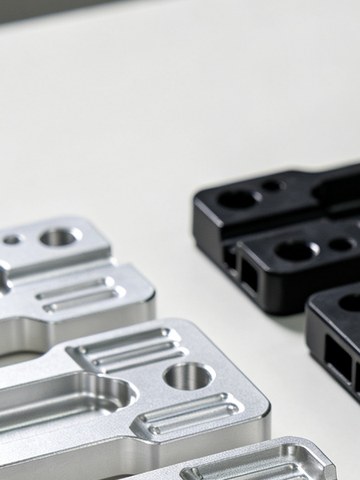
The right answer depends on your specific part, material, and volumes. KGL's CNC machining services include a free DFM review that evaluates geometry, tolerances, and production strategy. When injection molding is genuinely the better fit, we will tell you so honestly.
Send us your drawings through the RFQ page to get a quote. You will receive free DFM feedback within 24 hours, plus an honest recommendation on the most cost-effective manufacturing route for your parts.
Related Articles
More from the Design for Manufacturing series.
Have a project in mind?
Send drawings to kgl@kglmfc.com or request a quote. We respond within 24 hours.
Request a Quote