CNC Machining Plastics: PEEK, POM, PTFE, and How They Cut Differently
Engineering plastics for CNC machining compared: PEEK, POM, PTFE, acrylic and nylon properties, tooling, heat control, moisture movement, and the tolerances each material actually holds.
Plastics are not prototype materials anymore. We machine PEEK, POM, PTFE, PEI, and nylon into working components for medical, semiconductor, and food equipment every week, and the stock sits on our shelf next to the aluminum. But plastics do not forgive metal habits: heat, tool edge, clamping, and even humidity change the part after you cut it. Here is how the common engineering plastics differ and what we change so they come out right. For the deep dives we already published, see our PEEK machining guide and food-grade POM guide.
1. Why engineers specify plastics at all
Plastics do jobs metals cannot. They insulate electrically and thermally, resist chemicals that attack steel, run without lubrication, and weigh a fraction of aluminum. That is why they end up as insulators, seals, gears, wear strips, and food contact parts. The trade is stiffness and heat: a plastic part that behaves like a metal bracket in a CAD envelope will deflect or creep in service if the loads and temperatures were never checked. Where stiffness or heat conduction leads the requirement, metal stays the right answer, and our aluminum guide covers that side.
2. The five plastics you see most
PEEK is the premium option: high strength, chemically inert, and good for continuous service around 250 degrees Celsius. It earns its price in medical, aerospace, and semiconductor components. Our PEEK machining page covers grades including PEEK 1000.
POM (acetal) is the most machinable plastic we cut. Low friction, wear resistant, self lubricating, and dimensionally steady because it absorbs little moisture. Gears, bearings, and bushings are its home turf. We machine food contact grades regularly; see our POM machining page.
PTFE has almost no friction and shrugs off nearly every chemical, which makes it the sealing and insulating material of choice. It is also soft and moves under the cutter, so sharp tooling and gentle clamping decide the result. See our PTFE machining page.
Acrylic (PMMA) gives optical clarity and UV stability for lenses, light guides, and transparent covers. It is brittle, so feeds and edge engagement are controlled to stop edge chipping.
Nylon (PA) is tough and abrasion resistant, a standard for wear parts and rollers. It absorbs moisture though, so dimensions move with humidity unless the stock is conditioned and the service environment is known. See our nylon machining page.
| Material | Key properties | Typical applications | Machining notes |
|---|---|---|---|
| PEEK | Strong, heat resistant to about 250 degrees Celsius, chemical resistant | Medical, aerospace, semiconductor | Stable; watch stress relief and warpage |
| POM (acetal) | Low friction, wear resistant, self lubricating | Gears, bearings, precision bushings | Cuts cleanly; low moisture uptake |
| PTFE | Very low friction, chemically inert | Seals, gaskets, insulators | Soft; sharp tools, gentle clamping |
| Acrylic (PMMA) | Optical clarity, UV stable | Lenses, light guides, covers | Brittle; control feeds to avoid chipping |
| Nylon (PA) | Tough, abrasion resistant | Wear parts, bushings, rollers | Absorbs moisture; condition stock first |
Properties above are typical values. Actual performance depends on grade, reinforcement, and processing, which is why we confirm the grade before quoting rather than assuming from the drawing note.
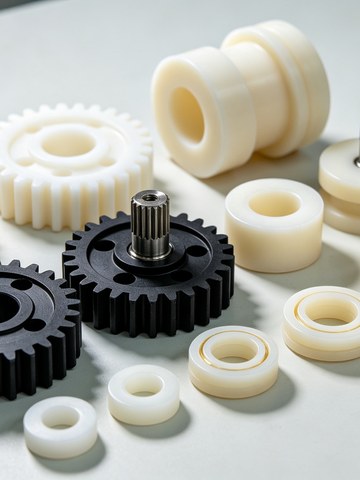
3. Four process rules that decide the result
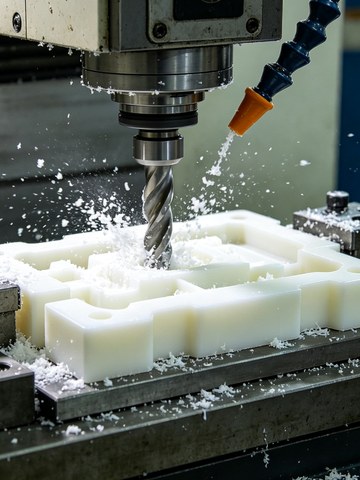
Heat comes first. Plastics expand roughly ten times more than metals with temperature, and cutting friction can melt or distort the material before the pass finishes. We run controlled speeds, sharp geometry, and air blast or coolant where the material allows, and we leave thermal growth out of tight features by finishing them last, in one setup.
The tool edge comes second. Plastics must be cut, not torn. A sharp, positive rake edge shears cleanly; a dull one rubs, melts, and smears the surface. Chip evacuation matters in deep holes and slots, where a packed flute turns into a heat source.
Clamping comes third. Plastics are softer and more flexible than metals, so vise pressure that would be routine on aluminum warps a thin wall or dents a sealing face. We support the workpiece close to the cut and torque clamps to the part, not to habit.
Moisture and time come fourth. Nylon and other moisture absorbing plastics change dimension with humidity, so tight tolerance features are machined from conditioned stock and specified against the service environment. For PEEK the enemy is residual stress rather than water: roughing, stress relief, then finishing keeps parts flat, the same route we describe in our PEEK warpage post.
4. CNC machining or 3D printing for plastic parts?
For early concepts and parts with internal lattices, printing is a fair first step; our prototyping comparison covers that route. But when the part carries load, seals, holds a fit, or needs a specific finish, machining wins, and the gap widens with every unit in the batch. A common path is print to prove form, then machine the functional version. The material decision runs the same way: a printed PEEK-like part is not a machined virgin PEEK part, and on medical or semiconductor duty that difference is the whole decision.
5. What tolerances plastic parts actually hold
On stable materials like POM and PEEK we hold our standard plus or minus 0.005 mm on machined features, verified on Hexagon and Zeiss CMMs, with tighter bands on specific features when the part is verified with full CMM inspection. PTFE and nylon get realistic bands against the service environment instead of numbers the material cannot hold in a humid summer. Saying the material honestly is part of the quote: an over-toleranced plastic drawing costs money twice, once in machining and once in inspection.
6. FAQ
Will my nylon part change size in service?
Some, with humidity. Nylon absorbs moisture and swells; conditioned stock and a tolerance band matched to the service environment keep it predictable. POM and PEEK are the stable choices when this worries you.
Can you hold plus or minus 0.005 mm in plastic?
On POM and PEEK, yes, on machined features with full CMM verification. Soft materials like PTFE get honest, wider bands, because a number the material cannot hold is not a specification.
Do you machine food contact plastic parts?
Yes. Food-grade POM parts are a regular order for us, with grade selection, cleaning, and packaging handled as part of the process. See our food-grade POM guide for the details.
What is your minimum order for plastic parts?
No MOQ. One-piece sampling and medium batch production run through the same process chain, so the part you approve is the part you receive in volume.
If you are choosing a plastic for a live part, send your STEP or IGES models and 2D drawings to kgl@kglmfc.com or request a quote on our RFQ page. We will confirm the grade, flag any tolerance the material cannot hold, and return a quote within 24 hours.
Related Articles
More from the Engineering Plastics series.
Have a project in mind?
Send drawings to kgl@kglmfc.com or request a quote. We respond within 24 hours.
Request a Quote