Deburring and Edge Finishing for CNC Machined Parts: A Practical Guide
Where burrs come from, what they cost you, the five common deburring and edge finishing methods, and how edge break callouts like 0.2 mm max or C0.5 translate into machined edges that pass inspection.
Burrs are an unavoidable by-product of cutting metal. Every milling, turning, and drilling operation leaves tiny raised edges and rough transitions behind, and if they are left in place they can cut assembly workers, damage wires and seals, cause premature wear, or shed particles in clean environments. Deburring and edge finishing are therefore not optional extras. They determine whether a part is truly ready for use. This guide explains what burrs are, how they are removed, and what edge finishing standards mean for your parts. At KGL we treat deburring and edge finishing as a standard step of every order, not an add-on.
1. What are burrs and why do they matter?
Where burrs come from
Burrs form where the cutting tool exits the material or where the workpiece material deforms ahead of the cutter. CNC milling and CNC turning produce them along edges, holes, and threads, and the burr type depends on material, tool geometry, and cutting parameters.
The cost of ignoring burrs
Sharp burrs can cause safety injuries during assembly, cut O-rings and seals, create electrical contact issues, trap contaminants, and reduce fatigue life. For precision assemblies, a single overlooked burr can scrap an entire part at final inspection.
2. Common deburring and edge finishing methods
Manual deburring
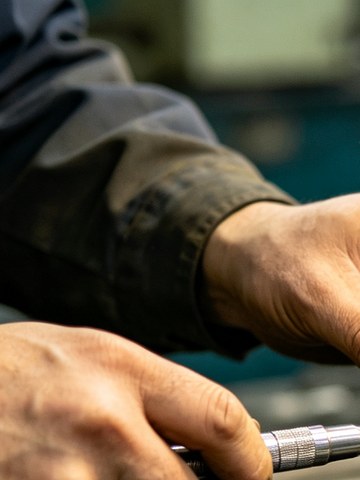
Hand tools and power tools are used by skilled operators to remove burrs from complex or delicate features. Manual deburring offers maximum control and is ideal for prototypes, low volumes, and features that cannot be reached by automated methods.
Mechanical mass finishing
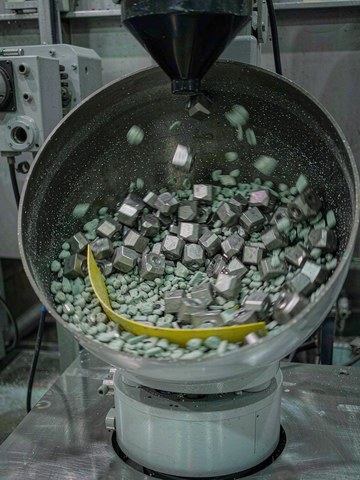
Vibratory bowls and tumblers process many parts at once using abrasive media, rounding edges uniformly and improving surface texture. This is the most cost-effective method for batches of small- and medium-sized parts.
Thermal and electrochemical deburring
For internal channels and hard-to-reach features, thermal deburring burns away burrs in a controlled chamber, while electrochemical deburring dissolves them with a shaped electrode. Both methods suit demanding applications where manual access is impossible.
Machining-based edge finishing
Chamfering, edge breaking, and corner rounding can be programmed directly into the machining sequence, and 5-axis CNC machining makes it possible to finish edges in a single setup. Combining machining and edge finishing reduces handling and improves consistency.
The table below compares the main deburring methods:
| Method | How it works | Best for | Considerations |
|---|---|---|---|
| Manual deburring | Hand or power tools remove burrs | Prototypes; complex features; low volume | Skill-dependent; slower |
| Vibratory tumbling | Abrasive media rounds edges in bulk | Batches of small/medium parts | Less control over specific edges |
| Thermal deburring | Combustion burns away burrs | Internal channels; cross holes | Requires dedicated equipment |
| Electrochemical deburring | Electrode dissolves burr material | Precision internal edges | Process and electrolyte control |
| Machined chamfer/edge break | Programmed edge finishing in the CNC program | Production parts; repeatable edges | Needs CAD support and tooling |
3. Edge finishing standards and specifications
Edge break and chamfer specifications
Drawings often call out edge breaks such as "0.2 mm max" or "C0.5 chamfer". These specifications prevent sharp corners while preserving function, and they should be defined on the drawing so the machinist knows exactly what the designer intends.
Surface roughness on edges
Edges that seal, slide, or contact other components may require controlled roughness or smooth transitions. Specifying edge finish alongside surface roughness avoids ambiguity and rework. Our surface treatment page lists the standard finish options we apply after machining.
When edge finishing matters most
Sealing surfaces, sliding fits, wire-passing holes, and parts that will be handled repeatedly all benefit from proper edge finishing. For CNC aluminum machining and CNC stainless steel machining parts, consistent edges also improve the appearance of anodized or passivated surfaces. Where parts enter controlled environments, edge quality becomes a contamination issue as well; we cover that side in our cleanroom machining guide.
4. How we ensure clean edges
Deburring and edge finishing are built into every KGL process plan, not added as an afterthought. Depending on the part, we apply machined chamfers, manual finishing, vibratory processing, or thermal deburring, followed by inspection of critical edges before packing. Our CNC machining services cover materials from aluminum to stainless steel and titanium, with the same edge-quality discipline throughout.
Send us your drawings through the RFQ page for a quote with free DFM feedback within 24 hours, including edge and finish recommendations for your parts.
Related Articles
More from the Design for Manufacturing series.
Have a project in mind?
Send drawings to kgl@kglmfc.com or request a quote. We respond within 24 hours.
Request a Quote