PEI ULTEM 1000 Machining Guide: Parameters, Tolerances, and Shop Practice
A practical guide to CNC machining PEI ULTEM 1000: material properties, cutting parameters, thermal management, tolerance control, and when ULTEM beats PEEK.
A 4 C swing in the workshop sounds harmless until the part you are holding is PEI ULTEM 1000 and the drawing calls a real tolerance. With a thermal expansion coefficient near 56 um/m.C, that 4 C moves a one-meter part by about 0.22 mm. Scale it to a 200 mm bracket and the number is still larger than most of the tolerances we machine. ULTEM 1000 does not fight you with strength. It fights you with heat, because amorphous polymers trap the energy of the cut instead of conducting it away. This guide covers what works on our floor: parameters, thermal management, and where the tolerance limits actually sit.
What ULTEM 1000 is
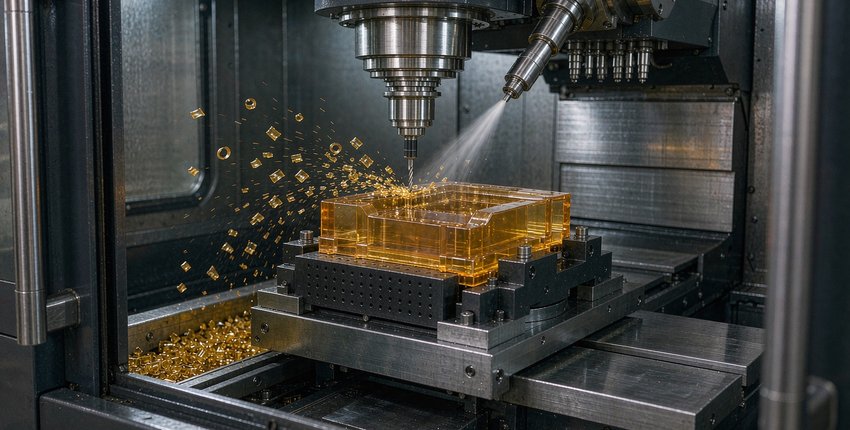
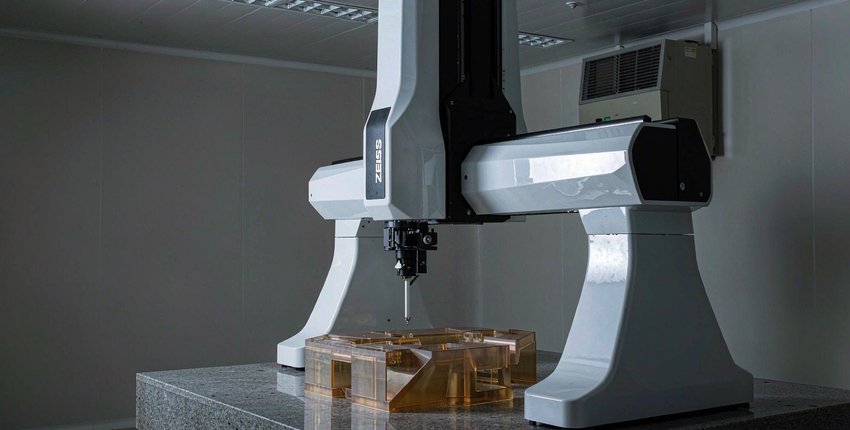
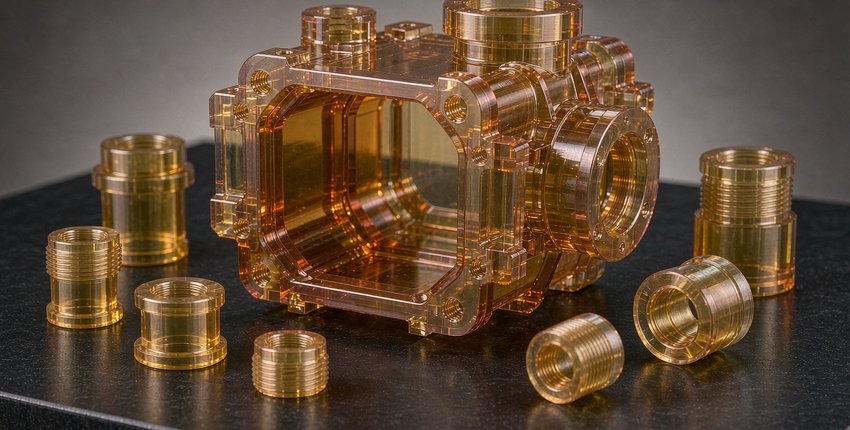
PEI (polyetherimide), sold as ULTEM 1000, is an amorphous thermoplastic specified under ASTM D5205. A glass transition of 217 C and a UL94 V-0 flame rating put it in a short list of engineering plastics qualified for aircraft interiors, medical sterilization cycles, and semiconductor handling equipment. The amber, translucent appearance has a practical side effect: light passes through thin walls, which can confuse optical measurement, so we probe polymer parts with contact CMM routines rather than non-contact scanning. Material-level data and stock sizes are collected on the PEI machining page.
| Property | ULTEM 1000 | Test standard |
|---|---|---|
| Density | 1.27 g/cm3 | ASTM D792 |
| Glass transition (Tg) | 217 C | ASTM D3418 |
| Heat deflection, 1.82 MPa | 200 C | ASTM D648 |
| Tensile strength | 105 MPa | ASTM D638 |
| Flexural strength | 150 MPa | ASTM D790 |
| CTE (23-100 C) | 56 um/m.C | ASTM E831 |
| Flammability | UL94 V-0 | UL 94 |
Stock shapes come from extruders such as Roechling, and the grade matters as much as the resin. ULTEM 1000 is the unfilled baseline. Glass-filled grades machine differently and need different tooling, so confirm the exact grade before the job is priced.
Why heat is the real enemy
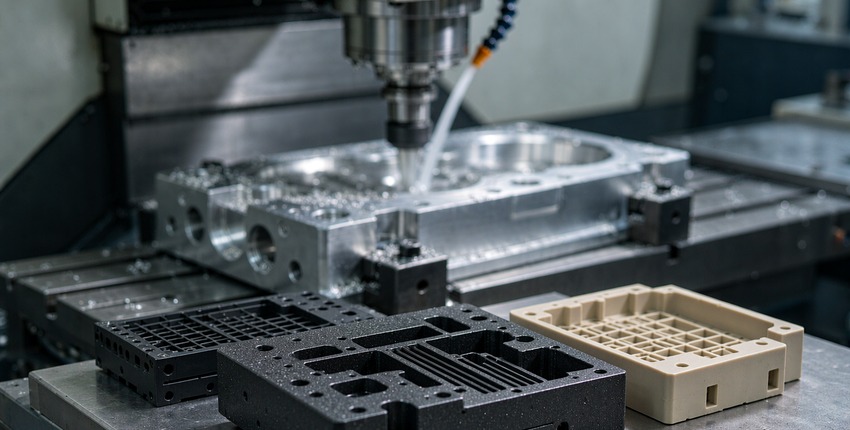
ULTEM 1000 conducts about 0.22 W/m.K. Aluminum conducts 167. Every cutting pass dumps friction energy into a thin zone around the tool tip, and in an amorphous polymer there is nowhere for that energy to go. Get the zone close to Tg (217 C) and the material softens, smears, and pulls out of tolerance inside a single finishing pass. Two rules follow. Never run flood coolant on unfilled PEI: liquid hitting a warm edge creates thermal shock that micro-cracks the cut surface, and you will not see the damage until the part is in service. And keep the edge geometry sharp. Coatings made for metal cutting round the edge, which generates heat instead of removing it, so we use sharp uncoated carbide with polished flutes for ULTEM, and switch to diamond-coated tooling only for glass-filled grades.
Parameters that work on the floor
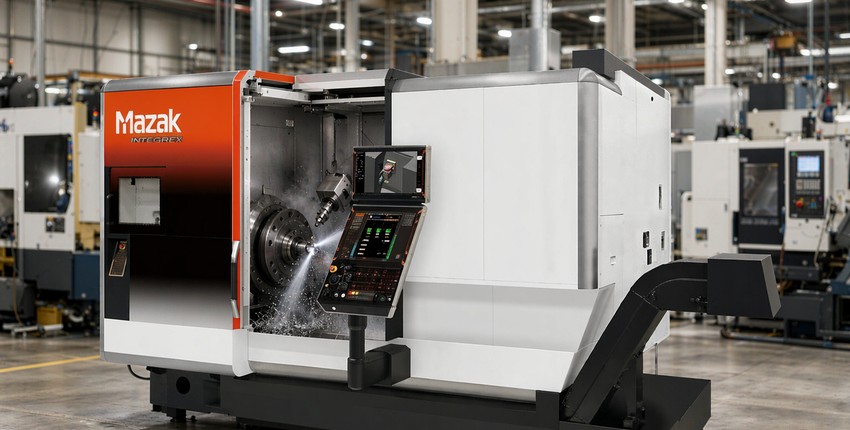
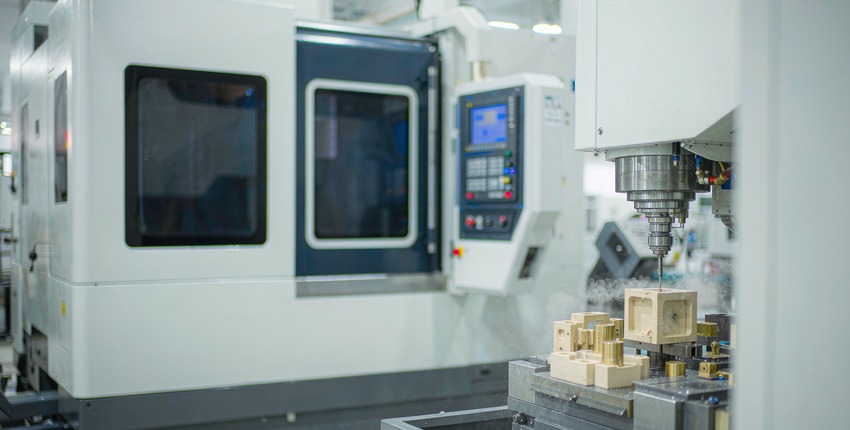
Our polymer programs run on Mazak VARIAXIS five-axis centers with compressed air cooling and vacuum workholding. The table below is the starting window we lock after first articles.
| Parameter | Roughing | Finishing |
|---|---|---|
| Tool | Uncoated carbide | Uncoated carbide, polished flutes |
| Cutting speed (m/min) | 100-150 | 150-200 |
| Feed per tooth (mm/tooth) | 0.08-0.15 | 0.05-0.08 |
| Depth of cut (mm) | 1.0-3.0 | 0.1-0.5 |
| Coolant | Compressed air | Compressed air |
These assume rigid workholding. Thin-wall sections change the answer: drop the feed per tooth by 30-40 percent and raise air pressure toward 6 bar so the chip clears without dragging. Mechanical clamps distort polymer parts while they cut, and the distortion comes back when the clamp releases. Vacuum and form fixtures are not a luxury here, they are the tolerance.
Tolerance is a thermal budget before it is a toolpath
Holding plus or minus 0.01 mm in ULTEM is an environment problem with a programming component. A 100 mm part heated 10 C during cutting expands 0.056 mm. Cut it to nominal while it is warm and it shrinks undersized at room temperature; on a 200 mm part that is a 0.11 mm error, enough to scrap the piece. We cut polymers in a temperature-controlled shop, and between roughing and finishing we let the part rest in a bake window sized per geometry so residual stress relaxes before the finish pass. After that, GD&T per ASME Y14.5-2018 behaves predictably: flatness and parallelism on thin sections hold only with vacuum fixturing and minimal clamp force, while general tolerances follow ISO 2768-mK on non-critical features.
ULTEM 1000 vs ULTEM 1010 vs PEEK
PEEK costs three to four times more than ULTEM 1000 with a lower Tg (143 C against 217 C) but better chemical resistance and a lower CTE (47 against 56 um/m.C). If the part never sees aggressive chemicals or continuous service above 200 C, ULTEM 1000 delivers comparable mechanical performance for a fraction of the material cost. ULTEM 1010 shares the base properties and adds food-contact compliance, which is why it shows up in food processing equipment. The premium grade only pays when the regulation or the chemistry demands it.
An aerospace example: printed PEI versus machined PEI
A wastewater treatment component for an aircraft system shows where machining earns its keep. The customer, a top-tier European aerospace and defense group, had tried the part in 3D-printed PEI and in injection molding. Printed PEI showed layer-bond inconsistencies at the sealing features, and molded parts warped during cooling on uneven sections. Neither held the assembly tolerance. We machined the part from extruded ULTEM 1000 stock sourced directly from the extruder, which cut material cost by roughly 20-30 percent against the typical supply chain. Dimensional accuracy improved from plus or minus 0.1 mm as printed to plus or minus 0.02 mm machined, and surface finish went from Ra 3.2 to below Ra 0.8. The layer-bond leakage risk disappeared by design because there are no layers. Full-size inspection plus an assembly trial closed the qualification in about four weeks before the program moved to serial production. The full background sits on our PEI aerospace case study.
Frequently asked questions
Can ULTEM 1000 hold metal-like tolerances?
On short dimensions, yes, down to plus or minus 0.01 mm on stable features. Across spans over 100 mm the thermal budget takes over, and the realistic number depends on the shop temperature and the part geometry more than on the machine.
Is PEEK always the better choice over ULTEM?
No. PEEK wins on chemical resistance and lower moisture uptake. ULTEM 1000 wins on cost, higher Tg, and stiffness at temperature. For clean, dry, hot environments, ULTEM is often the rational choice at a quarter of the material cost.
Do you machine glass-filled PEI grades?
Yes, and we change the process for them. Glass content is abrasive, so tooling moves to diamond-coated carbide and the parameters tighten. Confirm the exact grade and filler percentage at quoting.
What wall thickness can you hold in ULTEM 1000?
We regularly machine wall sections down to 0.3 mm with vacuum fixturing and reduced feed. Below that, the part needs to be assessed against its service loads, because machining it is easier than keeping it from flexing afterward.
Edited by Qiaosheng Hu, Founder & General Manager.
Have a project in mind?
Send drawings to kgl@kglmfc.com or request a quote. We respond within 24 hours.
Request a Quote