PEI vs PEEK vs Nylon for Aerospace Interior Parts: A Machining Perspective
PEI (ULTEM), PEEK, and nylon compared for aircraft cabin and interior components. FST behavior, temperature and moisture limits, machining notes, and cost ranking from a shop that cuts all three.
Aircraft interior parts live in a narrow box: limited mass, strict flammability rules, contact with cleaning agents, and temperatures that swing from a cold-soaked cabin floor to a sunlit window shade rail. Three machined plastics cover most of that box: PEI (sold as ULTEM), PEEK, and the nylon family. Customers ask us which one their bracket, clip, duct spacer, or seat component should be. The honest answer depends on the requirement they cannot relax, and this article walks the decision the way we walk it on the floor.
1. What each material actually is
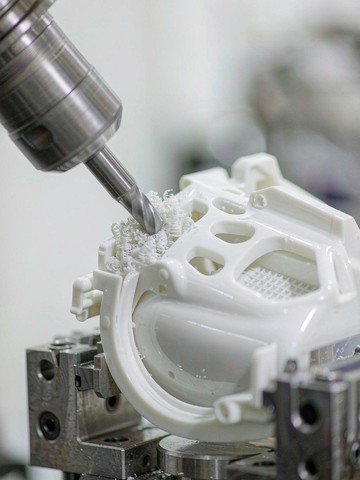
PEI (ULTEM 1000 and the glass-fiber grades) is an amorphous thermoplastic with a glass transition near 217 C. It is the workhorse of cabin interiors because flame-retardant formulations exist across the whole family, it holds a dimension well, and it machines like a well-behaved engineering plastic. ULTEM 9085, the grade most cabin specs name, adds FST performance tuned to aerospace test regimes.
PEEK is the semi-crystalline top tier: glass transition near 143 C, continuous service in the 200 C class, chemical resistance across fuels, hydraulic fluids, and solvents, and strength that approaches aluminum in filled grades. Unfilled PEEK is already expensive; the carbon- and glass-filled grades cost more and machine harder.
Nylon (PA66, PA66/6 blends, and PA12) is the volume plastic of the group: tough, abrasion resistant, cheap relative to the other two, and forgiving in cut. Its weaknesses are moisture and heat. Nylon absorbs water from the air in meaningful percentages, which moves dimensions and softens stiffness, and its glass transition sits near room temperature, so stiffness changes between a cold hold and cabin service.
2. The three-way comparison that decides interior parts
| Property | PEI (ULTEM) | PEEK | Nylon (PA66 / PA12) |
|---|---|---|---|
| Glass transition | About 217 C | About 143 C | About 55 to 60 C |
| Continuous service temp | About 170 C | About 250 C | About 100 to 120 C dry |
| Flammability and FST | Strong; aerospace FST grades standard | Inherently flame resistant, low smoke | Needs additives; rarely the FST pick |
| Moisture absorption | About 0.25 percent, low | About 0.5 percent, low | 2 to 3 percent or more, dimension shifter |
| Strength and stiffness | Good, predictable | Excellent, best with carbon fill | Tough and impact friendly, softer when wet |
| Chemical resistance | Good, weaker against some solvents | Excellent, near universal | Good against fuels and oils |
| Relative material cost | Medium | Highest | Lowest |
| Machining difficulty | Moderate | Moderate to high | Easy, watch heat and moisture |
Read the table through the cabin lens and the split appears. PEI is the default interior plastic because FST grades are standard and its low moisture uptake keeps clips and rails dimensionally quiet. PEEK wins where the part sees real heat, fuel, or hydraulic fluid, or where a filled grade must replace a metal part inside a tight mass budget. Nylon wins where the part is hidden, loaded in impact and abrasion, and far from any FST requirement, which is why it thrives in mechanisms behind panels rather than on them.
3. How to choose for an interior part
We route the question through four gates, in order.
Gate one: FST. If the part sits exposed in the cabin or in an air duct, flammability, smoke, and toxicity rules usually decide before strength does. That points to an aerospace FST grade of PEI or PEEK. Nylon is only in the conversation for concealed hardware.
Gate two: environment. Contact with hydraulic fluid, fuel, de-icing agents, or aggressive cleaners pushes toward PEEK. Constant moisture or a washdown step pushes away from nylon unless the drawing tolerances were set on a wet part.
Gate three: load and temperature. A seat track insert or a structural clip near a heat source needs the modulus of PEEK or a glass-filled PEI. A wire bundle spacer or a light-duty guide rarely needs more than nylon or unfilled PEI.
Gate four: volume and cost. Only after the first three gates pass does price get a vote, and the spread is wide: on a per-kilogram basis PEEK sits several times above PEI, and PEI several times above nylon. Our cost factors article explains how material choice ripples into cycle time and scrap risk.
Two traps worth naming. First, nylon shipped in one humidity state can drift outside tolerance in another; we machine nylon to dimensions that assume cabin humidity, and we say so on the inspection report. Second, "PEEK" on a drawing without a grade hides filled-versus-unfilled decisions that double the price; specify the grade and the stock form.
4. How each machines on our floor
All three cut dry-friendly compared to metals, but they punish heat differently.
PEI machines closest to a metal habit: predictable chips, stable dimensions, and sharp tooling lasts. The amorphous structure means less internal stress drama than semi-crystalline stock, though thick sections still get stress relief before finish passes.
PEEK's low thermal conductivity, similar to other engineering plastics, means cutting heat stays in the cut. Our sequence: sharp positive-geometry tools, air blast or light mist instead of flooding for thin parts, and staged roughing with rest periods so the section stays uniform in temperature. For tight-tolerance PEEK, annealing before and between operations is the difference between a part that measures true and one that moves overnight; our PEEK warpage article covers the full sequence.
Nylon machines easily and heats just as happily, with one extra wrinkle: it is hygroscopic, so stock that sat in a humid warehouse machines wet. We condition stock before cutting and keep glistening surfaces, a sign of heat smearing, out of the process with higher surface speed and lighter depth.
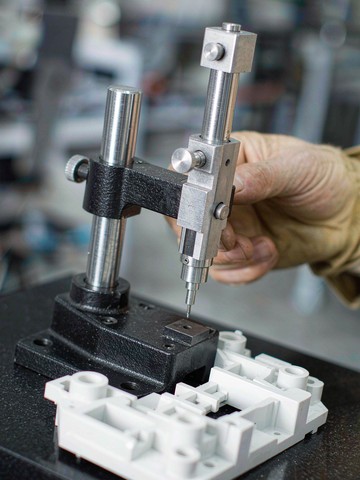
On controlled features we hold plus or minus 0.005 mm on all three families, verified on our CMMs with fixturing that grips plastic without crushing it. Plastic inspection has its own rhythm: the part must reach room temperature uniformly before layout, or the reading chases the cooling curve.
5. What each choice costs
Material sets the floor of the cost stack, and the ordering is stable: nylon cheapest, PEI in the middle, PEEK several times above PEI per kilogram. But two machining effects move the final number more than buyers expect.
Scrap risk scales with price. A warped PEEK bracket costs its full material value again, so the anneal-and-stabilize time we build into the plan is cheaper than the gamble. Buy-once-cut-twice is the expensive path.
Cycle time scales with care. PEEK's heat management adds rests and staged passes; nylon's moisture conditioning adds prep time; PEI mostly just machines. For a mid-size clip family in volume, the machining time spread across the three materials is modest, which is why the material bill dominates the comparison once volumes rise.
Our practical quote pattern: PEI lands in the middle on nearly every interior RFQ, PEEK costs more and buys real capability where heat and chemicals live, and nylon costs least until someone discovers the moisture drift. The cheapest part is the one that does not come back.
6. Where we land
Exposed cabin or duct part with FST on the drawing: PEI, usually ULTEM 9085 or 1000 depending on load. Heat, fluids, or metal replacement: PEEK, grade and fill specified up front. Concealed mechanism part with impact and abrasion: nylon, dimensioned for service humidity. If your drawing names a different combination, our PEI machining, PEEK machining, and nylon machining pages list grades and stock forms, and our aerospace team reviews interior drawings against AS9100D-aligned process controls.
Which of the three is most common for aircraft cabin brackets?
PEI. Aerospace FST grades of ULTEM are standard across cabin interiors, machine predictably, and hold dimension in the humidity range cabins see. PEEK appears where a specific heat or fluid requirement exists, and nylon mostly serves concealed mechanism hardware.
Can PEEK replace aluminum in interior parts?
In filled grades, sometimes, with a real mass saving. The check is stiffness at service temperature and the fastener scheme, since plastics creep under sustained bolt load where aluminum does not. Send the load case and we will give a straight answer.
How do you keep nylon parts dimensionally stable?
We condition stock before cutting, machine to dimensions that assume cabin humidity, and note the assumption on the inspection report. Parts that must hold tight tolerance in changing humidity are better routed to PEI, whose moisture uptake is roughly a tenth of nylon's.
Do you supply material certifications with machined plastic parts?
Yes. Mill certs trace every lot, and our dimensional inspection report ships with each order. FAI to aerospace formats is available for new interior parts under our AS9100D scope.
If you are choosing between these three for an interior program, send the drawing and the environment description through the RFQ page or write to kgl@kglmfc.com. We will route the material, state the machining plan, and quote what the choice really costs.
Related Articles
More from the Engineering Plastics series.
Have a project in mind?
Send drawings to kgl@kglmfc.com or request a quote. We respond within 24 hours.
Request a Quote