Prototype to Production: What Changes and What It Costs
What actually changes when a CNC part moves from prototype to production: fixturing, process control, quality documentation, and the cost drivers that decide unit price at volume.
A prototype answers one question: does the design work? Production has to answer a harder one: can every part, in every lot, meet the drawing for as long as the program runs? Buyers sometimes expect the move from prototype to production to be a price negotiation. In practice it is a process change. The part stays the same; almost everything around it changes. We have written about prototyping methods and about how to evaluate a supplier. This page covers the transition itself: what changes on the shop floor, what changes in the documentation, and where the unit cost actually goes.
1. What stays the same when volume changes?
The part definition does not change. Material specification, tolerance bands, surface finish, and the functional features that made the prototype worth testing all carry over. If a dowel bore was held to a ±0.005 mm band on the prototype, the production part needs the same band, verified the same way.
What does change is how often that claim is demonstrated. A prototype is verified once, part by part. A production run is verified by process: the first article proves the setup, and lot inspections keep proving it. The tolerance standard is identical. The evidence behind it becomes routine instead of exceptional. That is the whole discipline of the transition in one sentence.
2. What changes on the shop floor?
Prototype machining optimizes for speed of response. One machine, general-purpose fixtures, an operator who adjusts as the part develops. Production machining optimizes for repetition, and repetition changes the setup logic.
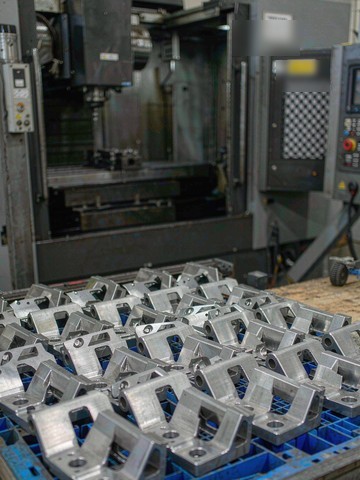
Fixtures become dedicated. Soft jaws and modular vises give way to fixtures built for this part, so every part clamps in the same place and the first chip lands on a known reference. The time to build them is real, which is why it belongs in the production quote, not hidden inside it.
Setup count drops. Where the prototype made do with two operations, production planning asks whether a five-axis cycle or a redesigned datum scheme removes the second setup entirely. Fewer handoffs means fewer chances for cumulative error and a lower cost per part.
Machines get assigned deliberately. Our shop runs 100+ CNC machines, including 11 five-axis centers. At volume we assign the job to specific machines that have proven stable for that feature set, and the process sheet records that assignment. A process that lives on one named machine is easier to keep capable than one that drifts across the shop.
Checks move in-process. Operators sample features at the machine on a defined cadence instead of inspecting a single part at the end. Problems surface on part twelve, not on part four hundred.
3. What changes in the quality documentation?
For a prototype, most buyers want a dimensional report and a material certificate. For production, the documentation has to be planned before the first chip is cut, because it becomes part of every shipment.
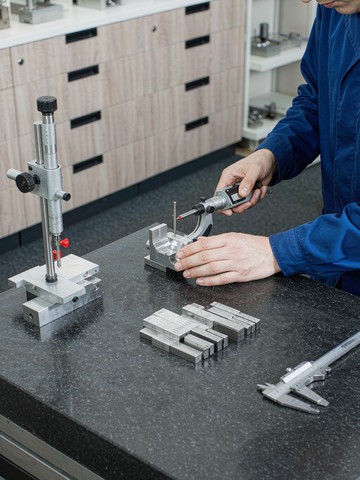
The first article report comes first: every dimensioned feature on the drawing, measured and reported, typically on the CMM. Our lab runs Hexagon and Zeiss bridge CMMs with 0.0015 mm machine accuracy within a pool of 40+ inspection instruments. After the first article, the inspection plan drops to the features that matter for the function, checked per lot at a frequency agreed with the customer, with material certificates and traceability records kept per order under our ISO 9001:2015 system, and under ISO 13485:2016 or AS9100D scopes where the program requires them.
The report format is worth agreeing at the start of production, not at the first audit. When the customer and the supplier sign off on the same inspection plan, every later conversation about quality starts from numbers both sides already accept.
4. What drives unit cost when volume grows?
Unit cost in machining is not a mystery. It is cycle time and material, plus a one-time pool that gets spread across the quantity, plus the quality overhead the drawing demands. Knowing which bucket a cost sits in tells you which lever moves it.
The one-time pool shrinks per part. Programming, fixture building, first article inspection, and the initial setup are fixed. On a single prototype they can dominate the quote. Spread over a thousand parts they become a small line, which is why a production unit price should never be extrapolated backward from a prototype price, or forward from it.
Cycle time becomes the whole game. At volume, the cutting time per part outweighs almost everything else. This is where setup reduction, tooling choices, and unattended running pay off. It is also where our customers ask the right question: not "what does this part cost", but "what would make this part cheaper without touching the function".
Tolerances price themselves. A band tighter than the function needs costs money twice: longer cycles and a lower first-pass yield. Call the tolerance the function requires and the cost curve stays flat. Ask for the tightest band on every feature and it climbs steeply. The same logic applies to finish callouts and to cosmetic requirements on non-cosmetic faces.
Quantity changes the process, not just the price. Batch size decides whether a job justifies dedicated fixtures and CAM optimization. A serious quote states the assumed quantity and the assumptions behind it, so when your forecast changes, you know exactly which cost lines move.
5. How should a buyer manage the transition?
Three habits separate smooth programs from painful ones, and none of them costs extra.
Freeze the drawing after prototype validation. Changes after production tooling exists are the most expensive kind. Take the lessons from the prototype, fold them into a released revision, and let production start from a stable definition.
Agree the inspection plan before the first production order. Which features are checked per lot, which are first-article-only, what ships with the parts. An hour here prevents a month of back-and-forth later.
Keep prototype and production under one roof where you can. When the shop that machined the prototype also runs production, the process knowledge, the fixturing decisions, and the error history carry over. Re-qualifying a new supplier mid-program usually costs more than any unit-price difference that motivated the move. If you do move, our supplier evaluation guide lists what to check first.
At KGL the transition runs on one workflow, described on our prototype to production service page: quote in 24 hours through the RFQ page with no minimum order for prototype quantities, first article on every new part number, and production lots reported against the same plan. The people who quoted the part stay with it into volume, which is the least glamorous and most effective cost-saving tool we know.
Frequently Asked Questions
Is there a minimum order quantity to move from prototype to production?
No. We machine prototypes with no minimum order and plan production runs against your forecast, from small batches upward. The process changes with volume; the ordering discipline does not.
Does the prototype supplier have to be the production supplier?
It helps. Process knowledge, fixtures, and inspection plans carry over, and the first article is faster because the shop already knows the part. Moving suppliers mid-program is workable but means re-qualification and a new first article.
What tolerance can you hold at production volume?
±0.005 mm on machined features is our standard band across the shop. ±0.002 mm is available on specific features machined on our five-axis centers, verified with full CMM inspection, with those conditions noted on the report.
Why is the production unit price lower than the prototype price?
The prototype quote carries programming, fixturing, setup, and first article in full. In production those one-time costs are spread across the quantity, and cycle-time optimization lowers the per-part cutting cost. The two prices answer different questions and should be quoted separately.
What documentation ships with production lots?
First article report on the initial run, per-lot inspection results against the agreed plan, material certificates, and traceability records kept per order. Additional documentation is available under our ISO 13485 and AS9100D scopes where the program requires it.
This article is general engineering guidance, not a binding manufacturing guarantee. Tolerances, lead times, and pricing are confirmed per part based on drawings, materials, quantities, and process review. Request a formal quotation for part-specific terms. (c) 2026 KGL. All rights reserved.
Related Articles
More from the Design for Manufacturing series.
Have a project in mind?
Send drawings to kgl@kglmfc.com or request a quote. We respond within 24 hours.
Request a Quote