How Fast Can You Get a CNC Quote? Inside Our 24-Hour Process
What happens in the 24 hours after you send an RFQ for CNC machined parts: file intake, engineering review, routing, costing, and the questions a serious supplier asks before quoting.
You send a drawing at 9 in the morning and a complete price lands before you leave the next day. That is the promise, and we have quoted that way since we opened the export desk. But a 24 hour CNC quote is easy to claim and easy to fake, because the fake version is just a number with nothing behind it. This piece walks through what the day actually looks like on our side of the RFQ, so you know what you are buying when the reply arrives, and what you can send to keep it fast and accurate.
1. What does a 24 hour quote actually contain?
The reply that lands in your inbox within one working day is not a single figure. It carries a unit price at your stated quantity, tooling and fixture charges broken out separately, a material line naming the grade and temper, a lead time with the routing behind it, and the assumptions we made where your drawing was silent. If your part has tight features, the quote answers them explicitly: our standard band on milled and turned features is ±0.005 mm, with ±0.002 mm available on specific five-axis features under full CMM verification.
The assumptions block matters as much as the price. It records what we presumed about finishing, packaging, documentation, and inspection depth, so that when your expectation differs, the conversation is about a line item instead of a misunderstanding. A quote you cannot argue with is a quote nobody checked.
2. What happens in the first hour after your RFQ arrives?
Intake is a technical screen, not a sales script. Within the first hour, an engineer opens the files and checks four things: whether the 2D drawing matches the 3D model, whether the tolerance block is legible at print size, whether the material is named to a grade, and whether any feature is dimensioned in a way the machine cannot reach. If something blocks pricing, you get a question inside that hour, not a price built on a guess.
This is where the clock is usually won or lost. An RFQ with a complete 2D drawing, a 3D model, and a stated quantity band moves straight to engineering. A screenshot of a part with "similar to this, please quote" needs a phone call before anyone can price it honestly, and the clock does not really start until the call ends. Our RFQ page lists exactly what to attach, because the fastest quote is the one that never has to stop and ask.
3. What does the engineering review actually check?
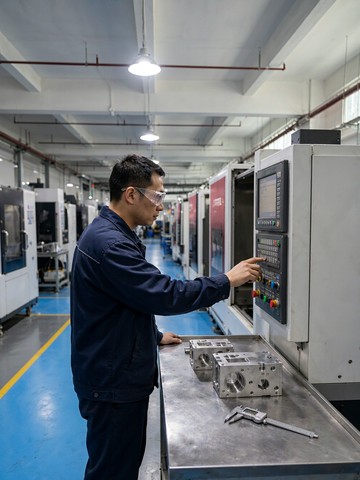
Between the first and the eighth hour, the part gets reviewed the way production will run it. Tolerances are read feature by feature against the function, and anything tighter than the standard band gets a plan before it gets a price. Material is checked for stock availability, since a grade we hold on the floor quotes today and a special order quotes with the mill's lead time attached. Fixturing is sketched, the number of setups is counted, and the machine assignment is made: a three-axis mill, a turn-mill cell, or a five-axis center from our park of 11 five-axis machines inside a floor of 100+ CNC machines.
Where the drawing raises a real question, the review writes it down and the question goes into the quote. Should this face carry the tight band, or is the mating bore the only functional datum? Does the anodizing mask include the bore, or only the cosmetic surfaces? Questions asked at this stage are free, and they are the same questions our engineers would raise in a design for machining review. That habit is also why our quotes read like engineering notes instead of invoices.
4. How is the price built between hours eight and twenty?
Costing runs off the routing, not off a lookup table. Cycle time is estimated per operation from the actual machine assignment, the fixture count turns into a one-time charge, and finishing, inspection depth, and documentation are added as named lines. The quantity band you gave decides how the pool spreads: on ten parts, programming and first article inspection dominate; on a thousand, they fade into a small line. Our guide to what drives machining cost covers the logic in detail, because buyers who understand the structure quote better next time.
Lead time is built the same way. The routing names the operations, the queue position of the assigned machines, and any outside process such as anodizing or passivation. When our published five-axis capability applies, sampling can move even faster than the quote: we commit to first samples on a scheduled window on parts that fit that route. A lead time with a routing behind it survives contact with the shop floor. A bare number of days does not.
5. What slows a quote down, and how do you avoid it?
Five things, in our experience, cause almost every delay. A drawing without tolerances. A 3D model that disagrees with the 2D. A material named only as "aluminum" or "stainless". A quantity stated as a single number when the real program has bands. And a silence about finishing and documentation that forces us to assume, then disclaim. Each one is fixable in a minute before you hit send.
The counter-habit takes even less time. Send the 2D with the tolerance block, the 3D as a STEP file, the grade and temper if you know them or an invitation to recommend one, realistic quantity bands, and the finishing plus certificates the order actually carries. Buyers who send that package regularly get quotes the same day, and our twenty point checklist for choosing a supplier in China uses the same file set as its scoring input.
6. When is 24 hours the wrong promise?
Honesty cuts both ways, so here is where our own clock stretches. Multi-part assemblies that need a full fixture plan quote in two to three days, because guessing at the holding would price the job wrong. Exotic alloys we do not stock carry the mill's lead time in the material line. Program-level work under our AS9100D or ISO 13485 scopes, where the first article plan and the documentation file are part of the deliverable, gets a quote with a longer clock and a much deeper content. If you need that depth, our inspection page shows what a full documentation package includes.
When a quote needs more than a day, we say so within the first hours and give you a firm time instead of a vague one. That trade is deliberate. A fast wrong number costs a week. A slightly slower right number starts production.
That is the whole day: a technical screen in the first hour, an engineering review before lunch, a priced routing by evening, and a reply with assumptions you can argue with by the same time tomorrow. If you want to test it, send a drawing through the RFQ page and time us. If you are still comparing suppliers rather than quoting a part, the factors worth weighing in a CNC supplier and the certifications behind our quality system are both published, and our equipment list shows the machines your part would actually run on.
Frequently Asked Questions
What files do you need for a 24 hour CNC quote?
A 2D drawing with the tolerance block, a 3D model in STEP or IGES, a quantity range, the material grade if it is decided, and the finishing plus documentation the order carries. That package is enough to price without follow-up questions, which is what keeps the clock under 24 hours.
Is a 24 hour quote less accurate than a slower one?
Not when it is built from the drawing. The price comes from the same routing and cycle time estimates a slower quote would use; the 24 hour target is a discipline about how quickly the review runs, not about skipping it. What suffers accuracy is a quote produced without reading the tolerance block, at any speed.
Do you charge for quoting or for DFM feedback?
No. Quoting includes a manufacturability review, and the questions it raises come back with the price at no cost. The reason is practical: a question asked at quote stage is free, while the same question after production starts costs a fixture or a delayed batch.
How fast can you deliver first samples after the quote?
For parts that route onto our five-axis or turn-mill cells, first samples on a scheduled window is the standing commitment. Parts that need outside finishing, special stock, or full program documentation take longer, and the quote states the lead time with the routing behind it so you can see why.
Can you sign an NDA before I send drawings for a quote?
Yes, and we recommend it for anything with proprietary geometry. Send the NDA first and the drawings second; the 24 hour clock starts when the technical package is complete and cleared. Our D-U-N-S number, 54-443-4542, ties the signature to a verifiable legal entity.
This article describes our standard quoting workflow, not a binding turnaround guarantee. Quote and delivery times are confirmed per part based on drawings, materials, quantities, and process review. (c) 2026 KGL. All rights reserved.
Related Articles
More from the Design for Manufacturing series.
Have a project in mind?
Send drawings to kgl@kglmfc.com or request a quote. We respond within 24 hours.
Request a Quote