What Are the Red Flags of an Unreliable CNC Machining Supplier?
Red flags that show up early when buying CNC machined parts: quotes that ignore tolerances, unverifiable certificates, evasive video calls, and inspection reports without measured values.
A CNC machining supplier tells you who they are before the first order, if you know where to look. The strongest warning signs show up early: a quote that ignores your tolerance callouts, certificates without numbers, a video call that never reaches the shop floor, inspection reports with pass stamps instead of measured values, and payment terms that push all the risk to one side. One red flag deserves a question. Two or three deserve a walk away. These are the signals we would act on if we were buying machined parts, and the standards our own customers held us to before their first order.
1. Which red flags show up in the first quote?
A serious quote talks back to the drawing. It names the material by grade and temper, 7075-T651 rather than "aluminum", and it asks about the callouts that drive cost. When we quote a part with tight tolerance features, we answer them: our standard band on milled and turned features is ±0.005 mm, with ±0.002 mm available only on specific five-axis work under full CMM verification, and we say so in the quote. A price that skips the tight features entirely is pricing them as if they do not exist.
Four patterns deserve attention. The first is a price far below every other quote with no clarifying questions behind it, which usually means nobody read the tolerance block. The second is missing batch logic, so part number one hundred costs the same as part number ten. The third is a lead time stated as a bare number of days with no routing behind it. The last is silence about what happens when a feature measures out of tolerance. Each one is answerable on its own; together they describe a supplier that will discover your part during production.
2. What do certificate and document red flags look like?
Certificates are the easiest claim to fake and the easiest claim to verify, which is why weak suppliers hide in the gap between the two. The red flags: a certificate image with the number cropped out, a scope of registration that covers trade rather than machining, an audit body nobody recognizes, and a refusal to name the registrar. A real certificate carries a number you can check on the certification body's website. Ours does: ISO 9001:2015 number 46524Q10234R0M, with AS9100D and ISO 13485:2016 held for aerospace and medical work, all listed on our certifications page.
Legal identity belongs in the same check. A D-U-N-S number ties the name on your purchase order to a registered entity; ours is 54-443-4542, and we explain what that number does for buyers in a separate note on business identity. If a supplier cannot produce a verifiable legal identity and a verifiable quality certificate in the same week, the delay is the answer.
3. Which answers on a video call should worry you?
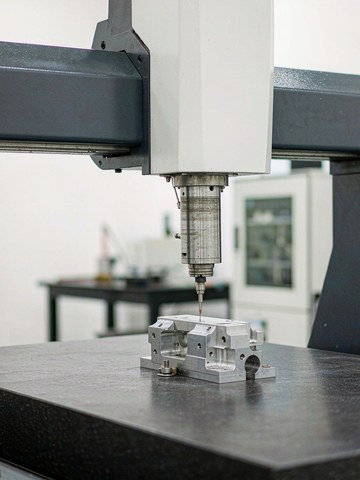
A scripted promotional video is not a factory tour. Ask for a live call from the shop floor and request three things on camera: a machine of their choice cutting a real part, a random walk down one aisle, and the inspection room. Evasive scheduling is the first red flag. Refusal to open a machine door or to show where parts get measured is the second.
Listen to how specifically they describe capability. A real shop names brands and models without hesitation. Ours runs 100+ CNC machines including 11 five-axis centers: Mazak VARIAXIS C-600 machining centers, Mazak INTEGREX mill-turn machines and FANUC ROBODRILL compact mills, and the list is published on our equipment page. The same applies to inspection. We name 40+ instruments, including Hexagon and Zeiss bridge CMMs at 0.0015 mm machine accuracy, and that room is open to a camera on request (see our inspection setup). A supplier who answers "machines and QC equipment, plenty" has already told you something.
4. How do sample parts and inspection reports expose a weak supplier?
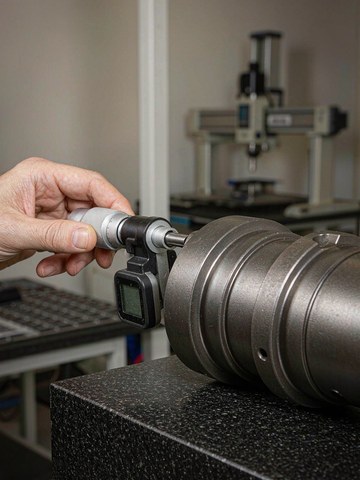
The sample round is where vague suppliers run out of adjectives. Ask for a first article inspection with a ballooned drawing: every numbered characteristic matched to a measured value. A report that says "OK" or "PASS" without numbers is not a report, it is a mood. The same applies to material. No mill certificate per lot means the supplier cannot prove what alloy went into your part, and on aerospace or medical work that alone disqualifies them.
Then watch what happens when something measures wrong. A strong supplier sends the before and after values, explains the cause, and re-runs the affected features. A weak one reworks quietly and hopes the next shipment passes. Our FAI flow with CMM verification is published so buyers can compare it against what they receive: a measured result for every dimensioned characteristic, read on Hexagon and Zeiss bridge machines (first article workflow).
5. Which commercial terms are warning signs, not dealbreakers?
Some warning signs are negotiable, and it helps to know which. Payment on a first order usually splits into a deposit with the balance before shipment; a demand for one hundred percent upfront is not disqualifying on its own, but it moves every risk to you and it is fair to counter. Tooling and fixture charges should be itemized, not blended into piece prices where they can be charged twice. A quote validity date should be in writing.
Contract paper matters too. A supplier that resists signing an NDA before receiving drawings, or offers one where confidentiality runs only one way, is telling you how they will treat your data for years. None of these items is a reason to walk on its own. The pattern is what matters, and the way a supplier negotiates your risk clauses previews how they will handle your warranty claims.
Red flags are cheap to read and expensive to ignore. Score the quote, verify the certificates, walk the floor on camera, and test the reports against the drawing before the purchase order, not after. The two checklists we run on ourselves cover the same ground from the positive side: the factors to weigh when evaluating a CNC machining supplier and a twenty point question list for choosing a supplier in China. Use them on us first. Then send the drawing through our RFQ page and compare what comes back against the standards in this article.
What a Real Quote Comparison Looks Like
A buyer once sent us a competing quotation for a 7075 aluminum valve block and asked why our price was higher. The other quote never named the material temper, so T6 and T651 were left interchangeable, asked no question at all about the 0.01 mm true position callout on the ports, and listed delivery as "as soon as possible." Our reply went back inside 24 hours: the material stated as 7075-T651 with its yield strength, a tolerance plan for the position callout backed by CMM verification records, and a phased delivery schedule with named dates. The buyer placed the order at a unit price 15 percent above the competing bid. Red flags on a quotation are not cosmetic details. They are the visible edge of how a supplier will behave once the part is on the machine.
Frequently Asked Questions
What is the biggest red flag when choosing a CNC machining supplier?
Inspection paperwork without measured values. A pass stamp is an opinion, while a dimensional report with a value for every drawing characteristic is the minimum evidence that anyone actually measured your part. Stamps cost nothing to print; numbers that exist cost nothing to share.
Is a low quote always a red flag?
No. Prices differ for honest reasons: overhead, machine park, batch size, location. A low quote becomes a red flag when it arrives with no questions about your tight features, no material grade, and no logic behind the lead time. That combination means the price was not built from the drawing.
Do certifications prove a CNC supplier is good?
They prove a management system exists and survived an audit, which filters out the unstructured shops. They do not guarantee that any single part ships good. The red flag is not the absence of a certificate, it is a certificate that cannot be verified: no number, no registrar, no scope.
How can I check a supplier without visiting the factory?
Three steps work from any desk. Verify the legal identity and certificates against third party registries, then run a live video call on the shop floor with machine doors and the inspection room in frame, then order a sample with a ballooned FAI report and cross check the values against your drawing. A small trial order tests the whole loop before volume moves.
What payment terms are normal with a new CNC supplier?
A deposit with the balance before shipment is the common structure, with tooling itemized separately. Terms beyond that are negotiable in both directions. What matters is that the terms are written, the price basis is stated, and the supplier treats your counterproposal as normal business rather than an insult.
This article is general sourcing guidance, not a binding manufacturing guarantee. Capabilities, tolerances and commercial terms are confirmed per part based on drawings, materials and process review. (c) 2026 KGL. All rights reserved.
Related Articles
More from the Design for Manufacturing series.
Have a project in mind?
Send drawings to kgl@kglmfc.com or request a quote. We respond within 24 hours.
Request a Quote