Aluminum vs Stainless Steel for Robot Parts: What We Machine and When
Aluminum vs stainless steel for robot structural parts. Density, stiffness, corrosion, damping, machining cost, and how we route joints, arms, and end effectors to the right alloy.
Every week a robotics team sends us a drawing set where the material callout says "6061-T6 or equivalent, TBD" on one part and "304" on the next. The two metals sit in completely different corners of the property table, and picking the wrong one does not fail in the lab. It fails six months into a production run, as corrosion pits, loosened fasteners, or an arm that got heavy. This article is the routing we actually use for robotics parts, written from the machine side rather than the brochure side.
1. What the two alloy families actually are
When a robot drawing says aluminum, it almost always means a wrought 6000-series or 7000-series alloy. 6061-T6 is the default: magnesium and silicon for strength, weldable, anodizes cleanly, and predictable in cut. 7075-T6 carries roughly 1.8 times the yield strength of 6061 at the cost of weldability and a tougher corrosion story. We cover the 6061 vs 7075 decision separately in our 7075 vs 6061 comparison, so this article treats them as one aluminum family against stainless.
When a robot drawing says stainless, it usually means one of three: 304 for general corrosion resistance, 316 where chlorides or cleaning chemicals show up, and 17-4PH where a joint needs spring-grade strength in a compact section. Each machines differently, and the thread galling habits of the austenitic grades catch teams that design stainless fastener interfaces without a plan.
2. Aluminum vs stainless steel: the numbers that matter for robots
Robot parts care about mass at the end of an arm, stiffness per gram, thermal drift near sensors, and corrosion in whatever the robot wipes, sprays, or breathes. Here is how the two families compare on the properties that drive those outcomes.
| Property | 6061-T6 / 7075-T6 aluminum | 304 / 316 / 17-4PH stainless |
|---|---|---|
| Density | 2.70 to 2.81 g/cm3 | 7.75 to 8.00 g/cm3 |
| Yield strength | 270 MPa (6061-T6) to 500 MPa (7075-T6) | 215 MPa (304) to 1,100 MPa plus (17-4PH H900) |
| Thermal conductivity | 130 to 170 W/m.K, dissipates motor and drive heat | 15 to 25 W/m.K, holds heat in the section |
| Corrosion behavior | Good with anodizing; galvanic risk next to stainless fasteners in wet service | Excellent as machined; 316 for chloride and washdown exposure |
| Damping | Higher internal damping, settles vibration faster | Lower damping, rings longer after impact |
| Cutting speed, typical | 3 to 6 times faster than stainless on the same rigidity | Slower, work hardens if feeds are timid |
| Finishing | Type II or III anodize adds hardness and a fastener friendly surface | Passivation or electropolish; no coating to chip |
Two rows do most of the deciding. Density: an aluminum joint housing weighs about a third of the same geometry in stainless, and on a six axis arm that saving repeats at every joint out to the wrist. Strength: on a per-volume basis stainless wins, and 17-4PH holds roughly twice the yield of 7075, which matters when a wrist shell is too small to thicken the walls.
3. How each family behaves on our floor
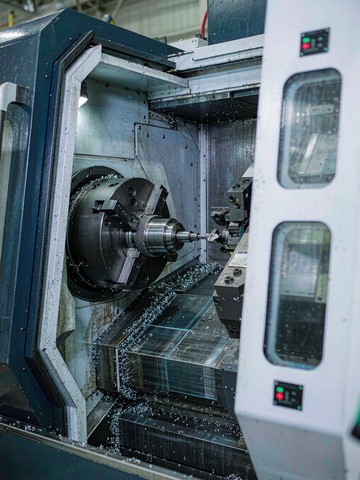
Aluminum forgives. On our 5-axis centers a 6061 housing cuts at feeds that would tear a stainless cutter apart, chips clear as bright curls, and a batch that would take two days in stainless finishes in hours. The risks are different ones: thin walls that spring after the last pass, and residual stress in thick plate that moves the part if you rough it all on one side. We rough symmetric, rest the stock, and finish both sides before critical features.
Stainless punishes hesitation. Austenitic 304 and 316 work harden right under the tool, so a light pass polishes the surface and the next pass fights a harder layer. We keep feeds aggressive and constant, use sharp positive-rake geometry, and flood coolant, because a heat-soaked insert smears and the surface gets glazy. 17-4PH in the H900 condition machines closer to a tool steel and eats inserts on schedule rather than by feel.
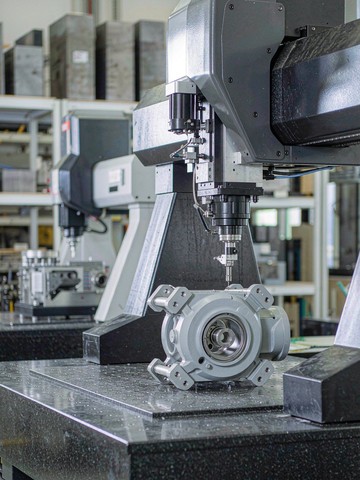
Inspection follows the material too. Aluminum parts go straight to the CMM at room temperature within minutes. Stainless holds dimension so stably that we batch its layout differently, and we watch for the burr behavior that differs between the two families; stainless burrs are tough and tenacious, aluminum burrs are soft and tear if you deburr carelessly.
4. How to choose, subsystem by subsystem
The routing below is what we quote from when a customer asks us to recommend instead of "TBD".
| Robot subsystem | Our default route | Why |
|---|---|---|
| Joint housings and arm links | 6061-T6, Type III hard anodize | Mass at the distal end dominates payload; anodize handles wear and fastener seats |
| Wrist shells and harmonic drive housings | 7075-T6 when walls are thin | Strength per section lets walls stay thin without buzzing in cut |
| Motor mounts inside the arm | 6061-T6 | Thermal conductivity pulls motor heat out to the housing surface |
| Gearbox shafts and couplings | 17-4PH or 304 depending on load | Shaft sections are small and torque dense; see our aluminum rotary coupling notes for the exception |
| Medical or lab robot wetted parts | 316L, electropolished | Chloride and disinfectant resistance beats any aluminum finishing scheme |
| Cable guides, covers, brackets off the load path | 6061-T6, Type II anodize | Cost wins where stiffness, not strength, is the requirement |
One mixed-material trap: a stainless screw threaded into an aluminum boss in a humid or washdown environment sets up a galvanic cell. The aluminum corrodes first, the joint loosens, and the design gets blamed for a materials decision. Specify coated fasteners, helicoils, or an isolation washer early, not after the first service visit.
5. What the cost difference looks like
Material price per kilogram is the smallest part of the gap. 6061 and 304 bar stock differ by a modest multiple, but the part cost rarely follows the metal.
Machining time is the first multiplier. For the same geometry and rigidity, stainless runs 3 to 6 times slower in cut, uses more inserts, and needs sharper attention to work hardening. A stainless joint cover that takes 25 minutes in aluminum can take 90 or more in 316.
Finishing is the second. Aluminum's anodize line adds a predictable, fast step and even improves dimension control if you account for buildup. Stainless finishing is passivation, cheap, or electropolish and hand blend, not cheap, depending on the surface spec.
Tooling and scrap close the gap. Stainless inserts cost more per edge and the scrap recycling value of aluminum chips partly offsets its own cost. When we quote both options for a customer, the aluminum version of a mid-size housing often lands at half the stainless price in volume, and the gap widens as the part gets bigger.
6. Our bottom line
Pick aluminum when the part carries mass penalty, heat, or a budget, and corrosion can be handled with anodize and fastener discipline. Pick stainless when the environment attacks, when the section is too small for aluminum's strength, or when a certification scheme expects it. And when a robot drawing set says "TBD", ask the shop that cuts both every day. Send the drawing through the RFQ page and we will route each part, state the machining plan, and price both alloys if the choice is genuinely close. Our aluminum machining and stainless steel machining pages list the grades we stock.
Is aluminum strong enough for robot structural parts?
For housings, arm links, and covers, yes. 6061-T6 at 270 MPa yield carries most robot joint loads with sensible wall thickness, and 7075-T6 reaches about 500 MPa for thin sections. Shafts and small torque-dense parts are where stainless or 17-4PH usually earns the call.
Which aluminum grade do you recommend for robot arms?
6061-T6 as the default: it cuts fast, anodizes cleanly, and welds if the design needs it. Move to 7075-T6 when a thin wall section needs the higher yield. We cover the tradeoffs in detail in our 7075 vs 6061 comparison article.
Can you hold tight tolerances in both materials?
Yes. On controlled features we hold plus or minus 0.005 mm as standard on both families, verified on our CMMs. Aluminum's thermal conductivity actually makes it easier to inspect quickly because the part reaches thermal equilibrium faster.
Do you machine other metals for robotics?
We cut titanium, brass, copper alloys, and carbon steel alongside aluminum and stainless, and we machine the engineering plastics used for covers and insulators. See our materials hub for the grade list, or send the drawing and we will confirm the stock we can source.
If a robot drawing set is sitting on your desk with "TBD" in the material column, send it through the RFQ page or write to kgl@kglmfc.com. We will route every part and tell you exactly where the cost and mass tradeoffs land.
Have a project in mind?
Send drawings to kgl@kglmfc.com or request a quote. We respond within 24 hours.
Request a Quote