CNC Machining 7075 vs 6061 Aluminum: Choosing for Robot Arms
7075 or 6061 for robot arm parts? Strength, fatigue, corrosion, anodizing color, machining behavior, and cost compared, with the selection our floor makes for each robot component.
Robot arms put aluminum in a specific kind of trouble: cyclic loads at the joints, long unsupported spans in the links, anodized surfaces that get handled every day, and a bill of materials where every gram and every dollar multiplies across six axes. So the 7075 versus 6061 question deserves a better answer than "7075 is stronger." We machine both alloys every week for robotics customers, and the selection we make per component is more split than you might expect.
1. The numbers that matter for a robot arm
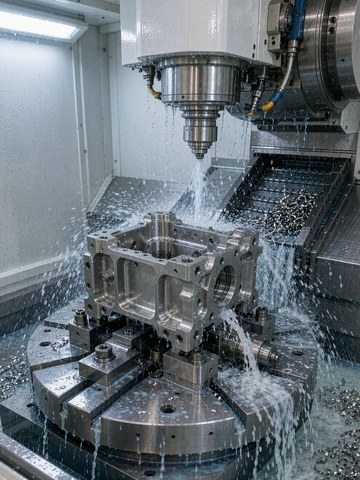
Both are aluminum, heat treated to the T6 temper, and easy to machine compared with steel or titanium. The differences that decide robot parts are strength, fatigue, corrosion behavior, and how each alloy takes an anodized finish.
| Property | 7075-T6 | 6061-T6 |
|---|---|---|
| Tensile strength | about 572 MPa | about 310 MPa |
| Yield strength | about 503 MPa | about 276 MPa |
| Fatigue strength (rotating beam) | about 159 MPa | about 96 MPa |
| Density | 2.81 g/cm3 | 2.70 g/cm3 |
| Corrosion resistance | Lower; 5.6 to 6.1% zinc leaves the natural oxide film less dense | Good; the general-purpose outdoor grade |
| Weldability | Not recommended; cracks and loses temper | Good with 4043/5356 filler |
| Anodized appearance | Yellow to olive-brown tint from copper | Clear, uniform, the familiar aluminum look |
| Typical stock cost | Higher; plate commonly around 1.5 to 2 times 6061 | Lower; the most available aluminum grade |
The fatigue row is the one robotics buyers underestimate. An arm link sees millions of small load cycles, not one big one, and 7075 carries roughly 60 percent more stress per cycle before fatigue becomes the failure mode. On a joint housing where section thickness is limited by packaging, that headroom is often the whole argument for 7075. Two more notes behind the table. Plate stock is usually supplied as 7075-T651, the stress-relieved temper, with the same strength values and better flatness stability on wide parts. And on strength to weight, 7075 outscores not only 6061 but stainless steel and titanium as well, which is exactly why high-load joints and connecting arms remain its home territory.
2. The anodizing detail that surprises design teams
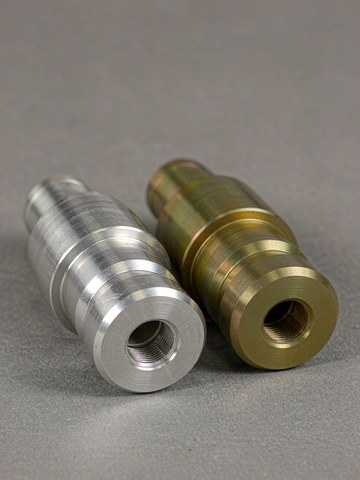
Both alloys anodize per MIL-A-8625 Type II or Type III, but they do not come out the same color. 6061 anodizes to the clear, uniform finish most people picture when they picture anodized aluminum. 7075 carries more copper, and copper in the alloy turns the same Type II bath a yellow to olive-brown tone, darker in Type III hardcoat. If your robot mixes 6061 covers with 7075 structural parts under one cosmetic spec, the parts will not match after finishing, and no amount of process control at the anodizer makes copper disappear.
We handle this two ways, depending on what the customer values. Where cosmetics lead, we suggest 6061 for visible components and keep 7075 underneath. Where the visible surface must also be a 7075 part, we sample the finish first so the color is agreed before the batch runs. Our anodizing page covers the finish options in detail, and our alloy selection guide compares both grades against titanium for higher-load work.
3. How we protect 7075 from corrosion: a three-layer scheme
7075 pays for its strength with corrosion behavior. With zinc at 5.6 to 6.1 percent, its natural oxide film is less dense than the film 6061 forms, so in humid, coastal, or washdown environments bare 7075 needs protection built into the plan. Our control scheme runs in three layers:
- Layer 1, all machined surfaces: Type II sulfuric anodizing per MIL-A-8625, film thickness 25 to 50 um, to build a uniform, dense oxide layer that seals the substrate.
- Layer 2, high-corrosion-risk duty: Type III hard anodizing, or electroless nickel plating per ASTM B733, which lifts surface hardness above HV 500 while isolating the alloy from the corrosive medium.
- Layer 3, at assembly: epoxy primer on mating faces to protect the interfaces the coating lines cannot reach.
Validated by salt spray testing per ASTM B117, 7075-T6 treated through this scheme reaches corrosion resistance comparable to 6061-T6. If your robot sees washdown, coastal air, or coolant splash, tell us at RFQ and the protection level goes into the quote instead of into a warranty claim.
4. Machining behavior and what it does to your quote
Both alloys cut fast with carbide tooling and flood coolant, and both hold our standard plus or minus 0.005 mm without drama. In standard machinability reference tables, aluminum alloys sit in the easiest class of all, well above stainless steel or titanium, so neither alloy punishes cycle time. The practical differences show up at the margins. 7075 is slightly more abrasive on tooling, so tool life between changes runs shorter on long production runs. 6061 galls and welds to the edge more readily, which is a tool geometry and coolant problem rather than a deal-breaker. On cost, the raw material gap is the bigger line: 7075 plate commonly runs around 1.5 to 2 times 6061 stock, and on large arm links where you buy a lot of billet per part, that gap shows up clearly in the quote. Thin-wall harmonic drive housings, where the strength-to-weight argument is strongest, use so little stock that the material premium nearly disappears next to the machining time.
5. What we pick, component by component
This is the table we effectively apply when a robotics customer asks us to recommend. It comes from production orders, not from a brochure.
| Robot Component | Our Default | Reasoning |
|---|---|---|
| Joint housings, harmonic drive housings | 7075-T6 | Cyclic load and packaging-limited section; fatigue headroom decides |
| Wrist shells and forearm links | 7075-T6 | Long spans and reverting loads; stiffness per gram with fatigue margin |
| End-effector mounting plates | Either; 6061 when cosmetic | Moderate loads; visible surface often drives the alloy |
| Motor mounts and brackets inside the arm | 6061-T6 | Load is light, cost multiplies across axes, welding possible if needed |
| Covers, cable channels, dress pack parts | 6061-T6 | Cosmetics and cost; no fatigue story |
| Any part that must be welded into an assembly | 6061-T6 | 7075 is not weldable without losing its temper |
One more flag for humanoid programs: the lightest answer is sometimes neither alloy. Our humanoid joint parts article covers where titanium earns its cost on joint components, and the aluminum machining page lists the grades and tempers we keep in stock.
6. FAQ
Is 7075 always the better choice for robot parts?
No. It is the better choice where cyclic load meets limited section. For brackets, covers, and lightly loaded internals, 6061 delivers the same function at lower material cost, with better corrosion behavior and a cleaner anodized color. Over-specifying 7075 across a whole bill of materials is a common and avoidable cost mistake.
Why does my 7075 part look yellow after anodizing?
Copper in the 7075 alloy tints the anodic film yellow to olive-brown. It is inherent to the alloy, not a process defect. If a uniform clear finish is required, 6061 is the alloy to specify, or the cosmetic spec needs to accept the 7075 tone.
Will 7075 parts corrode in a humid or washdown environment?
Bare 7075 is more corrosion-prone than 6061 because its high zinc content leaves the natural oxide film less dense, so protection is part of the plan rather than an option. Our three-layer scheme, Type II sulfuric anodizing, hard anodizing or electroless nickel on high-risk surfaces, and epoxy primer at assembly, has been salt spray tested per ASTM B117 to reach corrosion resistance comparable to 6061-T6.
Can you machine both alloys to plus or minus 0.005 mm?
Yes, as our standard tolerance, with critical features held to plus or minus 0.002 mm and verified on Zeiss and Hexagon CMMs. Both alloys are dimensionally well behaved compared with plastics; the alloy choice does not change the achievable tolerance.
Which alloy should I choose for a prototype that may later be welded?
6061-T6. It welds reliably with 4043 or 5356 filler, while 7075 cracks under welding and loses much of its strength. If the design may evolve toward welded assemblies, starting in 6061 keeps that door open.
Can you help us decide before we commit the drawing?
Yes, that is part of every RFQ. Send the part, the loads if you have them, and the cosmetic requirements through the RFQ page or to kgl@kglmfc.com, and we will recommend the alloy, the temper, and the finish together, with quotes in 24 hours and no MOQ.
If you are splitting a robot bill of materials between alloys right now, our robotics joint housing machining article shows the tolerance and inspection side of those parts in practice, and the quadruped robot parts article covers the same logic at a smaller scale.
Have a project in mind?
Send drawings to kgl@kglmfc.com or request a quote. We respond within 24 hours.
Request a Quote